


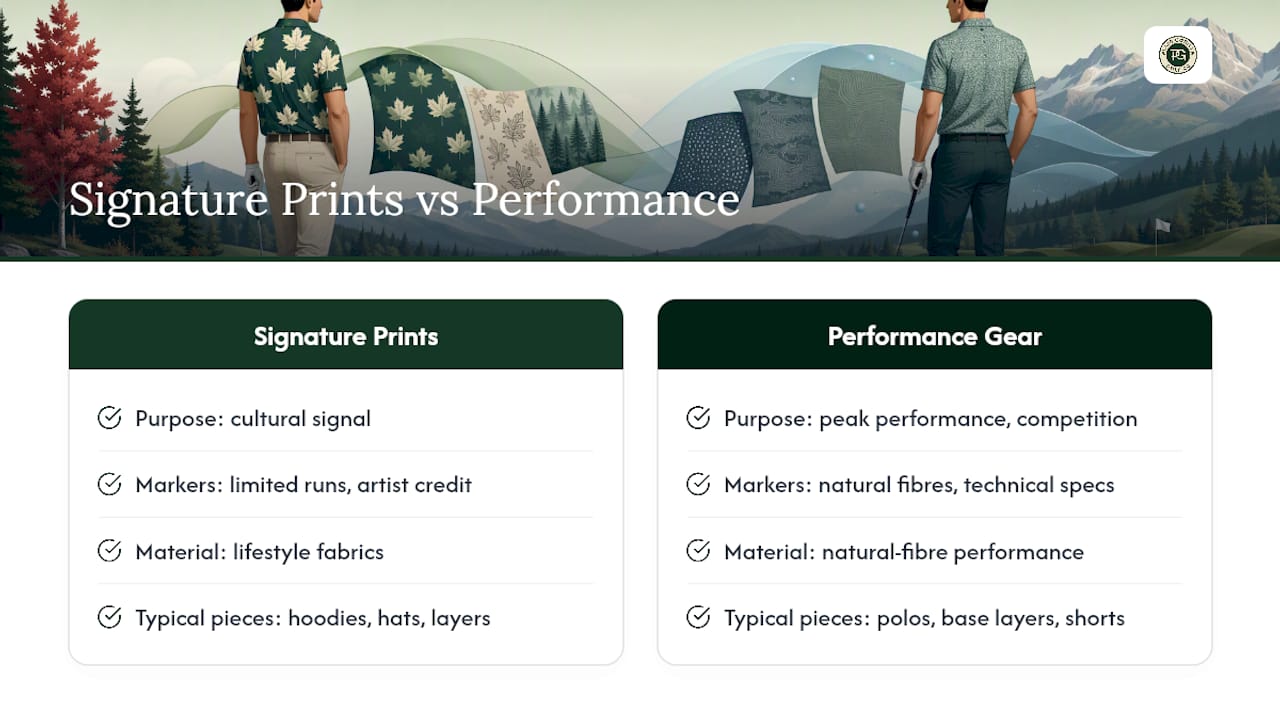
Signature golf prints are brand-distinctive, limited-edition fabric patterns applied directly to golf hoodies, snapbacks, and rope hats. They are not decorative patches or embroidered logos. The pattern is the garment. Three traits identify them quickly:
- Limited run or numbered release — each drop is capped, and once it sells out, it’s gone.
- Artist attribution or signature tag — a hang tag, interior label, or printed credit names the designer or creative direction behind the pattern.
- Performance-grade printing — methods like sublimation bond colour into the fabric rather than sitting on top, so the print moves and breathes with you.
Tour coverage confirms that all-over and repeat prints are back in a serious way, and retail trend data for 2026 shows bold prints and frequent limited drops are driving stronger sell-through with younger buyers. Plaidgorillagolf is a Canadian brand built around exactly this model.
Table of Contents
- What do signature prints actually look like on golf apparel?
- How are signature prints made, and what does fabric choice change?
- How Plaidgorillagolf approaches signature prints for Canadian shoppers
- Key takeaways
- Why signature prints matter more than most golfers admit
- Plaidgorillagolf’s current drops are worth your attention
- FAQ
What do signature prints actually look like on golf apparel?
The visual range is wider than most golfers expect. A few families dominate:
- All-over repeat prints — a single motif (a leaf, a crest, a geometric shape) tiled across the full garment. Bold from a distance, cohesive up close.
Scale and placement change everything. A small repeat pattern on a full hoodie reads as a texture in motion. That same motif blown up to a chest-panel graphic becomes a statement piece. Sports coverage of the WM Phoenix Open noted that louder, larger-scale prints were the ones turning heads on tour, not the subtle ones. On a snapback, the crown panels and brim edge are the prime real estate. On a rope hat, the front panel carries the whole visual weight.
For social-media-friendly styling, front-facing chest prints and structured hat crowns photograph cleanly. Side-panel and back-yoke prints reward in-person wear more than they reward a flat lay.
How are signature prints made, and what does fabric choice change?
The printing method determines durability, colour depth, and how the garment feels against your skin; see local options like the Customize Unisex Softstyle® Pique Polo for examples of print methods and fabrics. Here’s how the main methods compare:
| Method | Best use | Fabric compatibility | Key trade-off |
|---|---|---|---|
| Sublimation | Full-garment all-over prints | Polyester (majority) | Vivid, permanent colour; requires synthetic base |
| DTG (direct-to-garment) | Smaller chest or panel prints | Cotton and cotton blends | Soft hand feel; less suited to full-garment coverage |
| DTF (direct-to-film) | Detail prints on mixed fabrics | Most fabric types | Flexible; film layer can affect breathability |
| Heat transfer | Accent graphics, small runs | Most fabric types | Fast and affordable; less durable under repeated washing |
| Screen printing | Bold, limited-colour designs | Cotton, poly blends | Cost-effective at volume; not ideal for photographic detail |
Golf Digest’s feature on printing technology explains how sublimation lets brands reproduce fine art, multi-colour watercolours, and intricate textures with high colour fidelity on polyester fabrics. That’s what powers the wearable-art movement in golf apparel right now.
The fabric side of the equation matters just as much. Polyester and micro-modal synthetics hold sublimation prints with no fading, wick moisture well, and offer UPF protection. Natural fibres like cotton piqué, merino, and linen blends feel better against skin and breathe more naturally, but they don’t hold sublimation. The 2026 style forecast identifies this as the defining tension of the year: buyers want expressive prints and natural-fibre feel, which is pushing brands toward DTG and DTF on cotton blends as a middle path. For high-performance golf fabrics, understanding this trade-off before you buy saves real disappointment.
One production caution worth knowing: complex full-garment sublimation and gradient effects carry higher production risk and cost. Patterns that aren’t engineered for the garment’s panels can distort across seams or lose clarity in motion.
How Plaidgorillagolf approaches signature prints for Canadian shoppers
Plaidgorillagolf is Canadian-owned, born in Spruce Grove, Alberta, and built on a straightforward premise: limited drops, no filler, and prints that actually mean something. Every piece ships with artist attribution on the tag and a clear production story. Fabric choices lean toward premium materials that hold up on the course and look sharp off it.
The current lineup includes:
- Champagne Tees Rope Hat – Ponderosa Pine — a structured rope hat with a signature front-panel print in deep forest tones. The kind of hat that gets asked about at the turn.
- Country Club Snapback – Navy/Cloud White — clean navy and cloud white with a bold crown design. Versatile enough for the course and the clubhouse.
- Bogey Enthusiast Hoodie – Pine — a heavyweight fleece hoodie with a signature print that commits fully to the Bogey Enthusiast identity. Built for Canadian shoulder seasons.
- The Bogey Kit — Country Club Hat & Bogey Enthusiast Hoodie — the bundle option that pairs the hat and hoodie at a better price point than buying separately.
Drops are capped and don’t restock. Bundles offer the best per-piece value. Authenticity tags are on every garment. Canadian shipping is standard.
Key takeaways
Signature golf prints are limited-edition, artist-attributed fabric patterns on performance apparel — and buying one well means knowing the printing method, the fabric, and the drop policy before you click checkout.
| Point | Details |
|---|---|
| Definition | Signature prints are brand-specific, limited-edition patterns bonded into golf hoodies, snapbacks, and rope hats. |
| Production method matters | Sublimation on polyester delivers the most vivid, durable all-over prints; DTG suits cotton blends for smaller panels. |
| Authenticity signals | Look for artist credit on the tag, a stated production count, and fabrication transparency before buying. |
| Care essentials | Wash cold inside out, avoid fabric softener on polyester, and fold rather than hang limited pieces for storage. |
| Plaidgorillagolf | A Canadian-owned brand offering limited drops with artist attribution, including The Bogey Kit bundle and the Bogey Enthusiast Hoodie – Pine. |
Why signature prints matter more than most golfers admit
The conventional take is that prints are a style choice, full stop. Wear what you like, move on. That framing undersells what’s actually happening.
Golf has always used clothing as a signal. What’s shifted in 2026 is that the signal has gotten more specific. A limited-edition print with a named artist and a documented run isn’t just a pattern. It’s a position. It says you know the brand, you caught the drop, and you care about the culture enough to pay attention. That’s a different thing from buying a polo because it was on sale.
The tension the 2026 forecast identifies between expressive prints and natural-fibre performance is real, but it’s not a contradiction. The golfers I see getting this right are choosing prints for the pieces that live off the course — hoodies, hats, lifestyle layers — and saving their natural-fibre performance pieces for competition rounds. That split makes both categories work harder. And it means a well-chosen bold golf apparel piece isn’t competing with your performance kit. It’s completing it.
Plaidgorillagolf’s current drops are worth your attention
Canada doesn’t have many golf apparel brands doing this properly. Plaidgorillagolf is one of the few that combines limited drops, genuine artist attribution, and premium Canadian-made quality in pieces you’ll actually wear past the first season.
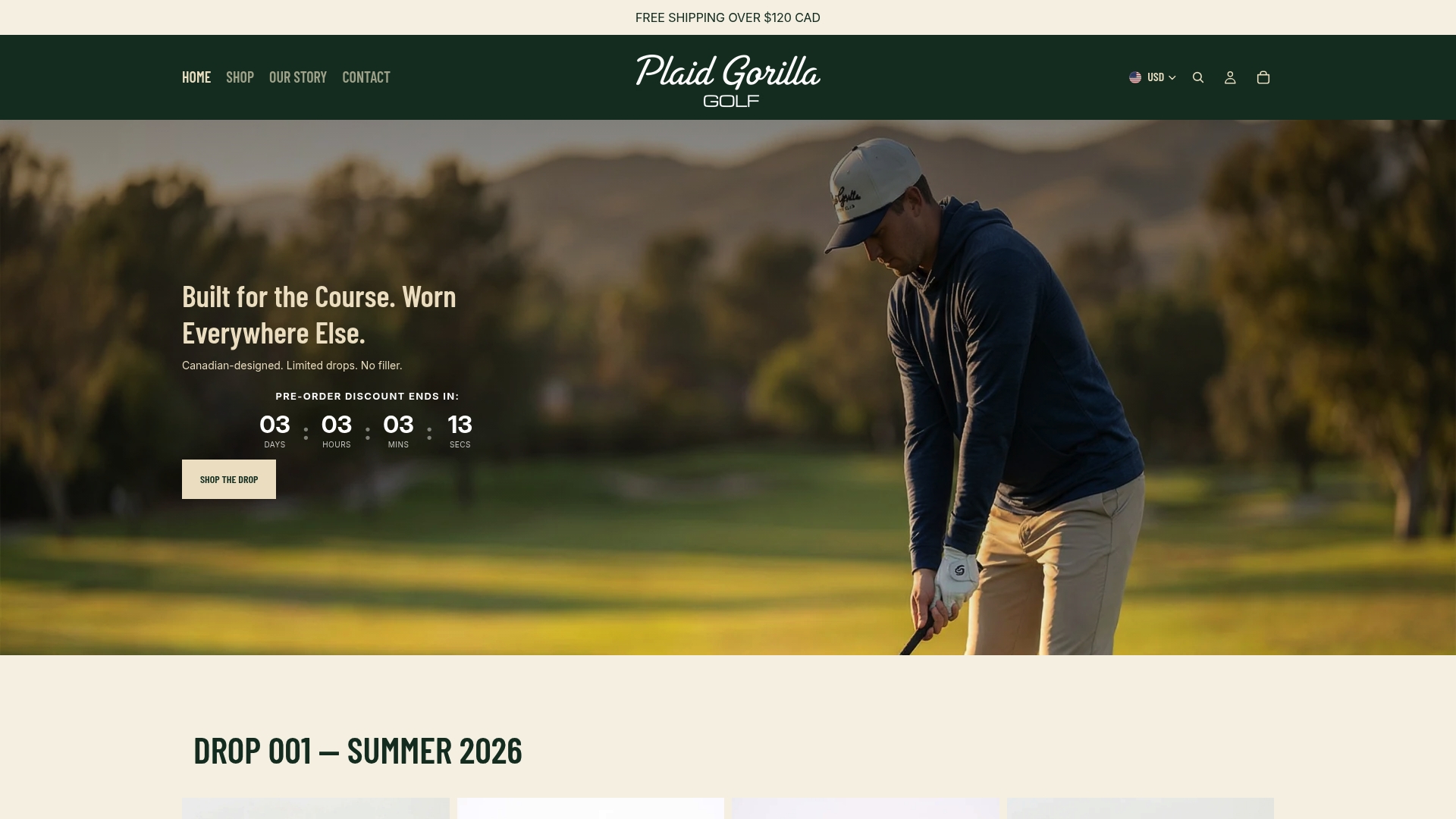
The Bogey Kit bundles the Country Club Hat and Bogey Enthusiast Hoodie together at a better price than buying each separately — a smart entry point if you want the full signature-print look without guessing at which piece to start with. The Champagne Tees Rope Hat in Ponderosa Pine and the Country Club Snapback in Navy/Cloud White are both current-drop pieces that won’t restock once they’re gone. Sign up for drop notifications on the site so you don’t miss the next release. These runs are capped, and that’s not marketing language — it’s the whole point.
FAQ
What are signature golf prints, exactly?
Signature golf prints are brand-specific, limited-edition fabric patterns applied to golf apparel like hoodies, snapbacks, and rope hats. They are identified by artist attribution on the tag, a capped production run, and a performance-grade printing method such as sublimation.
Is sublimation the best printing method for golf apparel?
Sublimation produces the most vivid and durable all-over prints, but it requires a polyester-dominant fabric. For cotton or cotton-blend garments, DTG (direct-to-garment) printing is the better fit.
How do I know if a limited-edition golf print is authentic?
Look for a named artist or designer credit on the hang tag, a stated production count or “sold when gone” policy, and clear fabric and printing method information on the product page.
Where can Canadian golfers buy signature-print golf apparel?
Plaidgorillagolf is a Canadian-owned brand based in Spruce Grove, Alberta, offering limited drops of signature-print hoodies and hats with domestic shipping and artist attribution on every piece.
Do signature golf prints hold resale value?
Limited-edition pieces with documented artist attribution and a clear production cap tend to hold value better than open-edition styles, particularly when the brand has an established drop cadence and collector following.
Recommended
- Choose comfortable golf apparel: a guide for Canadian golfers – Plaid Gorilla Golf
- Golf outfit accessories checklist for Canadian golfers – Plaid Gorilla Golf
- The role of pattern in golf fashion: a 2026 guide – Plaid Gorilla Golf
- Find alternative golf clothing options for Canadian golfers – Plaid Gorilla Golf