


Pick embroidery for small logos, uniforms, and a premium feel that survives years of washing. Pick printing (screen, DTF, or DTG) for large full-colour graphics, photo-style art, or big merch runs where cost per piece matters most. The right call comes down to your artwork, your order size, and where the design sits on the hoodie.
TL;DR:
- Embroidery is ideal for small logos, uniforms, and long-lasting quality, but it becomes costly for large or detailed designs.
- Printing methods like screen, DTF, and DTG excel at full-colour graphics and large orders, with costs decreasing as volume increases.
- Heavier fleece supports dense embroidery stitches, while thin fabrics risk puckering and stiff feel from stitching.
- Embroidery resists cracking, fading, and peeling better over time, but prints can last years if properly cured and cared for.
- A hybrid approach often offers the best balance, with embroidery on small or durable areas and printing on large, colorful graphics.
Table of Contents
- Embroidered vs printed hoodie at a glance
- How embroidery works and what it does well on hoodies
- Printing methods for hoodies: screen, DTG, and DTF explained
- How your artwork dictates the method
- Cost and order-quantity economics for embroidered vs printed hoodies
- Fabric, placement, and hoodie-specific constraints
- Care and durability: which hoodie holds up longer?
- A decision checklist for your next hoodie order
- Plaid Gorilla Golf’s approach to hoodie decoration
- What our customers actually choose (and why)
- Get the look without guessing on decoration
- Sources
- FAQ
Embroidered vs printed hoodie at a glance
Both methods can turn a blank hoodie into something worth wearing, but they solve different problems. Embroidery builds a design out of stitched thread, so it wins on texture and longevity. Printing lays ink or film onto the fabric, so it wins on colour range and cost at volume.
Embroidery pros:
- Textured, three-dimensional finish that reads as premium
- Resists cracking, fading, and peeling far better than most prints, according to Arklavo’s comparison of the two methods
- Holds up to repeated commercial washing, making it the standard for staff uniforms and outerwear
Embroidery cons:
- Cannot reproduce gradients, photos, or fine detail
- Gets expensive fast on large-format designs
- Can feel stiff or cause puckering on thin fabric
Printing pros:
- Handles full-colour art, photos, and gradients with no design ceiling
- Cost-effective for bulk orders, especially with screen printing, per Custom Ink’s breakdown of hoodie printing methods
- Works well for oversized front or back graphics
Printing cons:
- Prints can crack or peel over time, especially with poor curing
- Feels flatter against the hand than stitched thread
- Screen printing loses its cost edge on tiny orders
If you’re outfitting a golf league with matching left-chest logos, embroidery is your play. If you’re dropping a limited-run graphic hoodie with a bold photo print across the chest, printing wins. Plenty of brands run both on the same piece: an embroidered logo on the sleeve paired with a printed graphic on the back.
How embroidery works and what it does well on hoodies
Machine embroidery stitches thread directly into the fabric using a digitized file that tells the machine where every stitch goes. On a heavier hoodie, that stitching has something to grip, which is exactly why fleece and embroidery pair so well. Thin jersey doesn’t hold up nearly as well under dense stitch counts.
Embroidery hoops have real limits. A typical left-chest logo maxes out around 5 to 5.5 inches wide, and letters below a certain height simply won’t stitch cleanly, so tiny text gets lost. Thread colour counts matter too. Alsco notes embroidery works best with roughly 6 to 8 thread colours before a design starts looking cluttered or the cost climbs.
The upside is real: embroidery reads as higher quality the moment someone touches it. The trade-off is that heavy stitch density on a lightweight garment can pucker or pull, which is one reason choosing between puff and flat embroidery matters more on hoodies than most people expect.
Printing methods for hoodies: screen, DTG, and DTF explained
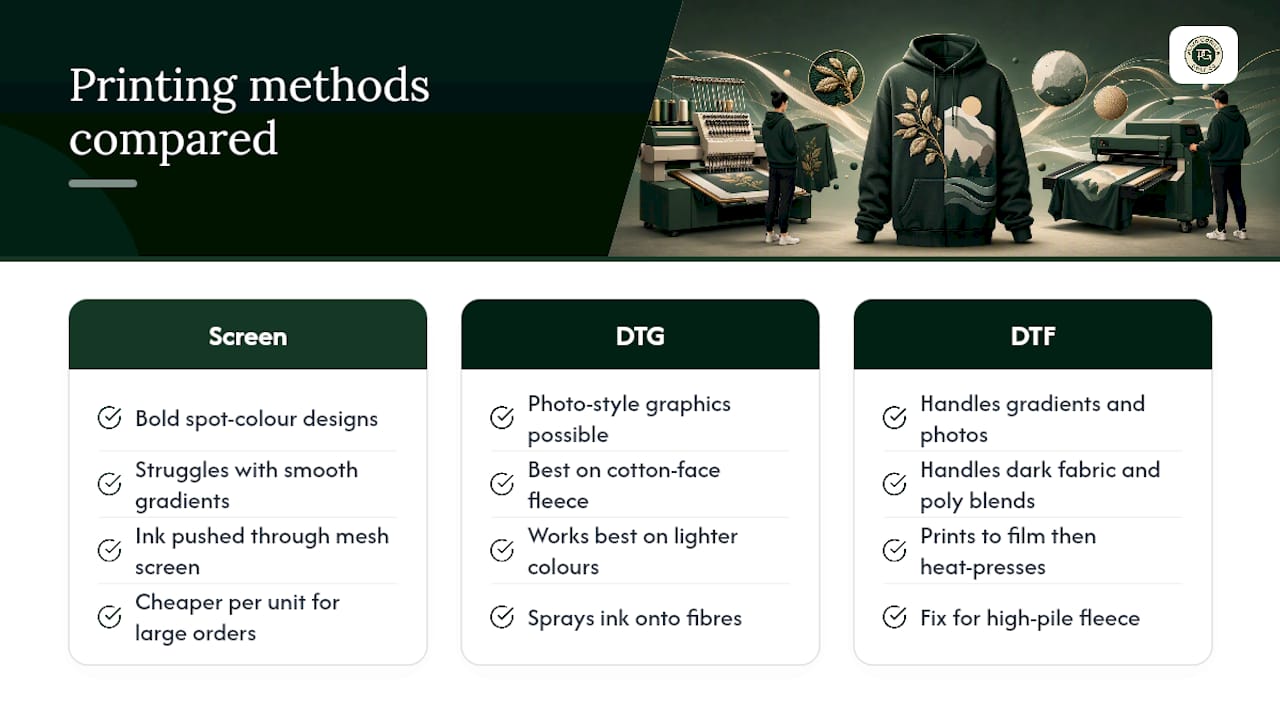
Screen printing pushes ink through a mesh screen, one screen per colour, directly onto the fabric. It’s the standard for bold, spot-colour designs and gets cheaper per unit the bigger your order gets. DTG (direct-to-garment) sprays ink like an inkjet printer straight onto the fibres, which works best on cotton-face fleece in lighter colours. DTF (direct-to-film) prints onto a film first, then heat-presses it onto the hoodie, and it handles dark fabric and poly blends far better than DTG.
Choosing between them comes down to your art and your fabric. Photo-style graphics with gradients need DTG or DTF, since screen printing struggles with smooth colour transitions. Dark-coloured hoodies are where DTF earns its keep. Custom Ink points out that DTF is especially reliable on dark garments, while DTG performs best on lighter cotton-heavy fleece. High-pile fleece can also resist ink adhesion, which is part of why heat-transfer methods like DTF have become the go-to fix for tricky blends.
How your artwork dictates the method
Your design file, more than anything else, decides which method makes sense. Embroidery cannot reproduce gradients or photographic detail; a sunset fade or a face simply won’t translate to thread. Printing has no such ceiling. It can handle full-colour photos, soft shadows, and complex blends without blinking.
Colour count is the other lever. Practical embroidery designs stay in the 6 to 8 thread range before cost and clarity both suffer. Screen printing works similarly, since every extra ink colour means another screen and another setup fee.
Before you send artwork, do this:
- Simplify or vectorise logos meant for embroidery, dropping tiny details that won’t stitch
- Separate colours cleanly for screen printing so each layer prints crisp
- Add a white underbase to any print design going on a dark hoodie, or the colours will look muddy
Pro Tip: Ask your decorator for a digitized preview before production on embroidery jobs. A stitch file preview catches size and legibility problems that are invisible in a flat vector file.
Cost and order-quantity economics for embroidered vs printed hoodies
Embroidery carries a one-time digitizing fee, then a fairly steady per-piece stitch cost regardless of quantity. Screen printing flips that model: setup costs a screen per ink colour, so the price per hoodie drops sharply as your order grows, according to Custom Ink’s cost comparison.
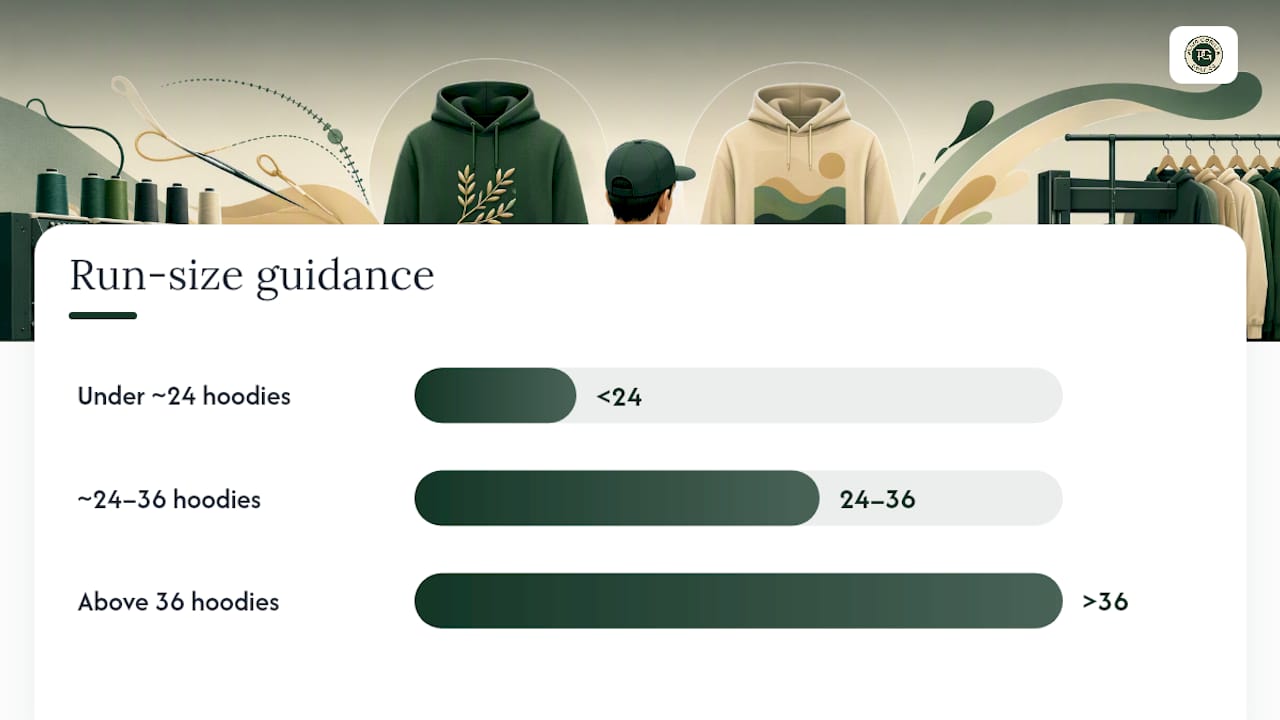
That difference creates a crossover point. For small runs and simple left-chest marks, embroidery often costs less overall since there’s no per-colour setup to spread across a handful of pieces. Once you’re ordering in bulk, screen printing usually pulls ahead. As a rough industry guideline, that crossover for hoodies tends to land somewhere around 24 to 36 pieces, though colour count, placement, and blank cost all shift that number.
If you’re testing a design before committing to a full run, order one or two sample units first. It costs more per piece, but it saves you from discovering a stitching or colour problem after 100 hoodies are already printed.
Fabric, placement, and hoodie-specific constraints
Hoodie weight changes what’s possible. Heavier fleece holds stitches securely and gives embroidery room to breathe. Thin jersey blends can pucker under dense stitching, which is why understanding how hoodie weight affects performance matters before locking in a decoration plan.
Left-chest placement stays the safe default for embroidery, typically capped around 5 to 5.5 inches wide. Sleeves, the hood, and the upper back also work well for smaller stitched marks. Printing has more flexibility for oversized front or back graphics, but zippers, kangaroo pockets, and seam lines still limit where either method can realistically sit on a full-zip or pullover style.
Care and durability: which hoodie holds up longer?
Both methods survive years of wear if you treat them right, but they fail differently. Embroidery is prone to snagging or abrasion, particularly on raised puff stitches. Prints are more likely to fade, crack, or peel, especially with heat or harsh detergents.
A few care rules that actually extend the life of either:
- Wash in cold water on a gentle cycle to slow fading and thread wear
- Turn the hoodie inside out before washing to protect the decorated surface
- Air dry or use low heat, since high heat is the fastest way to crack a print
- Full washing details are covered in our hoodie care guide
Cost-per-wear tends to favour embroidery over a long ownership period, since it resists cracking and peeling better than most prints. But a well-cured print, cared for properly, will still outlast a cheap, poorly digitized embroidery job.
A decision checklist for your next hoodie order
Run through these five questions in order, and the right method usually becomes obvious by question three.
- What’s the artwork? Simple logo or text: lean embroidery. Photo, gradient, or complex colour blend: lean printing.
- How many units? Under roughly 24 to 36 hoodies: embroidery often costs less. Above that: screen printing usually wins.
- Where’s it placed? Small left chest or sleeve mark: embroidery. Large front or full-back graphic: printing.
- What’s the fabric weight? Heavier fleece supports dense stitching; thin jersey favours printing to avoid puckering.
- What’s the budget? One-off digitizing fee vs per-colour screen setup: match your run size to the cheaper model.
Three quick scenarios: a golf club ordering 40 matching team hoodies should go embroidered for durability and a uniform look. A limited merch drop with a bold, full-colour graphic should go printed. A gift bundle pairing a hat and hoodie often works best as a hybrid, embroidered on the cap, printed on the hoodie.
Pro Tip: Always request a physical sample before a full production run. A stitched swatch or printed mock tells you more in five seconds than any digital proof ever will.
Plaid Gorilla Golf’s approach to hoodie decoration
We build every hoodie around the same rule this article lays out: match the method to the job, not the trend. Bold, expressive patterns get the print treatment where colour range matters, while cleaner marks get embroidered for a finish that survives seasons of wear. Limited drops are built for golfers who want gear with personality and structural quality. If you want design inspiration beyond the golf world, Prima Dons & Donnas’ guide to custom clothing details is a solid companion read for anyone thinking through bold personal style.
What our customers actually choose (and why)
Many golfers don’t pick one method outright. They often choose a matched hat and hoodie where the cap features a clean embroidered mark and the hoodie carries a bolder printed graphic. This follows the logic covered above: embroidery for the small, durable piece, printing for the statement piece. That hybrid split shows up in nearly every custom conversation we have, and it’s rarely a compromise. It’s usually the smarter answer.
*— Mike
Get the look without guessing on decoration
Skip the trial-and-error and grab a hoodie built with these exact trade-offs already worked out. The Prime Hoodie in Real Teal delivers a premium fleece base with the bold, no-filler design Plaid Gorilla Golf is known for.
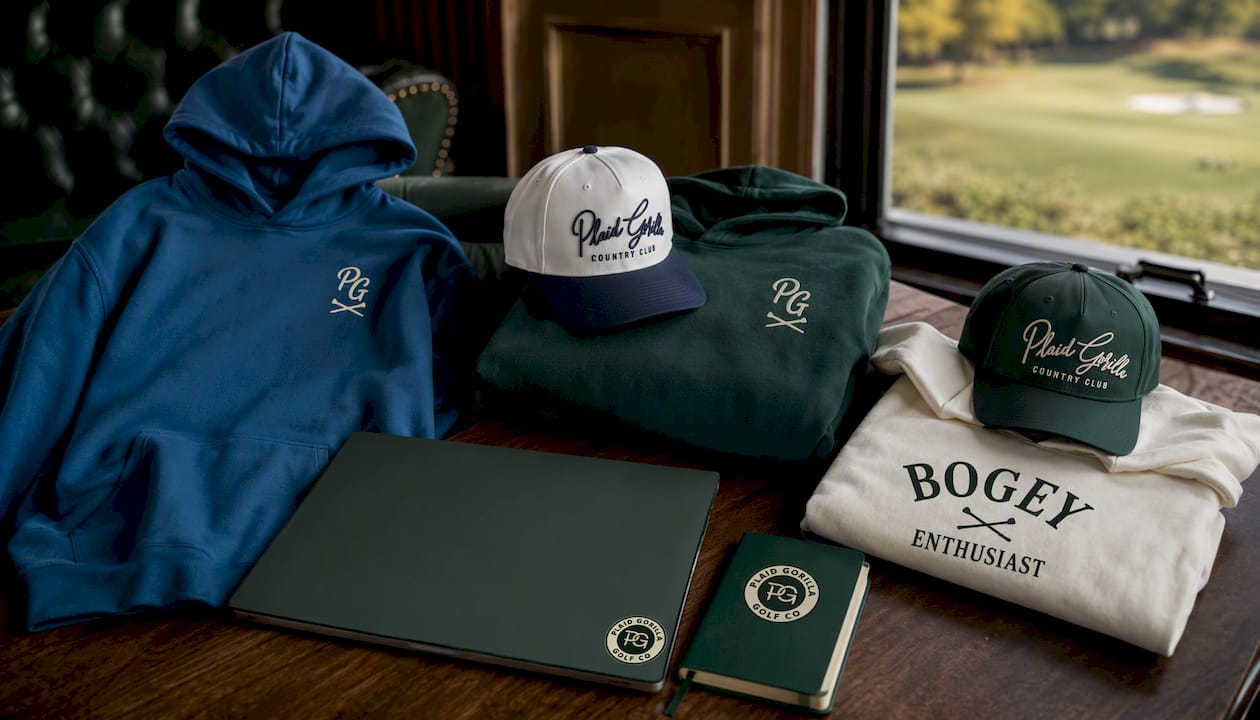
Want a matched set instead of a single piece? The Club Kit pairs a Country Club Snapback with the Prime Hoodie, giving you the embroidered accent up top and a standout hoodie underneath. The Bogey Kit bundles a Country Club Hat with the Bogey Enthusiast Hoodie for a gift-ready set that covers both decoration styles in one order. Browse the full golf hoodie lineup or check out our golf hats to build your own combo. Every piece is limited, so once a drop sells out, it’s gone for good.
Sources
- Screen printing vs embroidery: Which is better? — Alsco
- What Is the Best Printing Method for Custom Hoodies? Screen Printing, Embroidery, DTG, and DTF Compared - Custom Ink Blog
- Screen Printing vs Embroidery: Best Choice for Your Logo – Arklavo
FAQ
Which is better, printed or embroidered?
Neither wins outright. Embroidery is better for small logos, uniforms, and long-term durability, while printing is better for large, full-colour, or photo-style designs and high-volume orders.
What are the disadvantages of embroidery?
Embroidery can’t reproduce gradients or photographic detail, and it gets costly on large designs. Dense stitching on thin fabric can also cause puckering or a stiff feel.
Does embroidery last longer than print?
Embroidery generally resists cracking, fading, and peeling better than most prints over repeated washing, according to Arklavo’s comparison. A well-cured print can still last for years with proper care.
Is it cheaper to embroider or print?
It depends on order size. Embroidery often costs less for small runs since there’s no per-colour setup fee, while screen printing usually becomes cheaper once you’re ordering in bulk, per Custom Ink’s cost breakdown.