


Choose midweight for most day-to-day needs. Pick heavyweight when you want static warmth, structure, or a premium streetwear feel. GSM (grams per square metre) and fabric construction are what actually decide the outcome, not the label on the tag.
Midweight hoodies typically land between roughly 280 and 350 GSM, while heavyweight starts around 350 GSM and climbs higher. That range determines how a hoodie moves, breathes, and holds its shape. Plaid Gorilla Golf builds across both weights, and this guide (written with input from our own product notes and Mike’s field research) breaks down exactly where each one earns its keep.
- Midweight: better for movement, layering, year-round wear, and most embroidery work.
- Heavyweight: better for static warmth, oversized silhouettes, and cold-weather standing around (think spectating, not sprinting).
- GSM ranges: covered in full detail in the next section, with ounce conversions included.
Key Takeaways
Midweight hoodies (roughly 280 to 350 GSM) suit active, year-round wear, while heavyweight hoodies (350 GSM and up) deliver static warmth and structured, oversized silhouettes.
| Point | Details |
|---|---|
| Know your GSM range | Midweight runs ~280 to 350 GSM (~7 to 10 oz); heavyweight starts at ~350 GSM (~10.3+ oz). |
| Construction beats category labels | Brushed fleece traps more air than a flat knit at the same GSM, so check interior finish, not just weight. |
| Match weight to activity | Choose midweight for movement and layering; choose heavyweight for standing still in the cold. |
| Fit changes with weight | Heavyweight holds oversized shapes; midweight drapes closer and layers better under a shell. |
| Buy from specs, not adjectives | Confirm numeric GSM, fibre blend, and care instructions before checkout; skip listings that only show lifestyle photos. |
| Plaid Gorilla Golf builds true heavyweight | Its oversized fleece Prime Hoodie and Bogey Enthusiast Hoodie list fibre content and fit notes directly on the product page. |
Table of Contents
- Hoodie GSM meaning: weight ranges and ounce equivalents
- Why the same GSM can feel completely different
- Which hoodie weight fits your activity and climate?
- How hoodie weight changes fit and silhouette
- What to check before buying a midweight or heavyweight hoodie
- What Plaid Gorilla Golf’s product pages actually show
- Breathability and moisture control: midweight vs heavyweight
- Choosing hoodie weight by season and climate
- Why the GSM number matters more than the category name
- Get the heavyweight fit without the guesswork
- Sources
- FAQ
Hoodie GSM meaning: weight ranges and ounce equivalents
GSM measures fabric density: how many grams of material sit in one square metre. It’s the single most reliable spec on a hoodie’s tag, more reliable than words like “heavy” or “premium” printed on a website.
Midweight hoodies generally run 280 to 350 GSM, which converts to roughly 7 to 10 ounces per square yard. Heavyweight hoodies sit at 350 GSM and above, often landing in the 10 to 12+ ounce zone. A useful trade example: 8.8 oz (298 GSM) counts as a common midweight sample, while 12 oz (407 GSM) reads as a solid heavyweight benchmark.
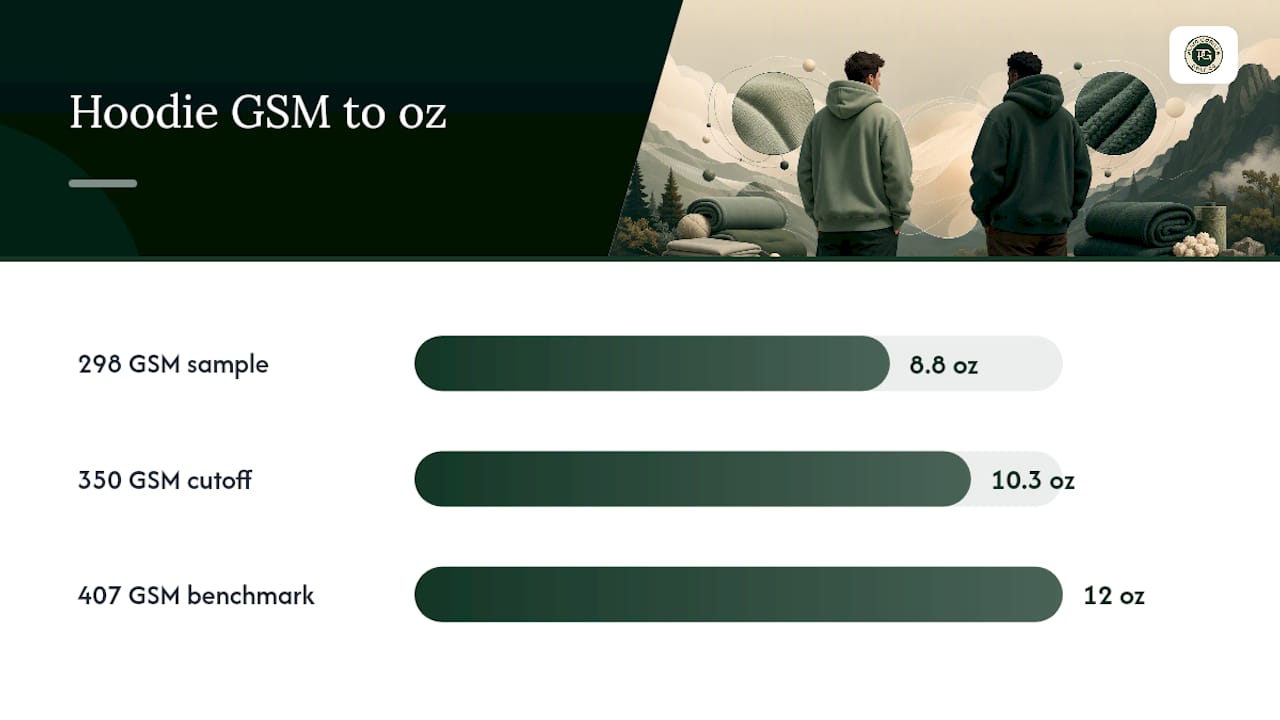
The conversion itself is simple. One gram equals 0.035274 ounces, so a 400 GSM fabric works out to roughly 14.1 ounces per square yard once you factor in the standard yard-to-metre area adjustment. Most reputable product listings state both GSM and ounces so shoppers comparing brands from different countries aren’t left guessing.
Statistic callout: the gap between “midweight” and “heavyweight” isn’t fixed. Some brands cut the line at 320 GSM, others at 340 or 350. That’s why the number on the tag matters more than the category name next to it.
- Midweight: ~280 to 350 GSM (~7 to 10 oz/yd²)
- Heavyweight: ~350 GSM and up (~10.3 oz/yd² and up)
- Always check GSM directly rather than trusting a marketing label alone
Why the same GSM can feel completely different
Two hoodies can share an identical GSM number and still feel worlds apart on your back. Construction decides that, not weight alone.
Brushed fleece has a raised interior loft that traps air, which is why it insulates more than a dense, flat knit at the exact same GSM. French terry sits in between: it has a looped interior rather than a brushed one, so it breathes better and dries faster, but it doesn’t trap as much warmth. Tight cotton knits without any brushing or looping tend to feel thinner even when their GSM matches a fleece.
Fibre blend changes the story again. An 80/20 cotton/poly blend resists shrinkage and holds colour better through repeated washes than a 100% cotton fleece of the same weight. A 70/30 blend leans further toward durability and quicker drying, at a small cost to that natural cotton hand-feel. Fexwear’s GSM breakdown makes the same point: weight tells you density, but construction tells you performance.
- Brushed fleece: high loft, warmest per gram, slower to dry
- French terry: less loft, more breathable, dries faster
- Cotton-poly blends: better shrink resistance and colour retention than pure cotton
Pro Tip: Don’t buy on GSM alone. A 320 GSM brushed fleece can feel warmer than a 380 GSM flat-knit blend. Ask about interior finish before you check out.
Which hoodie weight fits your activity and climate?
Match the hoodie to what you’re actually doing in it, not just the season on the calendar.
- Commuting or running errands: midweight wins. It layers under a jacket without adding bulk and won’t leave you sweating on a brisk walk.
- Dog walks and light hikes: midweight again. You’re moving enough that a heavyweight fleece traps too much heat, and midweight balances warmth with breathability for exactly this kind of mixed activity.
- Spectating sports or standing at a tailgate: heavyweight earns its place here. You’re static, the wind is cutting, and a dense fleece holds heat far better than a thin one.
- Sitting around a campfire or on a patio in late fall: heavyweight, for the same reason. No movement means no built-in heat generation, so the fabric has to do all the work.
- Layering under a golf shell or rain jacket: midweight fits under outerwear without bunching at the shoulders, which matters more than people expect once you’re swinging a club or reaching for a zipper.
- Everyday streetwear where the hoodie is the outer layer: heavyweight holds its shape and looks intentional rather than slouchy.
Most closets benefit from owning at least one of each. Treat midweight as your default and heavyweight as the piece you reach for when you’re standing still in the cold.
How hoodie weight changes fit and silhouette
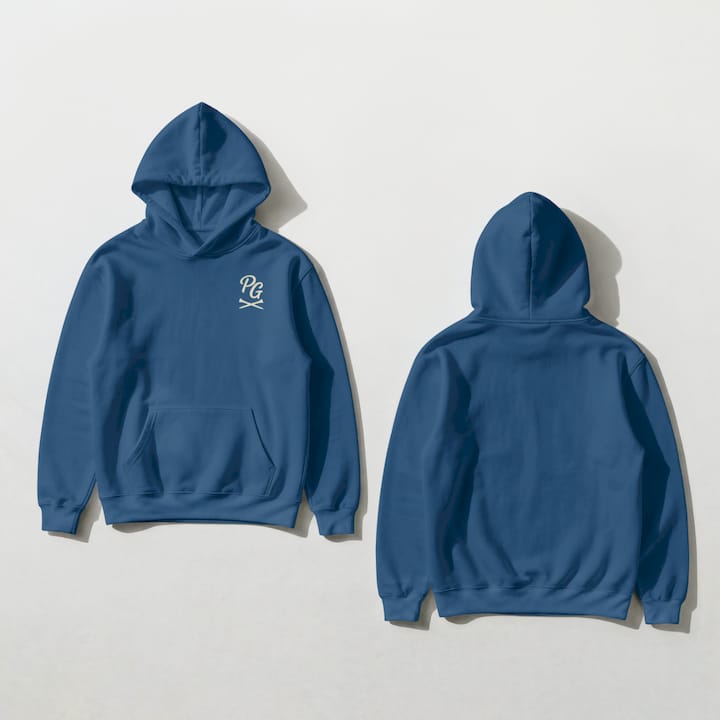
Weight doesn’t just affect warmth. It changes how a hoodie hangs on your frame and how it behaves under a jacket.
Midweight fabric drapes closer to the body, which suits a regular fit and layers cleanly under a golf shell or coat. Heavyweight fabric has enough structure to hold an oversized cut without collapsing into a shapeless pile, which is exactly why streetwear brands lean on heavier GSM for boxy silhouettes.
Hood behaviour tells the same story. A heavyweight hood tends to sit up with more shape and less flop, while a midweight hood folds flatter against your back when it’s down. Heavier fabric also means more shoulder structure and less pocket sag over time, since a thinner knit stretches out faster with repeated use.
- Want an oversized, structured look? Size up and choose heavyweight.
- Layering under a jacket or shell? Stay true to size and choose midweight.
- Watching for pocket sag after months of wear? Heavier GSM resists it better.
Our guide to golf hoodie styles breaks down silhouette choices in more depth if fit is your main hangup.
What to check before buying a midweight or heavyweight hoodie
A product page should tell you what you’re actually buying, not just how it looks on a model.
- Confirm the GSM number. If a listing skips it entirely and only uses words like “heavy” or “premium,” treat that as a gap in the spec sheet, not a selling point.
- Check fibre content and interior finish. A brushed interior, French terry, or tight cotton knit all behave differently at the same weight, so this detail matters as much as the GSM itself.
- Ask about shrinkage and care instructions. Reputable brands state expected shrinkage after a wash cycle and recommend a drying method; vague “machine washable” language without specifics is a shortcut worth questioning.
- Ask how the hood and shoulders perform under a shell. This is easy to overlook online and matters a lot if you plan to layer for golf or cold-weather activity.
- Watch for inconsistent photos. If colour swatches shift between images or every shot is a lifestyle photo with zero close-ups of the fabric, that’s a red flag worth pausing on.
Pro Tip: Email or message customer service and ask for the exact GSM and fibre blend if it’s missing. A brand that can’t answer that question in one line probably isn’t tracking its own specs closely. For more on evaluating hoodie quality generally, Moreci & Co’s guide to selecting a quality athletic hoodie covers similar ground from a performance angle.
What Plaid Gorilla Golf’s product pages actually show
Mike, who writes Plaid Gorilla Golf’s field notes on hoodie comfort, built that guide around the same principle this article follows: specs beat adjectives every time.
Plaid Gorilla Golf’s oversized heavyweight fleece hoodie is a direct example of heavyweight construction done with intention: a boxier cut, brushed interior, and enough structure to hold its shape through a cold clubhouse afternoon or a sideline at a weekend tournament.
- Built for shoppers who want static warmth and a structured, oversized look.
- Product pages list fibre content and fit notes rather than only lifestyle photography.
- Useful as a benchmark when comparing GSM claims across other brands.
Breathability and moisture control: midweight vs heavyweight
Weight and airflow move in opposite directions, and that trade-off decides comfort more than most shoppers expect.

Midweight fabric has less material trapping air near your skin, so sweat evaporates faster and body heat escapes before it builds into a damp, clingy layer. That’s part of why midweight hoodies balance warmth and breathability well enough for activity that mixes movement with rest, a golf round with stretches of walking and standing, for instance. French terry constructions push this further since the looped interior allows more air exchange than a brushed one.
Heavyweight fabric traps more air by design, which is the whole point when you want warmth. That same density slows evaporation, though, so sweat sits closer to your skin longer during activity. This is why heavyweight hoodies tend to feel great standing still in the cold and less great ten minutes into a brisk uphill walk. Overheating during activity is one of the more common complaints tied to heavyweight fleece, and it’s a fair trade-off rather than a flaw.
Neither weight is a true moisture-wicking performance fabric in the technical athletic-wear sense. Cotton and cotton-blend hoodies absorb moisture rather than pushing it away from the skin, regardless of GSM. If moisture management during hard activity is the priority, weight matters less than choosing a poly-heavy blend with a looser knit structure, and that decision applies whether you land on midweight or heavyweight.
Choosing hoodie weight by season and climate
Climate should drive this decision more than personal preference alone, especially if you only own one or two hoodies.
In shoulder seasons, spring and early fall, midweight covers nearly every scenario. Mornings are cool enough for a layer, afternoons warm up, and a lighter GSM hoodie won’t leave you overheated once the sun’s out. It also layers cleanly under a rain shell if the forecast turns, which matters for anyone spending a full day outdoors.
Deep winter changes the calculation, particularly in climates with sustained cold rather than brief cold snaps. Heavyweight fleece holds up better for standing outdoors: watching a game, waiting at a bus stop, or working an outdoor event where you’re not generating much body heat through movement. Pair it with a base layer underneath for genuinely cold days, since even a 400+ GSM hoodie has limits once temperatures drop well below freezing.
Humid or mild climates tend to favour midweight almost year-round, since heavyweight fleece rarely gets a chance to prove its warmth advantage and instead just traps unnecessary heat. Dry, cold climates with big day-to-night temperature swings are where owning both weights pays off: midweight for daytime activity, heavyweight for evenings once the temperature drops and you’re sitting rather than moving. Our technical guide to golf fabrics goes deeper into how climate should shape fabric choice across a full wardrobe, not just hoodies.
Why the GSM number matters more than the category name
Most buying guides treat “midweight” and “heavyweight” as fixed categories with hard borders, and that’s where the conventional advice falls short. The research doesn’t support a clean line. One brand’s 340 GSM hoodie is another brand’s heavyweight starting point, which means the label on a product page tells you almost nothing on its own.
What the evidence actually supports is a shift in how you shop: stop asking “is this midweight or heavyweight” and start asking “what’s the GSM, and what’s the interior construction.” A 320 GSM brushed fleece with a tight loft will often outperform a 360 GSM flat-knit blend for warmth, even though the second one technically sits in a heavier category. Construction is doing real work that the category label hides.
If there’s one thing to prioritize first, it’s this: treat GSM and fibre blend as the two numbers that actually predict how a hoodie will perform, and treat the midweight/heavyweight split as a rough starting filter rather than the final word. That’s a more useful mental model than memorizing where one brand happens to draw its cutoff, and it travels with you across every hoodie you shop for after this one.
— Mike
Get the heavyweight fit without the guesswork
If everything above points you toward heavyweight, Plaid Gorilla Golf builds exactly that spec into its core lineup rather than treating it as an afterthought. The oversized heavyweight fleece Prime Hoodie is cut for shoppers who want structure, static warmth, and a silhouette that holds its shape through repeated wear, not a hoodie that thins out after a season.
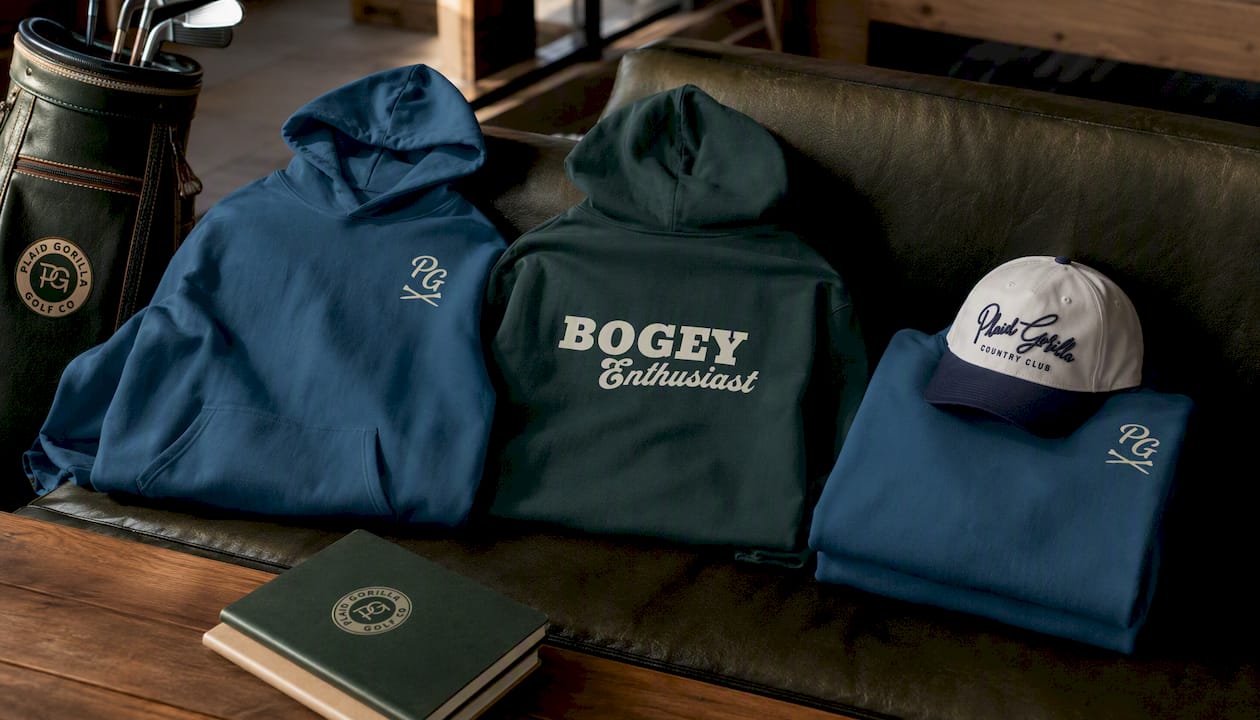
For anyone who wants the full look sorted in one order, The Bogey Kit pairs a country club hat with the Bogey Enthusiast Hoodie, and The Course Kit bundles a rope hat with the Prime Hoodie for a lower per-item cost than buying each piece separately. Every product page lists fibre content and fit notes up front, so you’re never left guessing at GSM or interior finish before checkout. If your size runs between two options, size up for the oversized, heavyweight drape this hoodie is built for.
Check the Bogey Enthusiast Hoodie in Pine for sizing details and pick your fit before the current drop sells out.
Sources
FAQ
What does “midweight hoodie” mean?
A midweight hoodie generally falls between 280 and 350 GSM, or roughly 7 to 10 ounces per square yard, balancing warmth with breathability for year-round wear.
How heavy is a midweight hoodie?
Most midweight hoodies weigh between 280 and 350 grams per square metre, with trade examples around 8.8 oz (298 GSM) sitting comfortably in that range.
What is considered heavyweight for a hoodie?
Heavyweight hoodies generally start at 350 GSM and climb higher, with 400+ GSM options offering the densest, warmest builds and the most structured, oversized silhouettes.
Are heavyweight hoodies good?
Heavyweight hoodies are a strong choice for static warmth, structure, and premium streetwear looks, though they can overheat during active movement and are less packable than midweight options. Plaid Gorilla Golf’s oversized heavyweight fleece hoodies are built specifically for shoppers who prioritize that static warmth and structured fit over packability.