


The best cold-weather golf outfit uses a three-layer system: a moisture-wicking base, an insulating mid layer, and a weather-protective outer shell all built from thin technical fabrics that let your shoulders turn freely. This is the gold standard approach that separates golfers who play comfortably through January from golfers who quit after nine holes with numb fingers and a swing that feels like it’s wrapped in cardboard.
Here’s what that looks like in practice, broken down by the cold you’re actually facing:
- Mild cold (around 8 to 12°C): A merino or synthetic base layer under your polo, a lightweight vest or quarter-zip, and a packable wind shell if the forecast turns.
- Wet cold (rain mixing with low temperatures): Base layer plus a hybrid insulated jacket, topped with a golf-specific waterproof shell with sealed seams.
- Sub-zero rounds: Two thin base layers instead of one thick one, an insulated vest, a full-zip technical shell, and serious attention to your hands, head, and feet.
That last point matters more than most golfers think. You can nail the torso layering perfectly and still have a miserable round if your fingers go numb on the fourth tee. Extremity protection isn’t an afterthought here. It’s part of the system.
Key Takeaways
Winter golf comfort comes down to a three-layer system built from thin technical fabrics, with mobility testing and extremity protection treated as non-negotiable parts of the kit, not afterthoughts.
| Point | Details |
|---|---|
| Use the three-layer system | Combine a moisture-wicking base, insulating mid layer, and weather-protective outer shell for warmth without bulk. |
| Choose thin over thick | Two thin technical layers preserve shoulder rotation and swing speed better than one heavy coat. |
| Test mobility before you play | Do a full mimed swing and shoulder reach test in your complete outfit before teeing off. |
| Protect hands, head, and feet first | Extremities lose heat fastest, so prioritize mitts, a toque, and insulated waterproof footwear. |
| Start slightly cold | Dress a touch cool at the first tee since walking and swinging generate heat quickly. |
| Stock a versatile mid layer | Plaid Gorilla Golf’s Bogey Enthusiast Hoodie suits dry, cooler days and off-course warming between shots. |
Table of Contents
- How does the three-layer system work for winter golf?
- What’s the best base layer for winter golf?
- Which mid layer keeps you warm without limiting your swing?
- Why does Plaid Gorilla Golf favour vests and hoodies for winter rounds?
- What outer shell should you wear for cold, windy golf?
- What should you wear on your legs and feet for winter golf?
- Which accessories matter most in cold weather golf?
- What should you wear golfing by temperature?
- How do you test your winter golf outfit for mobility?
- What layering mistakes hurt your winter golf game?
- What’s a good winter golf packing checklist?
- Why winter golf became my favourite time to play
- Get on-course ready with Plaid Gorilla Golf’s winter mid layers
- Sources
- FAQ
How does the three-layer system work for winter golf?
Each layer in the system does one job, and none of them can do another layer’s job well. The base layer moves sweat off your skin. The mid layer traps warm air near your body. The outer shell blocks wind and precipitation from stealing that warmth. Stack them in the wrong order, or skip one, and the whole thing falls apart, usually around hole 6 when your first hint of sweat turns to a chill.
Golf adds a wrinkle that skiing or hiking doesn’t have to deal with: you need full, uninhibited shoulder rotation and arm extension on every single swing. A downhill skier can wear a stiff, bulky jacket because their arms barely move through a turn. A golfer cannot. Every extra millimetre of bulk at the shoulder seam, every stiff panel across the back, translates into lost club head speed and mis-hit shots. Golf-specific shells solve this with gusseted shoulders and stretch fabrics designed specifically to preserve rotation, which is exactly why a generic winter coat from the closet is the wrong call even when it’s technically warmer.
Think of the three layers as a system that shifts as your round progresses. You start cold, your body generates heat as you walk and swing, and your mid layer either traps that heat or lets you vent it. A quarter-zip you can crack open at the collar does this better than a pullover with no adjustment at all. As the temperature drops on the back nine or clouds roll in, your outer shell becomes the layer doing the real work, blocking wind chill that can make a 4°C day feel like it’s well below freezing.
Pro Tip: Start your round slightly cold. If you’re perfectly comfortable standing on the first tee, you’re overdressed for the walk, and you’ll be shedding layers and sweating through your base layer by the third hole. Swinging a club and walking a fairway generates real heat within the first few minutes, so dress for that motion, not for standing still.
What’s the best base layer for winter golf?
A good base layer has exactly one job: pull sweat off your skin fast enough that you never feel damp, without adding any bulk that limits your turn. Everything else, including warmth, is secondary. A base layer that’s warm but traps moisture will leave you colder by the ninth hole than one that’s thinner but breathes properly.
The material decision comes down to two real options. Merino wool regulates temperature across a wider range and resists odour naturally, which matters if you’re wearing the same base layer for back-to-back rounds without a wash. Synthetic blends, typically polyester or nylon, wick moisture faster and dry quicker if you get caught in a wet round, and they’re generally the more affordable option at most price points. Neither is wrong. Merino suits golfers who run warm and want one layer that adapts across a temperature swing; synthetic suits anyone playing in genuinely wet or variable conditions where fast drying matters more than odour control.
- Choose a snug, not tight, fit through the shoulders and torso. Any looseness here bunches up under your mid layer and outer shell, adding bulk exactly where you can’t afford it.
- Look for four-way stretch fabric rather than a basic knit. It’s the difference between a base layer that moves with your swing and one that fights it.
- Avoid cotton entirely. It absorbs sweat and holds it against your skin, which is the fastest way to get cold on a golf course.
- Wash technical base layers in cold water without fabric softener, which coats the fibres and kills the wicking properties over time. Air dry when possible.
- A crew neck or mock neck base layer gives you a bit of extra warmth at the collar without needing a scarf or gaiter on milder days.
If you’re rebuilding your winter kit from scratch, our guide to choosing high-performance golf clothing covers fit and fabric selection in more depth, and it’s a good starting point before you spend money on mid layers and shells.
Which mid layer keeps you warm without limiting your swing?
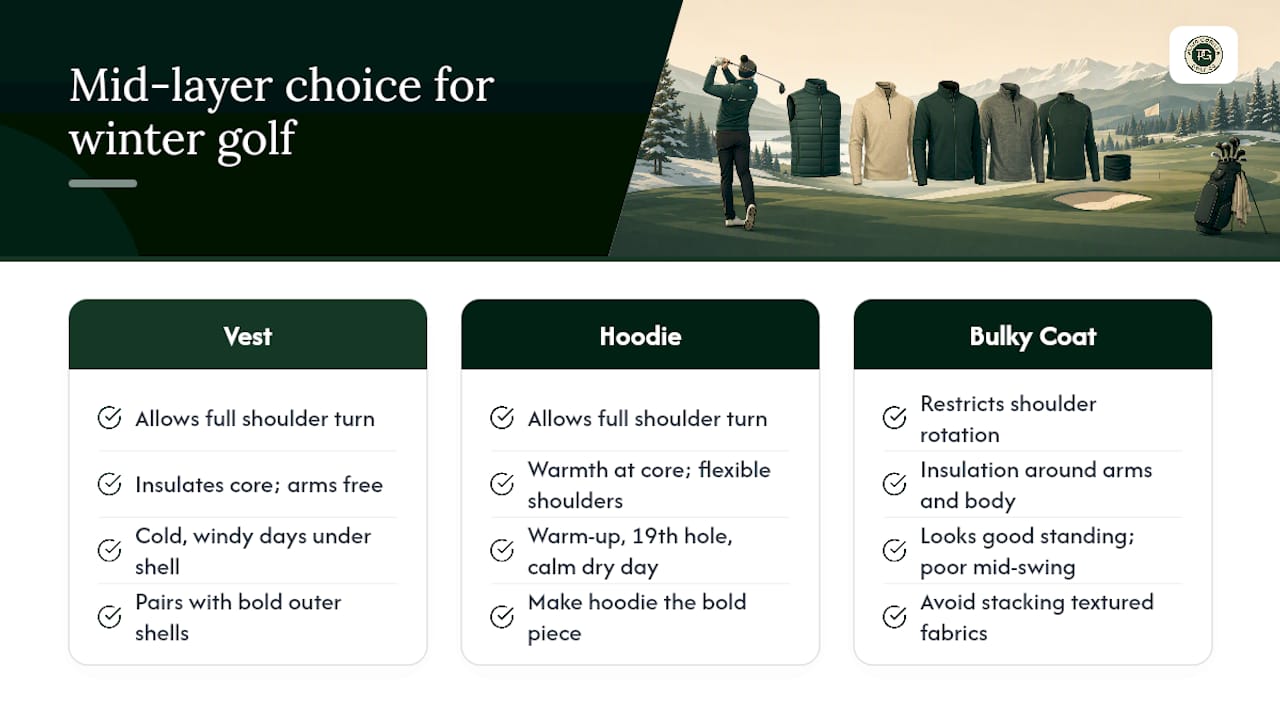
Vests and lightweight quarter-zips usually give you the best warmth-to-mobility trade-off of any mid-layer option, because a sleeveless design removes arm restriction entirely while still protecting your core. This is where a lot of golfers get the layering system wrong: they reach for the warmest thing in the closet instead of the piece that actually lets them play.

A vest or hybrid jacket with an insulated front panel and stretchy sides or sleeves gives you core warmth exactly where you need it most, since your torso loses heat fastest, while keeping your arms nearly unrestricted. That combination is why serious cold-weather golfers reach for a vest before they reach for a full jacket.
A hoodie earns its spot on this list because it’s genuinely useful. It’s just not primarily a swinging piece. Wear one over a base layer while you’re warming up on the range, walking to the first tee, or between shots on a slow group ahead of you, then swap to a vest or quarter-zip once you’re actually playing. The hood and kangaroo pocket that make a hoodie comfortable off the tee are the same features that add bulk across your shoulders when you try to make a full turn.
Layer your mid piece over a mock neck or crew neck base rather than a bare torso; that extra bit of fabric at the collar closes off a major heat-loss point without adding weight anywhere that matters for your swing.
Pro Tip: If you’re deciding between a vest and a quarter-zip, check the forecast for wind. Vests leave your arms exposed to wind chill, so on a still, cold morning a vest wins; on a breezy day, a quarter-zip under your shell keeps your arms from feeling the worst of it.
Why does Plaid Gorilla Golf favour vests and hoodies for winter rounds?
At Plaid Gorilla Golf, we design mid layers around one question: does this piece let you make a full shoulder turn without thinking about it? That’s the filter every silhouette goes through before it makes a drop, and it’s why our lineup leans on fitted vests and hoodies with real stretch built into the shoulders rather than boxy, oversized cuts that look good standing still and terrible mid-swing.
Golfers who prioritise full shoulder rotation are consistently better served by vests and hybrid jackets than by bulky insulated coats, because the insulation sits where it’s needed without restricting the arms.
That distinction, drawn from broader research on cold-weather layering for golf, lines up with how we build for our own golfers: warmth at the core, freedom at the shoulder.
Style-wise, our advice is simple. Pick one bold piece per outfit, not three. If your outer shell is a loud plaid pattern, keep your mid layer solid. If your hoodie carries a statement print, let your base layer and pants stay neutral. This isn’t just an aesthetic preference; it also keeps you from stacking too many textured, non-stretch fabrics that fight each other when you swing. For more on balancing that look with performance, our post on golf wardrobe modernization walks through how thinner technical layers replaced the bulky traditional gear that used to dominate cold-weather pro shops, and our breakdown of golf hoodie styles covers exactly which cuts hold up through a full swing versus which ones are better saved for the clubhouse.
The Bogey Enthusiast Hoodie fits into a winter rotation best as your warm-up piece, your nineteenth-hole layer, or a mid layer on a calm, dry day where you’re not swinging a driver on every hole. On a genuinely cold, windy day, we’d point you toward a vest under your shell instead, then save the hoodie for before and after the round.
What outer shell should you wear for cold, windy golf?
The most important features in a winter golf shell are articulated shoulders, four-way stretch fabric, and enough packability to stuff in your bag without a second thought, because those three things determine whether the jacket helps your round or hurts it. Everything else, colour, branding, pocket count, is secondary to whether the thing lets you finish a swing.
Run through this checklist before buying any outer layer for cold-weather rounds:
- Wind resistance: A windproof membrane cuts wind chill dramatically, which matters more on an open, exposed course than most golfers expect.
- Waterproof rating vs. breathability: A higher waterproof rating is worthless if the fabric doesn’t breathe, since you’ll end up soaked from sweat instead of rain.
- Seam sealing: Taped or sealed seams matter for wet-cold rounds where rain is a factor, not just wind.
- Articulated shoulders: Gusseted shoulder panels are the single feature that separates a golf shell from a generic rain jacket.
- Packability: A shell that folds down to the size of a water bottle means you’ll actually carry it, rather than leaving it in the trunk on a day it starts drizzling at the turn.
On a windy but dry day, a light wind shell over your vest or quarter-zip is usually enough; save the full waterproof shell for genuine rain. On a cold and wet day, you want the waterproof shell over a hybrid insulated mid layer, with a base layer doing the moisture management underneath. Mixed conditions, where it might rain on the front nine and clear up by the back, call for a packable shell you can stuff into your bag the moment the sky clears rather than sweating through it for nine extra holes. Our guide on choosing golf clothing built for a full swing goes deeper on how shell design affects your range of motion specifically.
What should you wear on your legs and feet for winter golf?
Warmth and traction matter equally for winter bottoms and footwear, and neglecting either one will cost you strokes just as fast as a bad mid layer will. Cold legs stiffen your hips and slow your turn; cold, slipping feet wreck your balance through impact.
For bottoms, a base layer under your regular golf pants beats switching to bulky thermal joggers, because it preserves the stretch and fit you’re used to swinging in. If you’re playing in genuinely cold conditions, look for golf pants with a brushed interior lining, and add a thin thermal base layer underneath rather than doubling up on thick outer pants that bunch at the knee and hip during your backswing. Rain pants belong in your bag for wet cold, and the same stretch-fabric priority applies here as it does to your shell: a stiff rain pant will fight your hip turn exactly when you need it least.
Footwear deserves its own attention because cold, wet feet end rounds early faster than almost any other discomfort. Prioritize a waterproof membrane, an insulated lining rated for near-freezing temperatures, and replaceable spikes for traction on soft or frost-covered turf. A boot that fits snugly through the heel but has room to wiggle your toes will keep circulation going, which matters more for warmth than an extra layer of sock ever will.
Which accessories matter most in cold weather golf?
Your hands, feet, and head lose heat faster than any other part of your body, so accessories aren’t an afterthought here. They’re often the difference between finishing a round comfortably and quitting at the turn. Get these three areas right and the rest of your layering system does its job properly.
- Gloves: Run a two-glove strategy: a thin liner glove or mitt between shots for warmth, and your regular golf glove only for the swing itself.
- Mitts: Keep a pair of insulated mitts in your bag for the walk between shots; they trap far more heat than fingered gloves since fingers aren’t separated and losing individual heat.
- Beanie or toque: A thin, snug beanie under a cap, or a golf-specific toque on its own, cuts heat loss through your scalp significantly.
- Neck gaiter vs. mock neck: A gaiter you can pull up or down gives more flexibility than a fixed mock neck, especially once you start generating body heat mid-round.
- Warm socks: Merino wool socks beat cotton here for the same wicking reasons as your base layer.
- Hand warmers: Disposable hand warmers in your pockets between shots do more for comfort than almost any glove upgrade.
Preserve your feel and grip by keeping your swing glove thin and well-worn rather than reaching for a thick, insulated glove on your lead hand. That insulation costs you the clubface feedback you rely on for distance control. Our accessories checklist for Canadian golfers breaks this down further if you’re building a kit from scratch.
What should you wear golfing by temperature?
Start slightly cold and layer for the heat you’ll generate once you’re walking and swinging, then adjust from there based on wind and precipitation rather than the raw temperature alone. This table gives you a starting outfit for each band; treat it as a baseline you tweak based on how your own body runs.
| Temperature | Base layer | Mid layer | Outer | Accessories | Wet-day note |
|---|---|---|---|---|---|
| 8 to 12°C | Light merino or synthetic tee | Optional light vest | Packable wind shell | Cap, thin gloves optional | Add packable rain shell if needed |
| — | Merino or synthetic long sleeve | Vest or quarter-zip | Wind shell | Beanie, liner gloves, hand warmers | Swap wind shell for waterproof shell |
| 0 to 5°C | Merino long sleeve | Insulated hybrid vest | Waterproof or windproof shell | Mitts, toque, neck gaiter, hand warmers | Waterproof shell mandatory, watch for sealed seams |
| Below 0°C | Two thin base layers | Insulated hybrid jacket | Full-zip technical shell | Mitts, toque, gaiter, insulated boots, hand warmers | Prioritize breathability to avoid sweat freezing |
A sample outfit for the 0 to 5°C band: merino base layer, insulated hybrid vest, a windproof shell with articulated shoulders, mitts for between shots, and a toque under your cap. The trade-off at every band is the same: add warmth at the core first, and only add bulk to your arms and shoulders as a last resort.
How do you test your winter golf outfit for mobility?
The single best pre-round mobility test is a full, exaggerated shoulder turn while wearing your complete outfit, because if you can’t reach a normal backswing position standing in your kitchen, you definitely can’t do it on the course under pressure. This takes thirty seconds and saves you from discovering the problem on your opening tee shot with your foursome watching.
- Stand in your golf posture and make a full backswing turn without a club. Your lead shoulder should reach close to your chin without the jacket pulling tight across your back.
- Reach your right hand behind your left shoulder blade and vice versa. If your outer shell restricts this, it will restrict your follow-through.
- Take a mimed full swing at moderate speed. Listen and feel for any fabric that catches, bunches, or resists at the top of the backswing.
- Hold a club and rotate through impact position slowly. Check that your grip and glove combination still lets you feel the clubface.
- Raise both arms straight overhead. If your mid layer rides up and exposes skin at your waist, it’s too short for winter layering.
Pro Tip: Sleeve length matters more than most golfers realize. A sleeve that ends right at your wrist bone, rather than one that runs long over your glove, keeps fabric from bunching at the exact point where your grip needs the most freedom.
What layering mistakes hurt your winter golf game?
The single worst mistake is bulking up in thick, non-technical layers instead of stacking thin technical ones, because bulk at the shoulder and elbow costs you swing speed no matter how warm it keeps you. Golfers who grew up thinking “more fabric equals more warmth” are usually the ones fighting their swing all day in January.
- Cotton base layers: They soak up sweat and hold it against your skin. Switch to merino or synthetic.
- Heavy parkas or ski coats: Designed for standing still, not rotating through a swing. Use a vest and shell system instead.
- Tight, non-stretch outer layers: These restrict rotation even more than bulky loose ones. Look for four-way stretch fabric specifically.
- Regular sneakers or hiking boots: They lack the traction and waterproofing golf demands on wet or frosty turf. Get dedicated winter golf footwear.
- Skipping hand protection between shots: Cold hands lose feel fast, and by the time you notice, your grip pressure has already changed.
What’s a good winter golf packing checklist?
Pack for changing conditions, not just the forecast at your tee time, because Canadian winter weather can shift by ten degrees or from dry to wet between your front nine and back nine. Compactness matters here as much as coverage; a bag stuffed with bulky spares is nearly as bad as being underdressed.
- One spare base layer in case you sweat through the first, especially on a warmer winter day.
- A packable wind or waterproof shell that compresses small enough to fit in a side pocket.
- A vest or quarter-zip you can add or remove as the temperature shifts through the round.
- Two pairs of gloves: your swing glove and a thicker pair or mitts for between shots.
- A beanie or toque, plus a neck gaiter you can push down once you warm up.
- One spare pair of dry socks, kept in a sealed bag in case your feet get wet.
- Two or three disposable hand warmers, kept in your jacket pocket, not your golf bag, so they stay warm against your body heat.
For the commute to the course, roll your spare layers rather than folding them flat; rolling avoids the deep creases that flat folding leaves in technical stretch fabrics, and it takes up noticeably less room in a gym bag or the trunk. Keep your shell in an outer pocket where you can grab it one-handed without digging through your whole bag if the weather turns while you’re already on the first tee.
Why winter golf became my favourite time to play
Winter rounds cut the course traffic down to almost nothing, and once I stopped fighting my own outfit, that quiet became the whole appeal. The single change that made the biggest difference wasn’t a fancier jacket. It was switching from one thick layer to two thin ones and finally trusting that a vest would keep me warmer through the round than a heavy coat ever did.
The turning point came on a frosty morning round where I’d overdressed in a bulky insulated jacket, the kind built for standing at a bus stop, not swinging a driver. By the third hole I’d lost fifteen yards off the tee and had no idea why until I realized my shoulder simply couldn’t complete the turn. I stripped down to a base layer and vest at the turn, kept a packable shell in my pocket for the wind, and picked up nearly all of that distance back by the twelfth. That’s the lesson this whole guide is built around: warmth that costs you your turn isn’t actually helping your game.
If you’re curious about the reasoning behind specific piece choices, our post on dressing comfortably for long golf rounds covers a lot of the same ground from a different angle, focused more on all-day comfort than pure cold-weather performance.
Get on-course ready with Plaid Gorilla Golf’s winter mid layers
If you want an on-the-spot mid layer that balances warmth with the mobility this whole guide is built around, The Bogey Kit pairs a Country Club Hat with the Bogey Enthusiast Hoodie in one bundle, giving you a warm-up and off-course piece without buying two separate items.

The Bogey Enthusiast Hoodie in Pine works best on cooler, dry days when you’re not swinging through wind or rain, or as your pre-round warm-up and clubhouse layer once you’re off the course. It’s built with the fit and stretch we talked about above, so it moves with you rather than fighting your shoulders when you toss it on between shots. For golfers who want the full bundled look, The Bogey Kit covers head and mid-layer warmth in one order, which is a practical way to round out a winter kit without piecing it together from three different brands. Grab yours before this drop sells through, and layer it into your winter rotation exactly where this guide recommends: over your base layer, under your shell, on the days it fits.
Sources
These sources back the core claims in this guide, from the three-layer framework to specific fabric and footwear recommendations, and they’re worth a read if you want to go deeper on any single piece of the system.
Breathability matters as much as insulation. A layer that traps sweat instead of moving it outward will eventually leave you colder than a thinner, more breathable option would have.
The layering masterclass from Field Day Challenge covers the vest-and-hybrid approach in more detail, while Golf Monthly’s base layer roundup is a solid reference if you’re comparing merino against synthetic options for your first winter kit.
- Golf apparel layering 2026 | The Smarter Play
- What to wear for cold weather golf (buyer guide) | The Review Caddie
- Winter golf layering masterclass: the three-layer system | Field Day Challenge
- Best golf base layers 2026 | Golf Monthly
FAQ
What are the best base layers for winter golf?
Merino wool and polyester or nylon synthetic blends are the top choices, since merino regulates temperature and resists odour while synthetics wick moisture and dry faster. Avoid cotton entirely, since it traps sweat against your skin and makes you colder as the round goes on.
What is the 70/30 rule in golf?
Definitions of this rule vary across sources, and it’s typically discussed in relation to distance loss as temperatures drop rather than a fixed layering formula. What layering guides agree on is that a proper three-layer system reduces the perceived cold and helps maintain the muscle warmth needed for a full, fast swing.
What is the best base layer for winter?
For golf specifically, a snug-fitting merino or synthetic long-sleeve with four-way stretch is the top choice, since it wicks moisture and moves with your swing without adding bulk under your mid layer. Steer clear of thick thermal underwear designed for standing still rather than rotating through a golf swing.
What is the proper attire for winter golf?
Proper cold-weather attire follows the three-layer system: a moisture-wicking base, an insulating mid layer like a vest or quarter-zip, and a golf-specific waterproof or windproof shell with articulated shoulders. Round it out with insulated waterproof footwear, a toque, gloves or mitts, and a neck gaiter for the coldest days.