


Combed removes the short, weak fibres from raw cotton before spinning. Ringspun describes how the yarn is twisted and drawn during spinning. Combine the two and you get combed ring-spun cotton, which usually produces the softest, cleanest-surfaced fabric on the shelf. Yarn count, GSM, and finishing still swing the final feel, so neither term alone guarantees quality.
TL;DR:
- Combed cotton removes short fibers to produce a softer, smoother fabric that resists pilling, but it results in higher production costs due to fiber waste.
- Ring-spun cotton creates finer, stronger yarns with a more refined hand feel, enhancing durability and surface appearance, especially in lightweight garments.
- Combining combing and ring spinning yields premium fabrics that are both soft and durable, ideal for high-quality T-shirts and other close-to-skin essentials.
- Proper fabric weight (GSM) and finishing treatments are more influential on garment feel and function than spinning or combing alone.
- Shrinkage mainly depends on finishing processes and laundry care, not whether the fiber was combed or ring-spun.
Table of Contents
- What do “ringspun” and “combed” actually mean?
- How does the spinning process change softness and durability?
- Which cotton type suits tees, hoodies, and caps?
- Will combed ring-spun cotton shrink?
- How Plaid Gorilla Golf chooses fabric for hoodies and hats
- Three rules for reading a cotton label without getting played
- Feel the difference in our hoodies and hats
- Sources
- FAQ
What do “ringspun” and “combed” actually mean?
Raw cotton fibre goes through several mill stages before it becomes the shirt on your back, and two of those stages get most of the marketing attention. Understanding where combing and ring spinning sit in that sequence is the fastest way to stop guessing at label language.
Carding comes first. It’s a mechanical process that untangles raw cotton fibre and roughly aligns it into a loose rope called a sliver, pulling out the biggest impurities along the way. Every cotton fabric, cheap or premium, goes through carding.
Combing is optional, and it’s where the real quality split happens. A combing machine pulls the carded sliver through fine-toothed rollers that comb out short, weak fibres and remaining debris, leaving only the longer, more uniform strands behind. This step is genuinely wasteful by design. A meaningful share of the raw fibre gets discarded as short-fibre waste, which is a major reason combed cotton costs more than uncombed cotton to produce. Brands comb cotton because that longer, cleaner fibre is what makes the next steps worthwhile.
Spinning is the second fork in the road, and it’s a completely separate decision from combing. Ring spinning twists and continuously thins the fibre bundle as it winds onto a bobbin, which is what produces finer, stronger yarn with a more refined hand than the alternative. Open-end spinning, sometimes called rotor spinning, works faster and cheaper by feeding loose fibres into a rotating chamber, but it produces a bulkier, less even yarn with more surface texture.
Here’s how the four building blocks combine on a garment tag:
- Carded, open-end — the budget tier, common in basic tees and workwear.
- Carded, ring-spun — stronger and smoother than open-end, still contains short fibres.
- Combed, open-end — less common, cleaner fibre but a coarser spin.
- Combed, ring-spun — the premium combination, often shortened on tags to “ring-spun combed cotton” or just “combed ring-spun.”
That last label is shorthand, not a separate fourth process. When you see “combed ring-spun” on a hang tag, the mill ran the fibre through both extra steps: combing to strip out the short stuff, then ring spinning to twist what’s left into a tighter, finer yarn.
How does the spinning process change softness and durability?
Every step described above shows up directly in how a shirt feels against your skin and how long it holds its shape. This is where the manufacturing choices stop being technical trivia and start mattering to your closet.
Combing’s whole job is removing short fibres, and those short fibres are exactly what causes fuzz. Fewer of them poking out of the yarn surface means less pilling and a smoother fabric face, which is why combed cotton is the default choice for anything worn next to skin, like undershirts and premium bedding.

Ring spinning attacks the same problem from a different angle. Because the fibre is drawn and twisted continuously rather than dumped into a rotor, the resulting yarn has fewer loose fibre ends poking out and noticeably better tensile properties than open-end yarn. That translates into two wearer-facing benefits: a smoother, more refined hand feel, and yarn that resists breaking down over repeated wear and washing.
Put the two together and the improvements stack, as explained in detail by Vintage Tee Buyers: Tell Garment Dyed From Pigment Dyed by Feel, which also covers surface finishes common on ringspun or combed cotton retail garments.
- Softness improves twice over: once from removing coarse short fibres, once from the tighter, more uniform twist of ring spinning.
- Pilling resistance climbs because there are fewer weak fibre ends available to ball up on the surface.
- Strength goes up thanks to the more even, tightly twisted yarn structure.
- Surface appearance turns cleaner and less fuzzy, which is why premium blanks photograph and print better.
A combing yield reality check: combing intentionally sacrifices a portion of the raw fibre as waste to leave behind longer, more uniform strands, which is the direct mechanical reason combed fabrics carry a higher price tag than carded equivalents.
None of this means either label alone guarantees a great garment. A ring-spun fabric woven from short-staple, uncombed cotton can still feel rougher than a well-finished carded piece. GSM (grams per square metre), knit structure, and finishing treatments all layer on top of the spinning method, and a heavy, loosely knit ring-spun fabric will never feel as refined as a lighter, tightly knit combed ring-spun jersey. The label tells you about the yarn. It doesn’t tell you about the fabric built from that yarn.
Which cotton type suits tees, hoodies, and caps?
Different garments put different demands on fabric, and matching the spec to the use case matters more than chasing whichever label sounds fanciest.
- Lightweight, next-to-skin tees call for combed ring-spun cotton in a fine yarn count, usually written as something like 30s or 40s singles. The fine yarn keeps the fabric light and drapey, while the combed ring-spun combination keeps the surface smooth against skin and resistant to pilling from friction with a golf bag strap or car seat.
- Hoodies and heavier layering pieces can lean on straight ring-spun cotton without full combing, especially once GSM climbs past 300. At that weight, the fabric’s hand comes largely from brushed fleece backing or a heavier knit structure, so paying a premium for combing delivers less noticeable benefit than it does on a thin tee.
- Structured caps, like snapbacks and rope hats, depend less on yarn spinning altogether and more on the face fabric, panel construction, and buckram structure that holds the shape. Cotton twill or a cotton blend front panel benefits from ring spinning’s smoother surface for embroidery and print clarity, but the fibre choice matters less than the structural build.
When you’re scanning a product page, look past the single buzzword and check for these specifics together: yarn singles count (higher usually means finer and lighter), GSM (lower for tees, higher for hoodies), and finish (combed, ring-spun, or both). A tag that lists all three tells you far more than one that just says “premium cotton.”
Pro Tip: For layering pieces you’ll wear over a golf shirt most of the season, prioritize GSM and knit density over the combing claim. A 340 GSM ring-spun hoodie will outperform a lighter combed ring-spun piece every time you need actual warmth and structure.
Will combed ring-spun cotton shrink?
Yes, and the spinning method isn’t what stops it. Shrinkage is governed far more by finishing treatments, like compacting and pre-shrinking, and by the tension applied during knitting and dyeing, than by whether the yarn was combed or ring-spun. Without a proper compacting finish, even a premium combed ring-spun jersey can shrink noticeably on its first wash.
Laundry testing on 100% combed ring-spun cotton confirms this directly: garments shrank measurably under hot water and high dryer heat, while cold water and low-heat or air drying kept shrinkage to a minimum.
Practical care rules that actually protect your investment:
- Wash cold, always. Hot water relaxes and contracts cotton fibre regardless of how it was spun.
- Use a gentle cycle to reduce mechanical stress on the knit structure.
- Tumble dry on low heat, or air dry when you can. High heat is the single biggest shrink trigger.
- Turn garments inside out before washing to protect printed graphics and reduce surface abrasion that causes pilling.
What repeated washing does over time: expect the most shrinkage in the first two or three washes as the fabric relaxes into its final resting state, then minimal change afterward if you stick to cold water and low heat. Tighter knit construction and proper compacting finishing hold shape far better long-term than fibre choice alone.
How Plaid Gorilla Golf chooses fabric for hoodies and hats
We build every drop around how a piece actually gets worn, not around whichever buzzword sells more units. That means the ringspun vs combed cotton decision gets made garment by garment, not brand-wide.
Our hoodies, including the Bogey Enthusiast Hoodie and the Prime Hoodie, lean on heavier ring-spun cotton blends built for structure and warmth on cool mornings at the clubhouse. At that weight, GSM and fleece backing do more work for comfort than a full combing process would, so we put the budget into fit and fabric weight instead.
Our headwear, from the Champagne Tees Rope Hat to the Country Club Snapback, prioritizes:
- A clean, printable face fabric that holds embroidery detail sharply.
- Structured panels that keep their shape drop after drop.
- Finishing that resists fading and fraying with regular course wear.
For readers who want the deeper technical breakdown of GSM, knit construction, and fabric weight before buying, our guide to choosing high-performance golf clothing walks through it garment by garment.
Three rules for reading a cotton label without getting played
Buzzwords sell fabric, but three habits will save you from paying premium prices for mediocre garments.
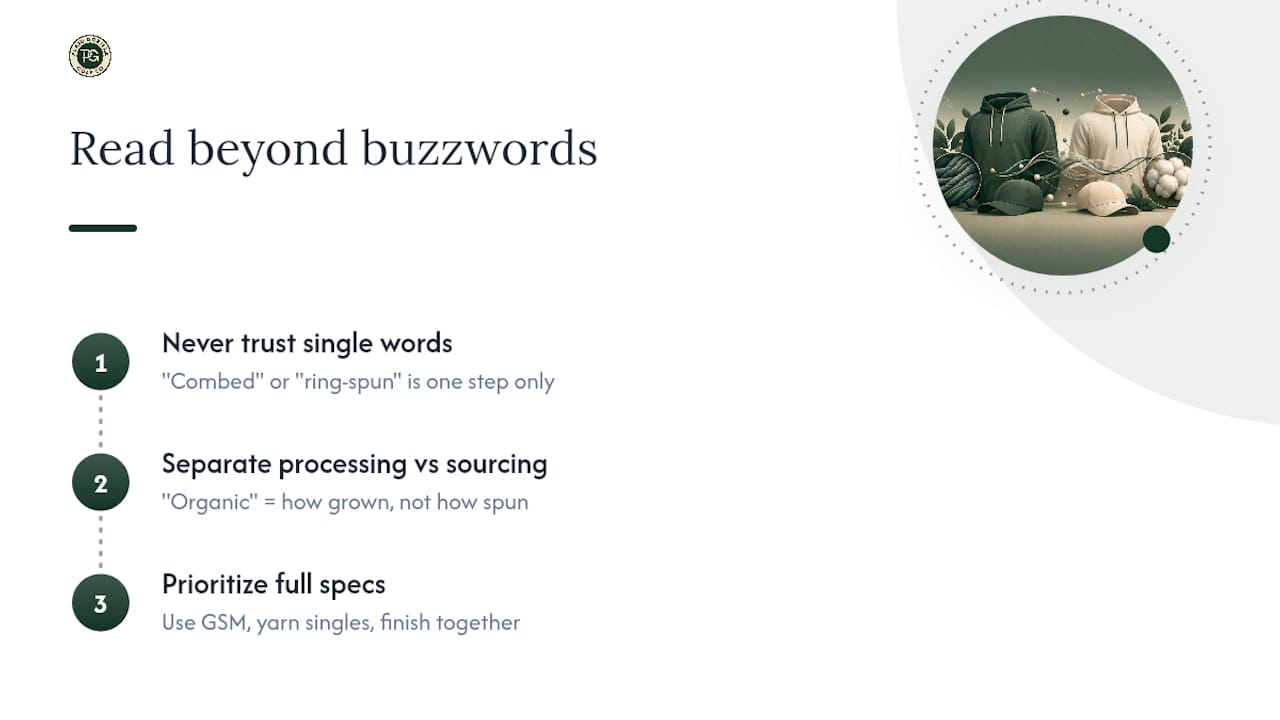
First, never trust a single word alone. “Combed” or “ring-spun” printed by itself tells you about one manufacturing step, not the finished fabric’s weight, knit, or finish. Second, separate processing claims from sourcing claims. “Organic” describes how the cotton was grown; it says nothing about whether it was combed or how it was spun. A shirt can be organic and rough, or conventionally grown and buttery soft. Third, weigh full specs over marketing language every time. GSM, yarn singles, and finish together tell you more than any one buzzword on its own.
The apparel world loves a good label. Read past it.
— Mike
Feel the difference in our hoodies and hats
Plaid Gorilla Golf builds around the same fabric logic covered above, not a single buzzword slapped on a tag. That means our team weighs GSM, knit structure, and finish for every drop, so a hoodie built for a cool morning round doesn’t get the same spec as a cap built to hold its shape through a Canadian summer.

If you want the refined, structured feel discussed in the tee and hoodie comparison above, The Bogey Kit pairs a Country Club Hat with the Bogey Enthusiast Hoodie for a complete look built on that heavier ring-spun logic. Prefer to mix and match structure with softness? The Course Kit bundles a rope hat with our Prime Hoodie, and The Club Kit does the same with a snapback. If you’re set on a single piece, start with The Ponderosa Pine Set or browse the full buying guide before you pick a bundle. Every kit ships in limited quantities, so check current stock before your size sells out.
Sources
- Combed vs. Ringspun Cotton: What’s the Difference and Which Is Better? - Knowing Fabric
- Ring Spun vs Combed Cotton Explained – MEXESS
- Combed Cotton vs. Ring-Spun Cotton: What the BELLA+CANVAS Airlume Label Actually Means – Storiginator
FAQ
Is 100% ringspun cotton the same as 100% cotton?
Yes. “100% ring-spun cotton” and “100% combed ring-spun cotton” both describe fabric that’s entirely cotton fibre; the extra words describe the spinning and processing method, not a different fibre content.
Will 100% combed ringspun cotton shrink?
It can. Laundry testing found shrinkage happens mainly with hot water or high dryer heat, while cold washing and low-heat or air drying keep it to a minimum.
Is ringspun cotton good quality?
Ring-spun cotton is generally considered higher quality than open-end spun cotton because ring spinning produces finer, stronger yarn with a more refined hand feel and fewer loose fibre ends that cause pilling.
What are the disadvantages of combed cotton?
Combed cotton costs more to produce because the combing process discards a meaningful share of raw fibre as short-fibre waste to leave only longer, uniform strands, which drives up the price of finished garments.
Which cotton is better: ringspun or combed?
Neither wins outright. Combed cotton wins on surface smoothness and pilling resistance, ring-spun wins on yarn strength and evenness, and combining both in a combed ring-spun fabric like the ones Plaid Gorilla Golf uses in its lighter pieces typically delivers the best overall balance.