


Your correct hat size is your head circumference converted through a standard hat-size chart, no guessing required. Get that one number right and every fitted cap, snapback, or bucket hat you order after that makes sense.
Here’s the three-step path to a hat that actually fits:
- Measure: wrap a soft tape around the widest part of your head, about 1/8 inch above your eyebrows.
- Convert: match that number (in cm or inches) to a size using the chart below.
- Between sizes? Size up. A slightly loose hat is easier to fix than a tight one.
Key Takeaways
Correct hat sizing comes down to one accurate circumference measurement, matched against a standard chart, then confirmed with a real fit check.
| Point | Details |
|---|---|
| Measure at hat height | Wrap a soft tape mid-forehead, snug but with one finger of slack, and repeat once to confirm. |
| Convert with precision | Use centimetres for accuracy; 57 cm converts to roughly a 7 1/8 fitted size. |
| Round up between sizes | A slightly loose fitted hat is fixable with padding; a tight one isn’t. |
| Match style to your needs | Fitted caps need an exact number, while snapbacks and Flexfit styles cover a wider range. |
| Consider adjustable options | Plaid Gorilla Golf’s Country Club Snapback uses a snap closure that removes the guesswork for many golfers. |
Table of Contents
- How do you measure your head for a hat?
- Hat size conversion chart: cm, inches, and international sizes
- Does hat fit change by style (fitted, snapback, beanie)?
- What if your head is between two hat sizes?
- How do you check if a hat actually fits?
- Getting hat sizing right after years of trial and error
- Find your fit with an adjustable snapback built for golf
- Sources
- FAQ
How do you measure your head for a hat?
Grab a soft fabric tape measure, the kind you’d find in a sewing kit, not a hard metal one. Stand in front of a mirror or get someone to help. Here’s the exact method:
- Find the spot. Place the tape where you want the hat to sit: across the mid-forehead, roughly 1/8 to 1/2 inch above your eyebrows.
- Wrap it around. Bring the tape around the back of your head across the widest point, right over the occipital bone (the bump at the base of your skull).
- Set the tension. Keep the tape snug against your skin, but leave enough room to slide one finger underneath. Too tight skews your number small; too loose skews it big.
- Read and record. Note the number in both centimetres and inches. Having both makes cross-checking against different hat size charts painless later.
- Repeat once. Measure a second time to confirm. If the two numbers differ by more than a few millimetres, take a third and go with the average.
No soft tape on hand? Use a piece of string and wrap it the same way, mark where it overlaps with a pen, then lay it flat against a ruler for the measurement. It’s not as fast, but it’s just as accurate.
If you’ve got thick hair, braids, or a hat you tend to wear low on your brow, measure exactly where that hat will actually sit, not where a bare head “should” be measured. Kids should be measured the same way as adults, just watch for wiggling and take the extra second measurement seriously.
Pro Tip: Measure at the end of the day rather than first thing in the morning. Heads can swell slightly overnight, and an evening measurement tends to match how your hat will feel during an actual round.
Hat size conversion chart: cm, inches, and international sizes
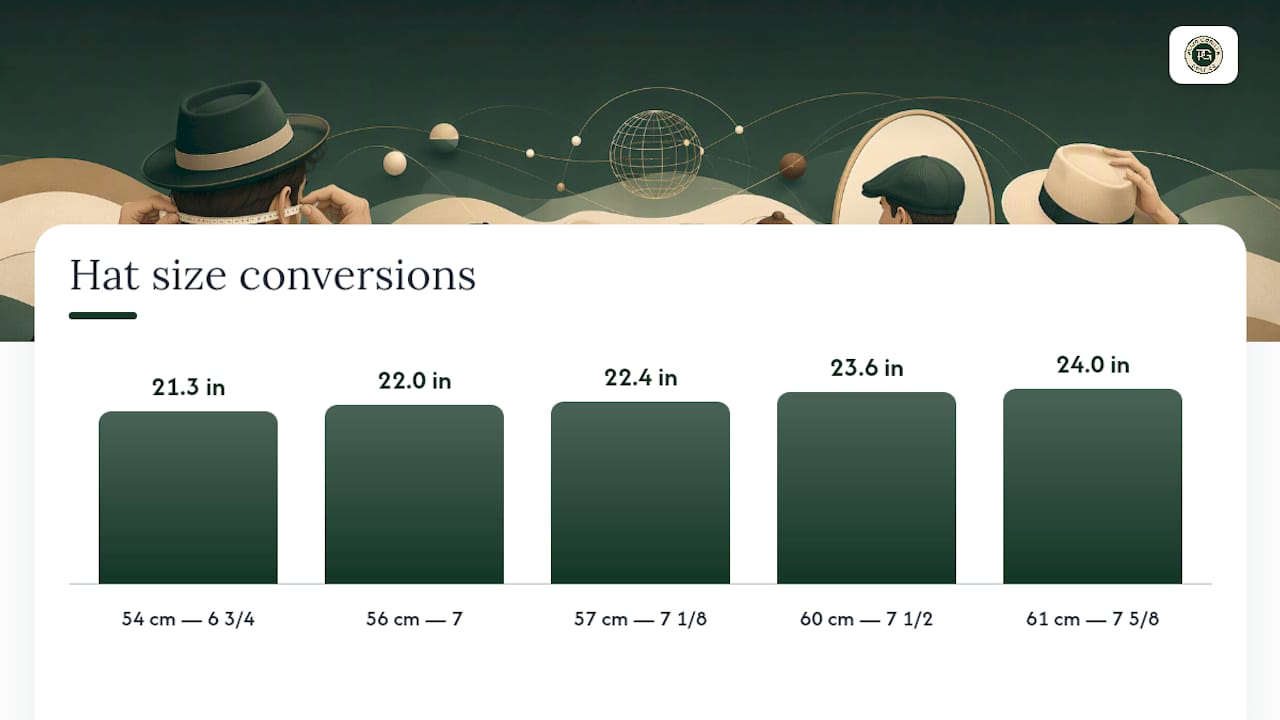
Once you’ve got your number, converting it into an actual hat size takes seconds. Fitted hat sizes are based on the diameter of your head (in eighths of an inch), while most everyday buyers just need the circumference match below.
| Head circumference (cm / in) | US/UK hat size | EU size | Fit notes |
|---|---|---|---|
| 54 cm / 21.3 in | 6 3/4 | 54 | Fitted; small adult or youth |
| 55 cm / 21.7 in | 6 7/8 | 55 | Fitted; average female adult |
| 56 cm / 22.0 in | 7 | 56 | Fitted; common adult size |
| 57 cm / 22.4 in | 7 1/8 | 57 | Fitted; average male adult |
| 58 cm / 22.8 in | 7 1/4 | 58 | Fitted; slightly large |
| 59 cm / 23.2 in | 7 3/8 | 59 | Fitted; large |
| 60 cm / 23.6 in | 7 1/2 | 60 | Fitted; large, order snug adjustable |
| 61 cm / 24.0 in | 7 5/8 | 61 | Fitted; extra large |
These conversions align closely with the standard Stetson fit guide and with the conversion chart Baruch College uses for graduation cap sizing, so the same math holds whether you’re buying a golf cap or a mortarboard.
Three quick examples:
- 55 cm rounds to a 6 7/8, close to the average adult female head circumference.
- 57 cm lands almost exactly on a 7 1/8, near the typical adult male average.
- 60 cm converts to a 7 1/2, which is where most people start looking at adjustable or big-and-tall options instead of fixed fitted sizes.
If your number falls on a fraction, like 57.5 cm, round up rather than down. Fitted hats built from stiffer materials rarely stretch to fit a head that’s even a millimetre too big, but they’ll happily sit a touch loose. When in doubt, work in centimetres. It’s the more precise unit, and it removes the rounding errors that creep in when eighth-inch increments get squeezed into whole numbers.
Does hat fit change by style (fitted, snapback, beanie)?
The same head measurement behaves differently depending on how the hat is built. Here’s what changes by style:
- Fitted caps: No adjustment mechanism, so your measurement needs to be dead on. Order the exact size, not a rounded guess.
- Flexfit and stretch-lined caps: One size typically spans two or three fitted increments, which makes them more forgiving across a range of head shapes.
- Snapbacks and adjustable straps: Give you a built-in range, often several centimetres, so a slightly imprecise measurement won’t ruin the fit.
- Beanies: Stretch knit fabric means sizing is loose by design; go by feel more than exact circumference.
- Brimmed hats (fedoras, bucket hats): Structured brims mean crown depth matters as much as circumference. A hat that measures right but sits too shallow will still feel off.
Crown depth, sweatband thickness, and fabric stretch all shift how a labelled size actually feels on your head. Two hats marked the same size from two different brands can fit noticeably differently once you factor those elements in.
Pro Tip: Never trust a size label alone across brands. Check the product’s specific measurement notes, and lean on your own cm/in number every time you shop somewhere new.
What if your head is between two hat sizes?
Size up. That’s the rule of thumb, and it holds for a practical reason: a slightly loose fitted hat is easy to fix, while a slightly tight one just hurts.
Once you’ve got the bigger size, here’s how to dial in the fit:
- Add hat tape or foam padding strips inside the sweatband.
- Use sweatband inserts designed specifically for oversized fitted caps.
- Try hat sizing beads, small elastic loops that cinch the interior band.
- Adjust the strap or snap closure if the style allows it.
- For brimmed hats, a professional blocking and reshaping service can tighten the fit without damaging the material.
One caution: don’t over-tighten in the name of a “snug” fit. A hat that leaves red pressure marks or a headache after twenty minutes is too small, no amount of padding removal fixes that safely.
How do you check if a hat actually fits?
Trying a hat on for ten seconds in front of a mirror doesn’t tell you much. Walk around, talk, move your head. Here’s what to check:
- Height check. The hat should sit where you intend it to, not perched high or slipping toward your eyebrows.
- Wind test. Tilt your head, or step outside if you can. A well-fitted hat stays put without you catching it.
- Pressure check. Run a finger around the inside sweatband. No pinching, no red marks after a few minutes.
- Even contact. The sweatband should touch your head evenly all the way around, not gap on one side and dig in on the other.
- Crown depth. Your head shouldn’t feel like it’s floating inside the crown, and the brim shouldn’t rest on your eyebrows.
Expect some settling over the first few wears. Sweatbands soften, and fabric with any give will stretch slightly to match your head shape. That’s normal. What’s not normal: persistent pressure points, slipping that padding can’t solve, or a crown that’s visibly caved in or misshapen. Those are exchange-worthy problems, not break-in quirks.
Getting hat sizing right after years of trial and error
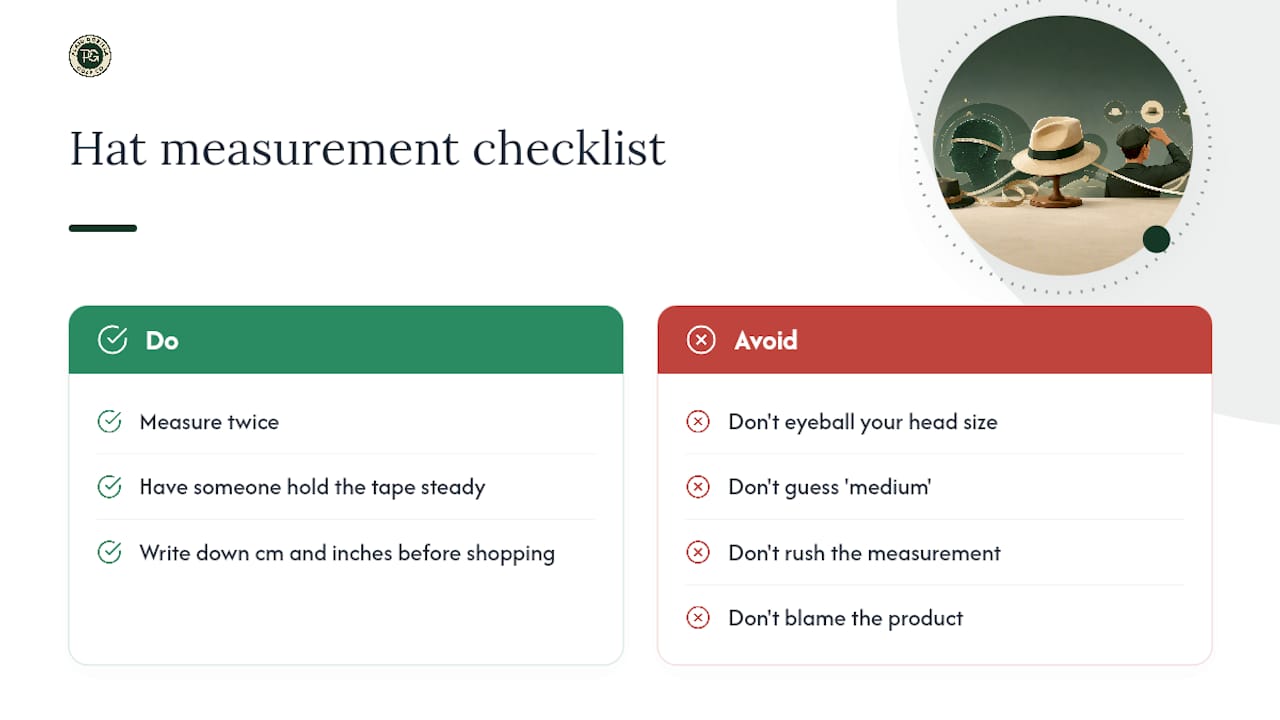
Fitting hats for golfers taught me one thing fast: most sizing complaints trace back to a rushed measurement, not a bad hat. People eyeball their head size, guess “medium,” and then blame the product when it doesn’t sit right.
Measure twice, ideally with someone helping you hold the tape steady, and write down both the centimetre and inch numbers before you shop. That one habit solves more fit problems than any padding trick ever will.
Find your fit with an adjustable snapback built for golf
Adjustable hats take a lot of the sizing stress off the table, and that’s exactly the thinking behind the Country Club Snapback in Navy/Cloud White from Plaid Gorilla Golf. Its snap closure covers a wide head-circumference range, so instead of chasing an exact fitted number, you get a comfortable sweatband and a clean, low-profile silhouette that works whether you’re teeing off or heading out for drinks after.
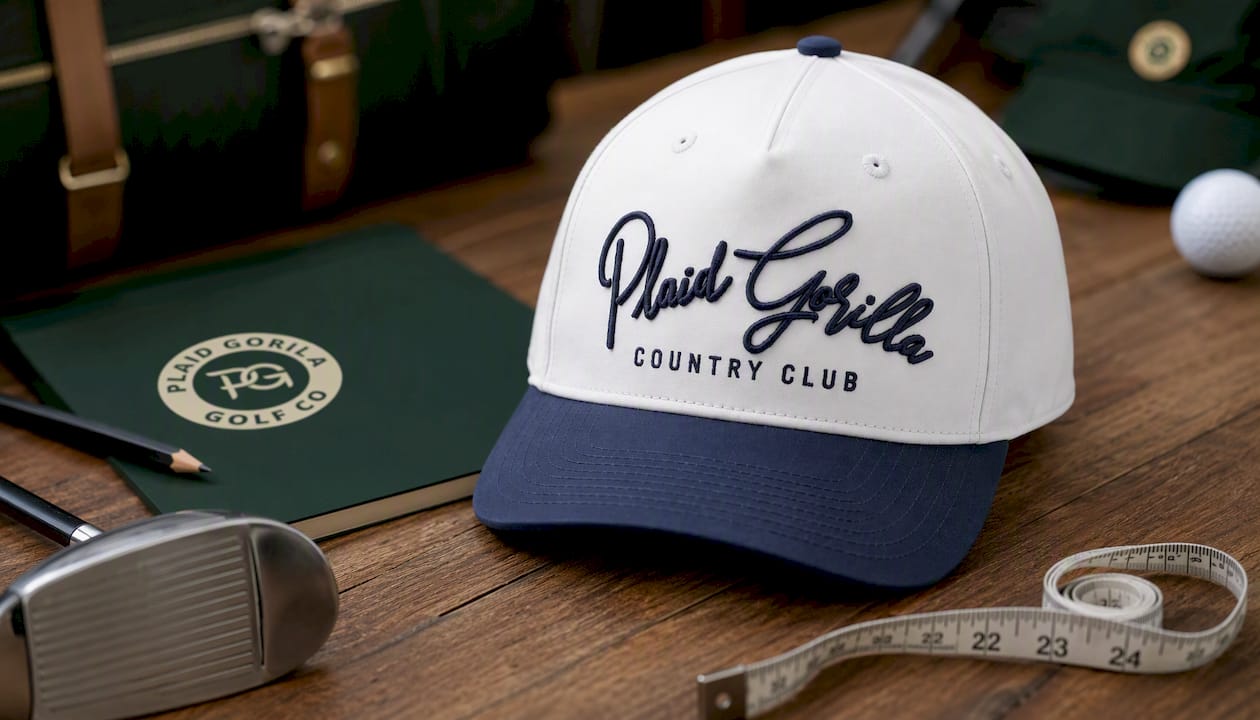
If you’ve been going back and forth over a fitted size, an adjustable style like this one takes that decision off your plate entirely. Browse the Country Club Snapback and check the fit notes on the product page, then pick your size range and get it added to your golf bag rotation.
Sources
- Hat size conversion chart - Student Affairs | Baruch College
- How to determine your hat size - Stetson Stories
- Fit guide | Stetson
- How to measure a fitted hat | Fitted hats sizing guide
Always check the specific brand’s own size chart before buying, since fitted numbers can shift slightly between manufacturers.
FAQ
How do you determine your hat size?
Measure your head circumference with a soft tape at mid-forehead height, then match that number in centimetres or inches to a standard hat-size chart. Round up if you land between two sizes.
Is a 7 3/4 hat size big or small?
A 7 3/4 is on the larger end of the standard fitted range, typically bigger than 7 5/8 which is the upper end of many everyday fitted caps, so 7 3/4 usually means shopping big-and-tall or adjustable styles.
What hat size is 57 cm?
A 57 cm head circumference converts to a US/UK fitted size of about 7 1/8, close to the typical adult male average.
What size cap is equivalent to a 7 1/2?
A 7 1/2 fitted size corresponds to roughly a 60 cm head circumference. If you’re shopping adjustable or snapback styles instead of fitted, look for a size range that includes 60 cm, like the adjustable fit on Plaid Gorilla Golf’s Country Club Snapback.