


Performance apparel, in shopper terms, is clothing engineered to manage sweat, regulate temperature, and move with your body. That’s the whole idea. You’ll see it described in labs as “textile performance testing,” but what it means on a product page is simpler: the garment is built to keep you comfortable and focused from the first tee to the 18th. Performance fabrics achieve this through fibre selection, knit construction, and finishing treatments rather than through any single magic material.
When you’re shopping, these are the features that signal a genuinely performance-driven garment:
- Moisture-wicking — pulls sweat away from skin to the fabric surface for evaporation
- Breathability — allows air and water vapour to pass through, preventing heat build-up
- Stretch and mobility — elasticated fibres that move with a full swing without binding
- Quick-drying — fabric dries fast after wicking, so you don’t carry the weight of sweat
- Odour control — antimicrobial finishes (such as Polygiene StayFresh) that suppress bacteria
- UV protection — UPF-rated constructions that block harmful sun exposure over a long period
The global golf apparel market continues to invest heavily in textile innovation, and those investments show up directly in what you can buy off the shelf today.
See what performance-built gear looks like — shop the hat + hoodie bundles.
Shop Bundles →Key takeaways
Performance apparel works by combining moisture-wicking fibres, breathable construction, and finishing technologies like Polygiene StayCool to keep golfers comfortable and focused across a full round.
| Point | Details |
|---|---|
| Performance means function, not just fabric | Look for named technologies (moisture-wicking, UPF, odour-control) on the label, not vague marketing language. |
| Breathability and wicking work as a system | A garment needs both to perform; breathability speeds the evaporation that wicking starts. |
| Keep elastane low | Quality golf apparel keeps elastane under roughly 3% to preserve airflow and wicking effectiveness. |
| Care preserves performance | Wash cool, skip fabric softener, and air dry to protect finishes through 30–50 wash cycles. |
| Plaid Gorilla Golf | Limited-edition kits like The Bogey Kit pair performance construction with bold design in coordinated bundles. |
Table of Contents
- What does performance apparel mean for each feature you’ll see on a label?
- How moisture-wicking and breathability actually work together
- Materials and construction: what each fabric does for golfers
- Fit and construction details that matter to golfers
- A practical checklist for buying performance golf clothing
- How to care for performance apparel so features last
- Polygiene® StayCool and StayFresh: what they mean for your round
- Why Plaid Gorilla Golf is worth a look
- The Plaid Gorilla Golf drop is worth your attention
- Sources
- FAQ
What does performance apparel mean for each feature you’ll see on a label?
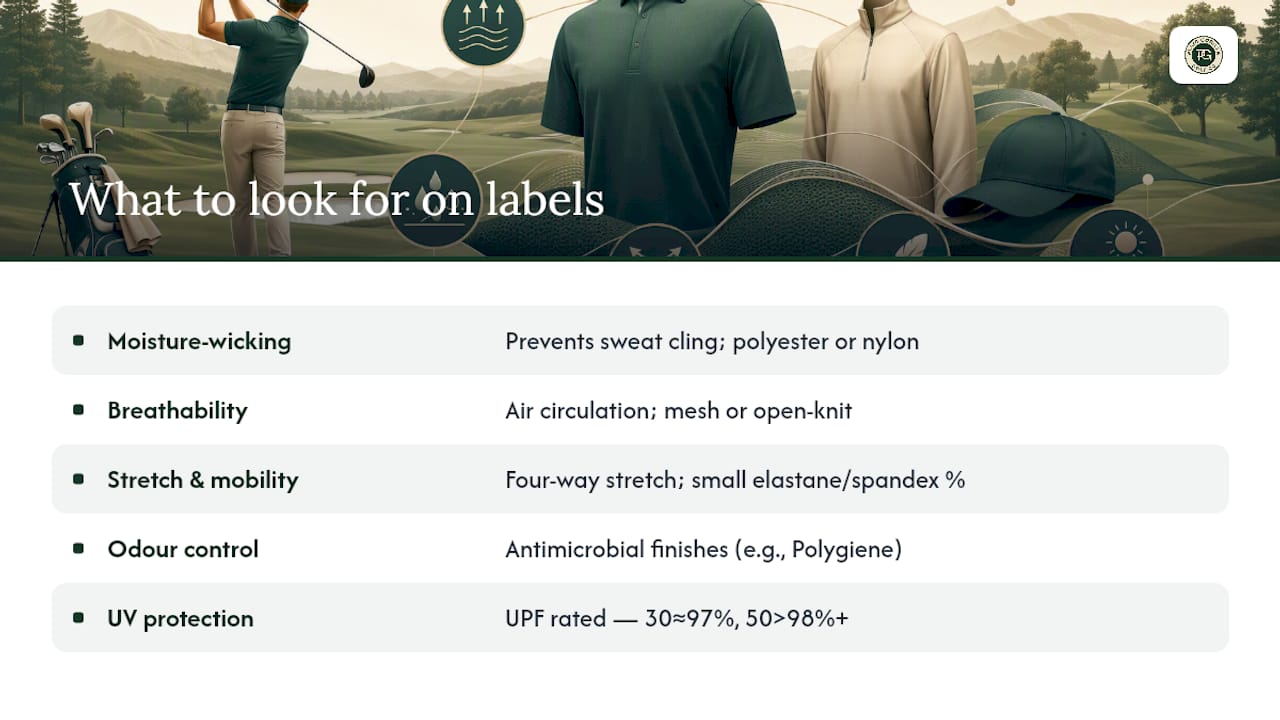
Performance golf apparel is built around three non-negotiable attributes: breathability, moisture-wicking, and stretch. Here’s what each one actually does for you on the course.
Moisture-wicking keeps sweat from pooling against your skin. On a warm day, that sticky, heavy feeling mid-round is a distraction. Wicking fabrics use hydrophobic (water-repelling) fibres to push moisture outward, where it can evaporate. Look for explicit “moisture-wicking” labelling or fabric compositions that are predominantly polyester or nylon.
Breathability is what happens after wicking does its job. Mesh panels, open-knit constructions, and lightweight single-jersey fabrics let air circulate and carry that moisture away faster. Without breathability, wicking stalls. The two features work as a system, not independently.
Stretch and mobility matter most at address and through the backswing. A garment with four-way stretch (warp and weft directions) won’t pull across your shoulders or restrict your hip turn. Check for a small percentage of elastane or spandex in the fabric composition, and look for articulated patterning in product photos.
Quick-drying is closely tied to wicking. Synthetic fibres like polyester dry significantly faster than cotton, which absorbs moisture and holds it. If a garment takes hours to dry after a wash, it’ll feel heavy on a humid afternoon round too.
Odour control is handled by antimicrobial finishes applied to the fibre or fabric surface. Polygiene’s StayFresh technology is one of the most recognisable on the market. Without it, polyester in particular tends to trap odour-causing bacteria.
UV protection is rated as UPF (Ultraviolet Protection Factor). UPF 30 blocks roughly 97% of UV radiation; UPF 50 blocks over 98%. For golfers spending four or more hours outdoors, this is worth checking on the label, especially for lighter-coloured or thinner fabrics.
Pro Tip: *Check the fabric composition label before anything else.
For moisture-wicking headwear that completes the kit, Plaid Gorilla Golf’s moisture-wicking golf hat guide covers what to look for from the brim up.
How moisture-wicking and breathability actually work together
Moisture-wicking relies on capillary action. Synthetic fibres are engineered with tiny channels or textured surfaces that draw liquid away from the skin through surface tension, the same physics that pulls water up a paper towel. Once sweat reaches the outer fabric surface, evaporation takes over. That evaporation is an endothermic process, meaning it absorbs heat from the fabric and cools the surface against your skin.
Advanced moisture-wicking systems use these channels to move sweat to the garment surface while also allowing water vapour to pass through the material, which prevents visible sweat marks from forming. Breathability accelerates the evaporation step. A fabric that wicks but traps heat underneath will still leave you uncomfortable. Mesh panels or open-knit zones placed at the back yoke, underarms, or side panels create airflow that carries moisture-laden air away from the body.
In humid conditions, this interaction becomes critical. High ambient humidity slows evaporation because the air is already saturated with moisture. Breathable constructions compensate by increasing airflow across the fabric surface, which is why a polo with strategic mesh panels outperforms a solid-knit shirt of the same weight on a muggy summer round.
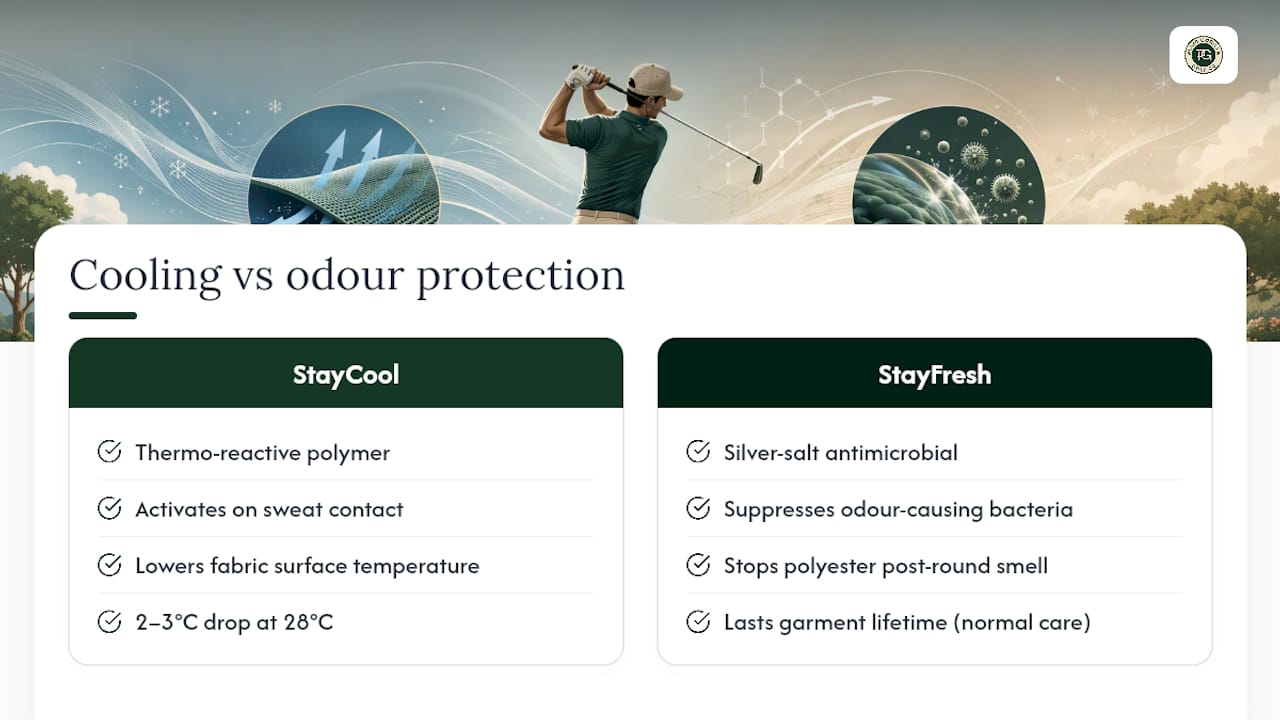
Cooling claim to know: Polygiene StayCool uses a thermo-reactive polymer matrix that activates on contact with sweat and can reduce fabric temperature by a small measurable amount. That’s a measurable, verified figure from the technology owner, not a marketing estimate.
Materials and construction: what each fabric does for golfers
Choosing the right fabric comes down to matching fibre properties to your playing conditions and priorities. Here’s how the common options stack up.
Polyester is the workhorse of performance golf apparel. It wicks fast, holds its shape, and dries quickly. The trade-off is that untreated polyester retains odour and can feel less breathable than natural fibres in extreme heat. Additive technologies like Polygiene StayFresh address the odour issue directly.
Nylon is softer than polyester, more abrasion-resistant, and slightly more breathable. It’s common in performance trousers and shorts where durability and drape matter more than raw wicking speed.
Merino wool and technical natural blends regulate temperature naturally and resist odour without chemical treatments. They’re heavier and more expensive than synthetics, but they perform well across a wider temperature range. A merino-blend hoodie works on a cool morning and a warm afternoon.
Cotton blends are comfortable but absorb moisture rather than wicking it. A small cotton percentage in a blend adds softness; a high cotton percentage undermines performance. Avoid anything above 50% cotton if performance is the goal.
| Feature | Polyester | Nylon | Merino blend | Cotton blend |
|---|---|---|---|---|
| Breathability | Moderate | Good | Very good | Low |
| Wicking speed | Fast | Fast | Moderate | Slow |
| Stretch | Moderate | Good | Moderate | Low |
| Durability | High | Very high | Moderate | Moderate |
| Ideal use | Warm, humid rounds | Trousers, shorts | Cool/variable conditions | Casual comfort only |
Knit construction shapes how these fibres perform. Single-jersey knits are lightweight and breathable. Double knits add structure and durability. Zoned knitting places open-mesh panels exactly where airflow is needed most, typically under the arms and across the back, without sacrificing the look of a clean garment.
For a deeper breakdown of high-performance golf fabrics, Plaid Gorilla Golf’s technical guide covers construction details worth reading before you buy.
Fit and construction details that matter to golfers
Fit is not just about how a garment looks. For wicking to work, the fabric needs consistent contact with the skin. A garment that’s too loose loses that contact and wicking slows. Too tight, and it restricts your swing and traps heat.
Key construction signals to look for when buying:
- Flatlock or bonded seams at the shoulders and underarms reduce chafing during a full swing
- Articulated patterning (pre-shaped elbows, curved hems) means the garment is cut for movement, not just standing still
- Gussets in the underarm or side panels add range of motion without adding bulk
- Elastic or stretch waistbands on bottoms prevent the shirt from pulling out mid-swing
- Lightweight fabric weight (under 180 g/m²) keeps the garment from feeling heavy late in a round
When reading product photos, look for seam placement on the shoulder line and whether the cut tapers at the waist. A golf-ready garment sits slightly longer at the back hem to stay tucked during the swing. Choosing golf clothing that stands out without sacrificing these details is possible, but it requires knowing what to look for in the specs.
A practical checklist for buying performance golf clothing
Use this in-store or when reading a product page online:
- Identify your conditions first. Hot and humid calls for maximum breathability and wicking. Cool and variable calls for stretch and layering options.
- Check fabric composition. Look for polyester or nylon as the primary fibre. Elastane should be present but low.
- Verify labelled technologies. Moisture-wicking, UPF rating, and odour-control finishes should be named explicitly, not implied.
- Inspect seam placement. Flatlock or bonded seams at stress points indicate a garment built for movement.
- Read the care label. Performance finishes degrade with heat and fabric softener. If the label says “tumble dry high,” the finish won’t last.
- Check elastane percentage. Quality golf apparel keeps elastane under roughly 3% to preserve breathability and wicking effectiveness. Higher percentages can degrade both.
Pro Tip: If your budget is limited, prioritise the top layer you wear closest to the skin. That’s where wicking and breathability matter most. A performance base layer or polo does more work than a performance outer layer.
How to care for performance apparel so features last
Performance finishes are durable, but they’re not indestructible. How you wash and dry a garment determines how long the wicking and odour-control properties hold up.
- Wash in cool or warm water (30°C maximum). Hot water breaks down hydrophobic finishes faster.
- Skip fabric softener entirely. It coats fibres and blocks the microscopic channels that make wicking work.
- Use a gentle, sport-specific detergent or a plain low-residue detergent. Heavy detergents leave residue that clogs fabric structure.
- Air dry or tumble dry on low heat. High heat degrades elastane and can shrink synthetic fibres.
- Wash inside out to protect any printed graphics and reduce pilling on the outer face.
Most performance finishes hold through 30–50 wash cycles under proper care. After that, wicking and odour-control may noticeably decline. Abrasion from rough surfaces (a golf bag strap, for example) accelerates wear on the outer fabric face. A garment with a tight, smooth knit construction will outlast a loosely woven one under the same conditions.
Polygiene® StayCool and StayFresh: what they mean for your round
Polygiene is one of the few additive technology brands whose claims are independently documented and consistently cited across the golf apparel industry. Two of their technologies are directly relevant to golfers.
StayCool uses a thermo-reactive polymer that activates when it contacts sweat. The result is a measurable reduction in fabric surface temperature.
On a 28°C day, a 2–3°C reduction in fabric temperature is perceptible. It won’t replace shade or hydration, but it reduces the accumulated discomfort that costs you focus on the back nine.
StayFresh works through silver salt-based antimicrobial treatment applied to the fibre. It suppresses the bacteria that convert sweat into odour, which is the main reason polyester garments smell after a round even when they’ve dried out. The treatment is designed to last the life of the garment under normal care conditions.
When evaluating vendor claims on a product page, look for the Polygiene logo or a direct mention of the technology by name. Generic “odour-resistant” or “cooling fabric” language with no named technology is a weaker claim and harder to verify.
Why Plaid Gorilla Golf is worth a look
Plaid Gorilla Golf builds its apparel around the same principles this guide covers: materials that perform, cuts that move, and designs that don’t look like every other garment on the course. Their product line maps directly to what golfers need from a performance perspective.
- The Bogey Kit (Country Club Hat and Bogey Enthusiast Hoodie) pairs coordinated headwear with a hoodie built for comfort across a full round. The bundle approach means the fit and materials are designed to work together.
- Bogey Enthusiast Hoodie – Pine is the flagship piece. The deep forest green colourway and premium construction make it as at home in the clubhouse as on the course. The cut allows a full range of motion without pulling.
- The Ponderosa Pine Set (Rope Hat and Bogey Enthusiast Hoodie) is a coordinated set that handles cool morning rounds and stays sharp through the afternoon.
- The Course Kit (Rope Hat and Prime Hoodie) offers a slightly different silhouette for golfers who prefer a cleaner, more minimal look without giving up the performance construction.
All four options are limited drops, which means the designs don’t get watered down across mass production runs. That matters for premium golf clothing buyers who want something that holds its quality and its look.
A note on what performance apparel actually delivers
Performance apparel won’t fix a slice or add twenty yards. What it does is remove the small, cumulative distractions that cost you focus: the shirt that binds at the top of your backswing, the fabric that feels like a wet towel by the 14th hole, the hoodie that’s too stiff to layer comfortably. Real performance gains from apparel are mostly indirect. The benefit is staying comfortable and undistracted long enough to play your actual game.
Style matters too, and not just for vanity. A golfer who feels good in what they’re wearing tends to carry themselves differently on the course. Bold design and genuine performance aren’t in conflict. The best garments deliver both, and that’s exactly the gap Plaid Gorilla Golf was built to fill. For more on how bold golf apparel can work alongside performance, their field notes are worth a read.
The Plaid Gorilla Golf drop is worth your attention
Plaid Gorilla Golf gives you performance construction and a design that actually stands out, without the generic look that floods most golf racks. Limited drops mean you’re not buying what everyone else is wearing next season.
Three reasons to check the current drop:
- Premium materials and construction built for comfort across a full round
- Bold, limited-edition designs that work on the course and off it
- Bundle pricing on kits like The Bogey Kit means you get a coordinated look without hunting for matching pieces
Browse the current drop at Plaidgorillagolf and pick up the kit before it’s gone.
Sources
The sources below back the key claims in this guide. Each covers a distinct area worth exploring if you want more detail.
- Advanced moisture‑wicking technologies: the ultimate 2026 guide - Athletic Brands
- A complete guide to performance golf clothing - Polygiene
- How to choose the right moisture wicking stretch fabric for sportswear manufacturing - Ningbo Nashe Textile Co., Ltd
- Performance golf apparel 101: the big 3 | MyGolfSpy
- What are performance fabrics? A complete guide to technical athletic materials - Lydia Design Studio
FAQ
What does performance apparel mean for a golfer?
Performance apparel is clothing engineered to wick sweat, allow airflow, and stretch with your swing so you stay comfortable and focused across a full round. It’s defined by specific fabric technologies, not just a marketing label.
What fabric features should I prioritise when buying golf clothing?
Breathability, moisture-wicking, and stretch are the three core attributes.
Does performance apparel actually improve your golf game?
Not directly. The benefit is removing distractions like binding fabric or heavy sweat so you can maintain focus and consistent motion. Comfort supports concentration; it doesn’t change swing mechanics.
How do I know if a garment’s performance claims are real?
Look for named technologies (Polygiene, UPF rating, specific fibre percentages) rather than vague descriptors like “breathable feel.” A garment with no fabric composition data or care instructions is a red flag.
What makes Plaid Gorilla Golf’s kits a practical performance choice?
Plaid Gorilla Golf’s bundles, like The Bogey Kit and The Ponderosa Pine Set, pair coordinated headwear and hoodies built for range of motion and comfort, with limited-edition designs that don’t compromise on construction quality.