


Humour is a design tool. In golf apparel, it boosts social connection, signals approachability, and gives a brand a reason to be remembered. The role of humor in golf apparel design goes well beyond a funny slogan on a chest pocket. It shapes placement decisions, production methods, audience targeting, and how a piece performs from the first tee to the 19th hole.
The short version:
- Humour functions as a social lubricant, reducing tension and sparking conversation on course
- It differentiates a brand in a category crowded with safe, traditional silhouettes
- Tone must match the buyer: subtle and hidden for luxury players, cheeky and visible for beer-league regulars
- Production method (embroidery vs. print) affects how humour reads and how long it lasts
- Canadian club dress codes permit tasteful humour; profanity and political content are out
- Limited-run drops with embroidery raise per-unit cost but increase perceived value
Table of Contents
- Why does humour matter on the golf course?
- How do you choose the right tone for your audience?
- What design choices make humorous golf apparel work?
- Which production method preserves the look and the joke?
- What do Canadian club dress codes allow?
- What do limited-run humorous apparel drops actually cost?
- How does Plaidgorillagolf apply these principles?
- Designer’s checklist for tasteful, humorous golf apparel
- Key takeaways
- Why humour belongs at the heart of golf apparel
- The Ponderosa Pine Set is ready for your next round
- Sources and further reading
- FAQ
Why does humour matter on the golf course?
Golf has always carried a reputation for seriousness. Humorous golf clothing pushes back on that. Amateur golfers are increasingly using apparel to reject the overly professional aesthetic, choosing pieces designed to show they enjoy the game rather than endure it. A well-placed slogan or a wry embroidered icon does something a plain polo cannot: it starts a conversation before you even pull a club.
From a brand perspective, the benefits compound. Funny golf apparel earns organic word-of-mouth, photographs well for social sharing, and sells secondary units at the pro shop or online after a playing partner asks “where did you get that?” Designer Michael Huynh of Students Golf describes translating course frustrations — three-putts, lost balls, the yips — into motifs that build genuine camaraderie among amateurs. That emotional resonance is what separates a memorable piece from a novelty item that gets worn once.
How do you choose the right tone for your audience?
The answer is simple: tone must match the buyer and the occasion. A private-club member expects something different from a craft-beer scramble regular, and a gift buyer has different instincts than a competitive amateur.
| Audience | Tone | Placement | Price expectation |
|---|---|---|---|
| Luxury / private-club player | Subtle, hidden (under-collar, hem tag) | Discreet motifs, interior slogans | Premium pricing |
| Fashion-forward amateur | Clever, visible but tasteful | Chest embroidery, sleeve trim | Mid-range pricing |
| Beer-league / recreational | Cheeky, overt | Bold chest graphic, full-back print | Entry-level pricing |
| Gift buyer | Broad appeal, low-risk | Recognisable motif, clean silhouette | Mid-range pricing |
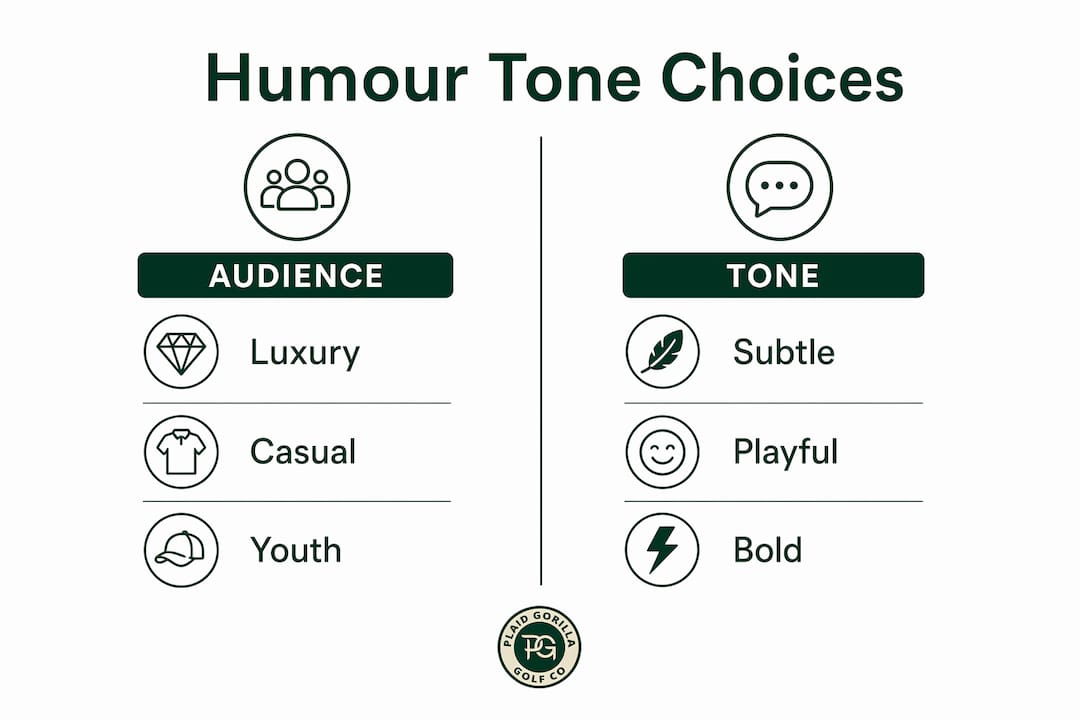
Luxury players favour subtle humour — hidden slogans and discreet motifs that preserve elegance while adding personality. If you are designing for that segment, keep the joke private. For recreational players who want to express personality through golf clothing, bolder placement works well.
Pro Tip: Before a full drop, test tone with a small focus group or at a local pop-up event. Reactions in person tell you far more than an online poll.
What design choices make humorous golf apparel work?
Placement and scale determine whether humour reads as classy, cheeky, or garish. Get those two variables right and almost any motif can work.
- Under-collar message: The most discreet option. Only the wearer and anyone close enough to fix a collar knows it’s there. Ideal for luxury and private-club contexts.
- Hem tag or interior label: A secondary joke that rewards the curious. Works well as a brand signature.
- Chest embroidery (left or right): The classic placement. Small icons — a three-putt tally, a lost-ball counter — read as refined when kept under 5 cm.
- Sleeve trim or cuff text: Visible during the swing, subtle at rest. Good for short phrases.
- Hat embroidery (front panel or side): High visibility, high impact. Works for bold statements and brand marks alike.
- Full-back or all-over print: Maximum impact, maximum risk. Reserve for recreational contexts and scramble events.
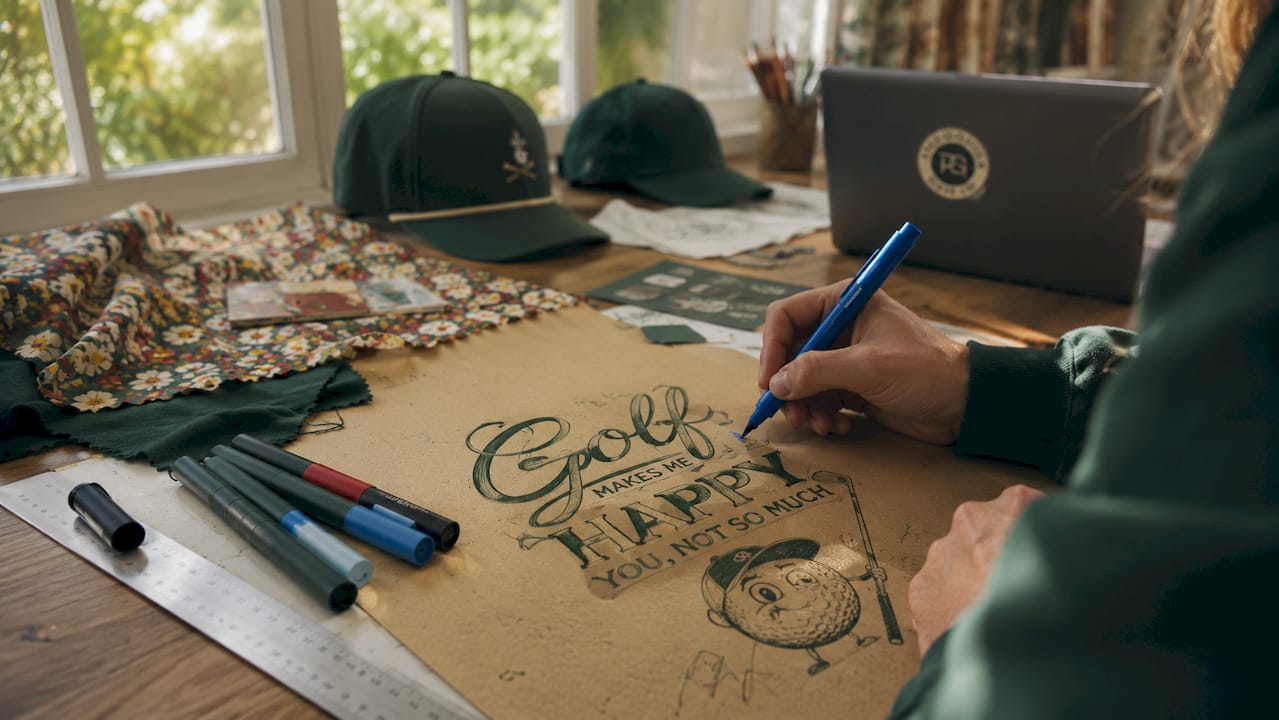
Typography matters as much as placement. Use a single typeface with strong contrast against the base fabric. Avoid condensed fonts on stretch materials — they distort mid-swing. Keep slogans under eight words; anything longer loses legibility at a glance. For colour, golf clothing colour combinations that anchor humorous motifs in classic tones (navy, forest green, cream) keep the overall silhouette grounded even when the joke is bold.
Designers who keep a “humour journal” — a running log of overheard on-course sayings and self-deprecating moments — consistently produce more authentic motifs than those working from generic brief sheets.
Which production method preserves the look and the joke?
Production method affects longevity, tactile quality, and perceived value. Embroidery communicates quality and endures abrasion; prints allow more graphic detail but vary significantly by fabric.
| Method | Best for | Durability | Tactile feel | Minimum order |
|---|---|---|---|---|
| Embroidery | Icons, logos, short text | Excellent | Premium, raised | Low minimum order quantities |
| Screen print | Bold graphics, multi-colour | Good on cotton | Flat, slightly stiff | Medium minimum order quantities |
| Direct-to-garment (DTG) | Complex artwork, photography | Moderate | Soft | Very low minimum order quantities |
| Woven label | Interior branding, hidden jokes | Excellent | Smooth | Low minimum order quantities |
| Silicone patch | Retro badges, dimensional detail | Very good | Tactile, flexible | Medium minimum order quantities |
For Canadian conditions specifically, test every decorated piece through at least 20 wash cycles, a cold-weather flex test (fabrics stiffen below 5°C), and a moisture-wicking check after rain exposure. Salty coastal air in British Columbia and Atlantic Canada accelerates ink degradation on untreated prints. Technical fabrics that combine moisture-wicking and stretch accept embroidery and silicone patches far better than DTG, which can crack on high-stretch panels.
What do Canadian club dress codes allow?
Most Canadian clubs permit tasteful humour, but always confirm specific club policy before a tournament or private event. The general rule: if you would hesitate to wear it to a club dinner, leave it in the bag.
Do:
- Use self-deprecating golf humour (bogey counts, lost-ball references, course frustrations)
- Keep slogans clean and broadly readable
- Opt for discreet placement at formal or private-club events
- Check the club’s written dress code before pitching custom orders to a pro shop
Don’t:
- Use profanity, even softened or abbreviated
- Include political statements or divisive imagery
- Choose all-over prints for stroke-play tournaments
- Assume a scramble dress code applies to a member-guest event
Overt slogans can increase conversation and discovery, but designs that cross etiquette lines risk exclusion from private-course events. When pitching to a pro shop, ask the buyer: “Would this pass your club’s dress code for a Saturday member event?” That single question filters out most problems before production begins.
What do limited-run humorous apparel drops actually cost?
Limited runs with embroidery raise per-unit cost but increase perceived value. Screen printing needs larger minimums to be cost-effective.
For hoodies, expect embroidered limited-edition pieces to land in a moderate per-unit price range at mid-level quantities, depending on stitch count and fabric weight. Screen-printed hoodies at larger quantities typically have a lower per-unit cost. Rope hats with embroidery start at a moderate price point at minimum order quantities.
A typical drop timeline runs: design finalisation (1–2 weeks), digital prototype and approval (1 week), physical sample (2–3 weeks), production run (3–5 weeks), fulfilment and shipping (1–2 weeks). Budget 10–14 weeks from brief to customer delivery for a first run. Repeat orders with approved artwork cut that to 6–8 weeks.
How does Plaidgorillagolf apply these principles?
Plaidgorillagolf deliberately pairs subtle humour with premium materials to preserve a refined silhouette while adding personality. The brand’s approach is the practical version of everything above: limited drops, bold-but-tasteful design, and Canadian DTC distribution.
The Ponderosa Pine Set — Rope Hat and Bogey Enthusiast Hoodie — is the clearest expression of this. The hoodie’s name, “Bogey Enthusiast,” is the joke. It sits on the chest in clean typography against a deep forest green base, self-deprecating enough to earn a laugh, restrained enough to wear off the course. The rope hat carries a complementary embroidered mark. Together, the set signals exactly what golf fashion with humor should signal: you play seriously, you just don’t take yourself that way.
“Golf on your terms. Built for the course. Worn everywhere else.”
— Plaidgorillagolf brand ethos, plaidgorillagolf.ca
The brand reinforces authority through editorial content — design journals and field notes that document the thinking behind each drop. That content strategy mirrors the humour-journal approach recommended above: stay close to real golfer language, test ideas with the community, and let the product reflect genuine on-course experience. Recreational players who want to understand why golf hoodies are trending will find the brand’s editorial content as useful as its product pages.
Designer’s checklist for tasteful, humorous golf apparel
Before releasing any humorous piece, run through this list:
- Audience fit confirmed — does the tone match the buyer’s context (luxury, recreational, gift)?
- Placement chosen — is the humour visible at the right distance and occasion?
- Slogan tested — under eight words, legible at arm’s length, no ambiguous double meanings?
- Fabric compatibility checked — does the decoration method suit the fabric’s stretch and wicking properties?
- Durability tested — 20 wash cycles, cold-flex test, moisture exposure completed?
- Club etiquette reviewed — would this pass a Saturday member-event dress code at a typical Canadian club?
- Packaging and care notes included — does the label reinforce the brand voice (a hidden joke on the care tag earns loyalty)?
Pro Tip: Run an A/B test on a small e-commerce drop: list the same hoodie with two different name variants (one straight, one humorous) and measure click-through and add-to-cart rates. The data tells you exactly how much humour your specific audience wants.
Key takeaways
Tasteful humour in golf apparel works when tone, placement, and production method align with the buyer’s context and the course’s expectations.
| Point | Details |
|---|---|
| Humour as social tool | Funny golf apparel sparks conversation, builds camaraderie, and signals approachability on course. |
| Tone matches audience | Luxury players want hidden slogans; recreational golfers respond to bold, visible humour. |
| Placement drives perception | Under-collar and hem-tag placements read premium; full-back prints suit casual scramble events. |
| Embroidery outlasts print | Embroidery endures Canadian weather and repeated washing better than DTG or screen print on stretch fabrics. |
| Plaidgorillagolf leads by example | The Ponderosa Pine Set pairs the “Bogey Enthusiast” name with premium materials — tasteful humour executed at a Canadian DTC level. |
Why humour belongs at the heart of golf apparel
The conventional wisdom says humour is a risk in golf apparel — that it cheapens the product or alienates serious players. I think that gets it exactly backwards. The golfers who buy premium apparel are not humourless. They are self-aware. They know they bogey more than they birdie, and they would rather wear that truth than pretend otherwise. A piece that acknowledges the gap between aspiration and reality does not undermine the sport. It respects the player enough to be honest with them.
What actually cheapens a product is forced humour: a slogan that tries too hard, a graphic that belongs on a novelty mug, or a joke that only works if you explain it. The design discipline required to make humour feel effortless is the same discipline that makes any premium apparel work. Restraint, placement, and material quality do the heavy lifting. The joke just has to be good enough to earn a second look.
The Ponderosa Pine Set is ready for your next round
The Ponderosa Pine Set from Plaidgorillagolf is the practical proof of this entire guide. The Bogey Enthusiast Hoodie pairs a self-deprecating name with a deep forest green premium build, clean chest typography, and a silhouette that works from the first tee to the coffee shop after. The Rope Hat completes the set with a complementary embroidered mark. Both pieces are limited edition, built in Canada, and designed to be worn everywhere.
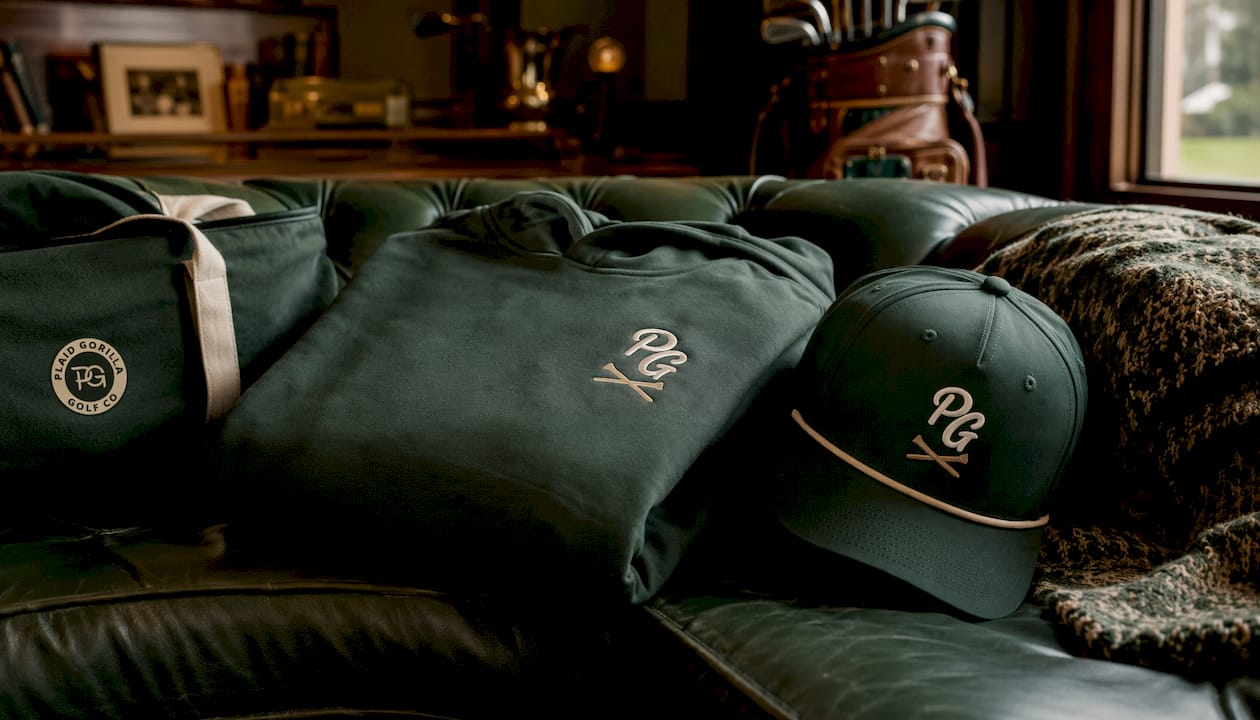
This is golf apparel with a personality. If you want a set that starts conversations and holds up through a Canadian season, shop the Ponderosa Pine Set now at Plaidgorillagolf.
Sources and further reading
- Golf’s ‘emotional frustrations’ inspire this apparel brand — Golf Digest. Supports the social rationale for humour in design and the emotional-frustration-to-motif approach.
- ModGolf LIVE Show with Raymond Bach — Spot Sports. Source for the social-lubricant insight, humour journals, and designer commentary on community-building.
- Adding humour to your game: funny golf clothes for the luxury golfer — MyLuxuryGolf. Covers subtle humour for premium audiences and etiquette limits on overt designs.
- Plaidgorillagolf field notes and product pages — Canadian DTC brand case study, editorial content on golf apparel trends, and the Ponderosa Pine Set product detail.
FAQ
What is the role of humour in golf apparel design?
Humour functions as a social lubricant, a brand differentiator, and a conversation starter. It signals approachability and helps golfers express personality without sacrificing performance.
Where should humorous details be placed on golf apparel?
Placement depends on audience: under-collar messages and hem tags suit luxury contexts, while chest embroidery and sleeve text work for fashion-forward amateurs. Full-back prints are best reserved for casual scramble events.
Does humorous apparel violate Canadian club dress codes?
Most Canadian clubs permit tasteful, self-deprecating humour. Profanity, political content, and all-over prints are typically prohibited at member events and tournaments — always confirm the specific club’s written policy.
Which production method works best for funny golf apparel?
Embroidery is the most durable option for Canadian conditions and reads as premium. DTG and screen print allow more graphic complexity but require fabric-compatibility testing, especially on moisture-wicking stretch materials.
Where can I buy humorous premium golf apparel in Canada?
Plaidgorillagolf offers limited-edition pieces like the Ponderosa Pine Set, which pairs the “Bogey Enthusiast” name with premium materials and tasteful placement — built for Canadian golfers who play seriously but don’t take themselves that way.
Recommended
- Examples of fun golf apparel brands for bold golfers – Plaid Gorilla Golf
- Express personality through golf clothing: your 2026 guide – Plaid Gorilla Golf
- Golf clothing colour combinations: your 2026 style guide – Plaid Gorilla Golf
- The role of pattern in golf fashion: a 2026 guide – Plaid Gorilla Golf