


The single best thing you can do before a long round is build a compact, four-layer system: a moisture-wicking base, a stretch polo as your playing layer, a packable mid layer, and a lightweight waterproof shell. That system keeps you compliant on any Canadian course, adjustable as conditions shift, and comfortable from the first tee to the 18th green.
Quick checklist — copy this before you tee off:
- Moisture-wicking synthetic base layer (skip cotton entirely)
- Stretch polo with a collar (course-compliant, breathable)
- Packable mid layer: quarter-zip or vest
- Lightweight waterproof shell (packable, breathable)
- Belt-looped shorts or trousers
- Spikeless or soft-spike shoes with moisture-wicking socks
- Hat or visor with UPF protection
- Sunglasses with UV400 lenses
- Rotation plan: at least two polos for back-to-back rounds
- Check Environment Canada before you leave home
Table of Contents
- How to stay comfortable while meeting golf course dress codes
- Which fabrics and technical features actually matter over 4+ hours?
- How does layering work for long, changeable Canadian rounds?
- How do shoes, socks, and accessories affect comfort across 18+ holes?
- How should golf clothes fit so they move with your swing?
- What should you pack in your bag for a long Canadian round?
- How do you launder technical golf gear without wrecking it?
- Three Canada-ready outfit builds for long rounds
- How do microclimate variations on Canadian courses change what you wear?
- Key takeaways
- The thing most golfers get wrong about dressing for long rounds
- Plaidgorillagolf gear that works for long rounds
- Useful sources
- FAQ
How to stay comfortable while meeting golf course dress codes
Dress codes are the constraint that shapes every other clothing decision on a long round. Get it wrong and you are turned away at the pro shop before you ever swing a club.
Most Canadian courses, from public municipal tracks to private clubs, expect a collared or collar-style top, tailored shorts or trousers with belt loops, and no gym-style sweatpants or offensive graphics. Private clubs often add restrictions on denim and sleeveless tops for men. Municipal courses tend to be more relaxed, but belt loops on bottoms remain a near-universal requirement. Many courses will refuse entry if your shorts or trousers have a drawstring waist instead of belt loops, so that detail matters more than most golfers realise.
The good news: technical golf apparel is designed to look club-appropriate while performing like athletic wear. A polyester-blend polo with a classic collar satisfies dress codes everywhere. Tailored stretch shorts with belt loops look sharp and move freely through a full swing. You do not need stiff cotton or heavy fabrics to appear course-ready.
Compliance is simple when you choose technical pieces that mimic traditional silhouettes. A collared performance polo, stretch trousers or shorts with belt loops, and a removable outer layer cover the dress code at virtually every Canadian course without sacrificing comfort over four-plus hours.
Practical compliance swaps for long rounds:
- Replace cotton polos with polyester-blend stretch polos that wick moisture and hold their collar shape
- Choose shorts or trousers with a stretch waistband and dedicated belt loops
- Opt for sleeveless collared tops (widely accepted for women) paired with compliant bottoms for maximum airflow
- Keep your outer shell packable so you can remove it cleanly in the clubhouse
- For tournament play, check the specific event’s dress code in advance; some restrict hoodies or require tucked shirts
Pro Tip: Wear your full outfit, including belt and shoes, before your first round in new gear. A polo that fits perfectly on a hanger can pull across the shoulders mid-backswing. Catch that at home, not on the first tee.
Which fabrics and technical features actually matter over 4+ hours?
Fabric choice is the single biggest factor in whether you finish a long round feeling good or feeling wrecked. Cotton fails on every front for multi-hour play: it absorbs sweat, stays heavy when wet, and changes how it feels thermally as it soaks through. Synthetic blends with elastane are the standard for a reason.
The features worth paying for
Moisture wicking pulls sweat away from your skin and moves it to the fabric surface where it evaporates. Look for branded treatments like Nike Dri-FIT or FootJoy ProDry — these are verified, not marketing language. 4-way stretch (elastane or spandex blended into the fabric) lets the garment move with your swing rather than against it. UPF/UV protection matters on exposed Canadian courses, particularly during peak sun hours between 10 AM and 4 PM. DWR (Durable Water Repellent) finish on outer layers causes light rain to bead off rather than soak in.
Fabric comparison by layer
| Fabric family | Best layer | Key features | Watch out for |
|---|---|---|---|
| Polyester blend + elastane | Base / playing layer | Wicking, stretch, UV resistance | Pilling after 20+ washes |
| Nylon + elastane | Base / bottoms | Durability, soft hand, quick-dry | Slightly heavier than polyester |
| Technical knit (polyester) | Mid layer | Breathability, stretch, packability | Less insulation than fleece |
| Softshell (polyester + DWR) | Outer shell | Wind resistance, light rain protection | Not fully waterproof |
| Waterproof membrane (e.g. Gore-Tex style) | Outer shell | Full waterproofing, breathability | Can restrict swing if cut poorly |
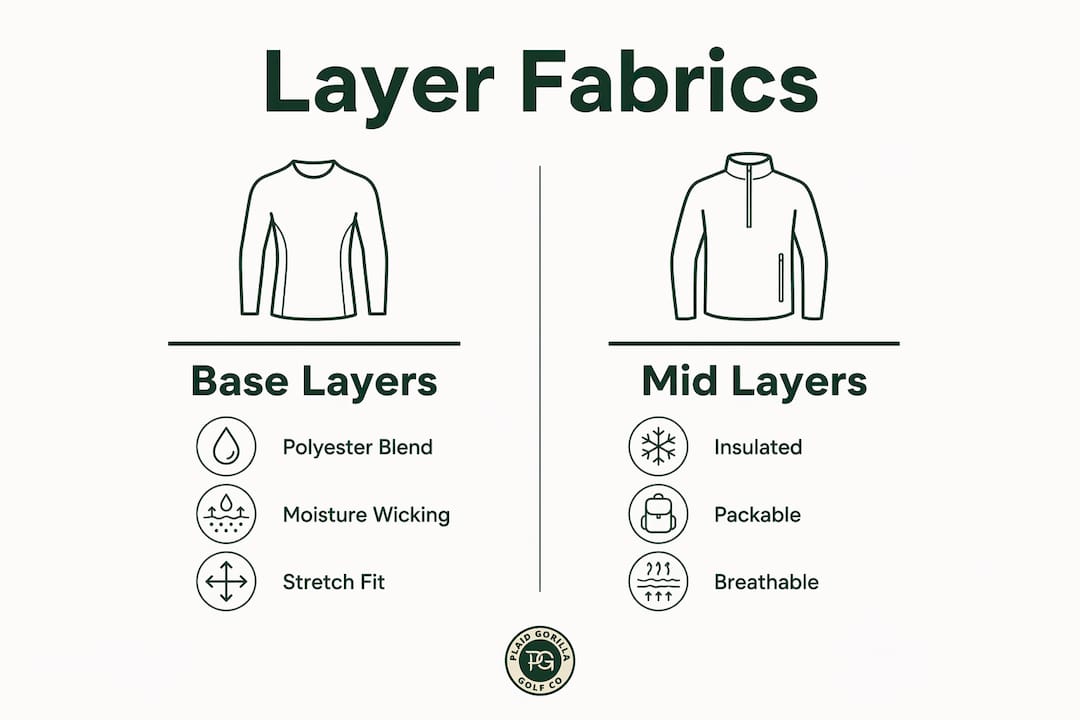
Polyester blends with 4-way stretch maintain moisture management and shape across multi-hour play, which is why they dominate the playing-layer category. For the base layer under a mid or outer piece, nylon-elastane blends like 92% nylon / 8% elastane offer a softer feel and strong durability. For high-performance fabric details, the technical fabric guide at Plaidgorillagolf breaks down treatments and construction in more depth.
Quick fabric checklist:
- Playing layer: polyester or polyester-blend with wicking treatment and 4-way stretch
- Base layer (under mid/outer): nylon-elastane or lightweight polyester-elastane
- Mid layer: technical knit or lightweight fleece with stretch
- Outer shell: DWR-treated softshell for light rain; waterproof-breathable membrane for heavy rain
- Avoid cotton in any layer during multi-hour play
How does layering work for long, changeable Canadian rounds?
The compact system has four components. You will not always wear all four, but you should always have them accessible.
- Base layer — moisture management. Lightweight synthetic or nylon-elastane. Worn under your polo on cold mornings; optional in summer heat.
- Playing layer — your polo or collar-style top. This is the layer you are in for most of the round.
- Mid layer — insulation and wind resistance. A vest or quarter-zip in technical knit or lightweight fleece. Layering with a stretch mid layer preserves swing mobility better than a bulky jacket.
- Outer shell — wind and rain protection. Packable, breathable, and DWR-treated at minimum; fully waterproof for serious rain.
Seasonal tweaks
Summer (June–August): Drop the base layer unless mornings are cool. Prioritise a UPF-rated polo, ventilated shorts, and keep a packable shell in your bag for afternoon thunderstorms. Carry an extra polo for back-to-back days.
Spring and fall (April–May, September–October): This is where the full four-layer system earns its keep. Start with a base layer and mid layer; shed them as the round warms. A windproof shell matters more than a waterproof one on dry but breezy days.

Cold months (November–March on milder Canadian courses): Add a thermal base layer, an insulated mid layer, and a fully waterproof outer. Thermal bottoms under stretch trousers keep legs warm without restricting movement.
Rainy days: Waterproof, breathable rain gear keeps you dry without overheating. Pair a waterproof shell with waterproof overtrousers. Lined rain gear adds warmth on cold drizzle days.
Pro Tip: The classic Canadian scenario: you tee off at 7 AM in 10°C with a light frost, and by hole 12 it is 22°C and sunny. Start with all four layers. Stuff the mid layer into your bag pocket at hole 5, the shell at hole 9. You will be glad you packed both.
Scenario checklist — early chill turning into a hot afternoon:
- Tee off: base layer + polo + vest + shell
- Hole 4–5: remove shell, stow in bag pocket
- Hole 8–9: remove vest, stow
- Hole 12+: polo only, shell back on if afternoon storm rolls in
How do shoes, socks, and accessories affect comfort across 18+ holes?
Foot fatigue and blisters are the most common regret after long walking rounds. Treat footwear selection as seriously as your shirt choice — the wrong shoes will end your round mentally before the scorecard does.
Footwear priorities:
- Choose spikeless or soft-spike shoes for cushioning and walking comfort over 18+ holes
- Prioritise a roomy toe box and firm heel counter to prevent blisters on long walks
- Rotate between two pairs of golf shoes across back-to-back rounds to let each pair dry and recover its cushioning
- Waterproof uppers matter on dewy morning rounds and wet fairways
Socks: Moisture-wicking synthetic or merino wool socks reduce friction and blister risk. Choose a cushioned sole for walking rounds; thin socks work for riding. Crew height keeps debris out better than ankle socks on longer grass.
Accessories that earn their place:
- Golf glove: prevents blisters on the grip hand and improves control in humid conditions
- Hat or visor with UPF protection: reduces sun fatigue on exposed courses
- UV400 sunglasses: protect eyes and reduce squinting fatigue over a four-hour round
- Lightweight waterproof hat: a packable option for sudden showers without the bulk of a full hood
- Small microfibre towel: clip to your bag for wiping hands and grips between shots
Pro Tip: Pack a second pair of socks in your bag. Wet socks from morning dew or a surprise shower are the fastest route to blisters. A dry change at the turn costs nothing and saves the back nine.
How should golf clothes fit so they move with your swing?
Fit is where comfort and performance meet. A shirt that looks great on the rack can bind across your shoulders at the top of your backswing, and trousers that feel fine standing up can pull at the waist when you reach for a ball.
Fit rules for long rounds:
- Shoulders: seams should sit at the edge of your shoulder, not pulled inward
- Chest and back: no binding at full swing extension; fabric should give, not stretch to its limit
- Sleeves: short sleeves should not restrict your bicep at the top of the backswing
- Waist: trousers and shorts should stay put while walking without needing constant adjustment
- Hips: bottoms should allow a full hip turn without pulling down at the back
In-store or at-home fit checklist:
- Raise both arms overhead: no shirt untucking or pulling across the back
- Simulate your takeaway: rotate your torso fully; the shirt should move with you
- Sit down and stand up: trousers should not gap at the waist or bind at the thigh
- Walk ten steps: nothing should slide, bunch, or rub
Pro Tip: Always try a short practice swing wearing the complete outfit, including shoes, belt, and base layer. Each layer adds a small amount of restriction. Testing them separately misses how they interact. A polo that passes the arm-raise test alone can still bind when layered over a base layer.
For more on choosing golf clothing that moves with you, the golf clothing selection guide at Plaidgorillagolf covers fit and style together.
What should you pack in your bag for a long Canadian round?
Pack light, pack smart. The goal is to carry only what you will actually use and be able to reach it between holes without unpacking your entire bag.
Copyable bag checklist:
- Two technical polos (one to change into at the turn if needed)
- Lightweight mid layer: vest or quarter-zip
- Packable waterproof shell
- Waterproof overtrousers (if rain is in the forecast)
- Spare pair of moisture-wicking socks
- Small microfibre towel
- Sunscreen (SPF 30+ minimum)
- Hat with UPF protection
- Small blister kit: moleskin, bandages, anti-chafe balm
- Insulated water bottle and a snack
Bag organisation tips:
- Keep your shell in the outermost, easiest-reach pocket so you can grab it fast when a shower hits
- Use a mesh pouch for damp items (wet socks, a used towel) to keep them separate from dry gear
- Walkers: prioritise compressible, lightweight pieces; every gram adds up over 18 holes
- Riders: you have more bag space, but resist the urge to overpack — you still carry items between cart and ball
A rotation of several technical polos is the practical standard for weekly play. Wearing the same shirt back-to-back without washing degrades wicking performance faster and shortens garment life.
How do you launder technical golf gear without wrecking it?
Technical fabrics need simple, consistent care. The wrong detergent or a hot dryer cycle can strip DWR finish and flatten the wicking treatment in a single wash.
Dos and don’ts:
- Wash in cool water on a gentle cycle
- Use a mild detergent designed for technical or athletic gear
- Never use fabric softener: it coats fibres and reduces DWR effectiveness
- Air dry when possible; tumble dry on low only when the garment label allows
- Turn garments inside out before washing to protect surface treatments
Restoring DWR finish (step by step):
- Wash the garment as normal with no fabric softener
- Test: sprinkle water on the outer shell. If it beads, DWR is intact. If it soaks in, proceed.
- Tumble dry on low heat for 20 minutes — heat reactivates DWR in many factory-applied treatments
- If beading still does not return, apply a spray-on DWR product (available at most Canadian outdoor retailers) and follow the product instructions
- Retest with water before storing
Off-season storage:
- Clean and dry every garment fully before storing; residual sweat or moisture degrades fibres
- Fold rather than hang heavy fleece or insulated pieces to prevent stretch distortion
- Avoid compressing garments in vacuum bags for extended periods; this damages elastane
- Inspect seams and DWR early in the season so you have time to repair or retreat before the first round
Three Canada-ready outfit builds for long rounds
These three combinations follow the layering system and use pieces available in Canada, including Plaidgorillagolf options where they fit naturally.
Summer walker (warm, sunny, 25°C+)
- Playing layer: Lightweight polyester-blend stretch polo with UPF 30+ rating
- Bottoms: Stretch shorts with belt loops
- Outer: Packable shell in bag only (for afternoon storms)
- Shoes: Spikeless golf shoes with breathable mesh upper
- Accessories: UPF hat, UV400 sunglasses, golf glove
Why it works: minimal layers keep you cool and mobile. The UPF polo handles sun exposure without sunscreen on covered skin. The shell stays packed until you need it.
Transitional long round (spring or fall, 10°C–18°C)
- Base layer: Lightweight synthetic long-sleeve base
- Playing layer: Stretch polo over the base
- Mid layer: Bogey Enthusiast Hoodie in Pine worn as an insulating mid layer over the polo; the deep forest green colourway reads as course-appropriate and pairs cleanly with neutral bottoms
- Bottoms: Stretch trousers with belt loops
- Outer: Packable windproof shell
- Shoes: Waterproof soft-spike shoes
The Bogey Enthusiast Hoodie works here as a mid layer because it is warm enough for cool mornings and packable enough to stow when the afternoon warms up. Pair it over a technical polo, not a cotton tee, to keep moisture management working underneath.
Cold and wet round (November or early spring, under 10°C with rain)
- Base layer: Thermal synthetic base, top and bottom
- Playing layer: Stretch polo
- Mid layer: Bogey Kit hoodie (Country Club Hat included) for insulation and head coverage
- Outer: Fully waterproof, breathable shell + waterproof overtrousers
- Shoes: Waterproof soft-spike shoes with cushioned insole
- Accessories: Waterproof packable hat, golf glove
Pro Tip: For women, sleeveless collared tops and performance dresses with detached inner shorts are widely accepted on Canadian courses and deliver excellent airflow in warm conditions. The detached-shorts design avoids the restroom-access issue that built-in liners create on long rounds.
Building a golf wardrobe with purpose means choosing pieces that work across multiple conditions, not just one.
How do microclimate variations on Canadian courses change what you wear?
Canadian courses are not uniform environments. A course in the Fraser Valley sits in a rain shadow that can mean dry conditions while Vancouver gets soaked. An Alberta parkland course at 1,000 metres elevation runs 5°C–8°C cooler than the city it sits near. A course along Lake Ontario generates its own wind patterns that can make a calm morning brutal by hole 14.
The practical implication: always check Environment Canada’s hourly forecast for the specific region, not just the city. Wind speed and direction, humidity, and the probability of afternoon convective storms all change what you carry. A 30% chance of rain in the forecast is enough to justify packing overtrousers on a walking round.
Coastal British Columbia courses tend toward cool, damp mornings that warm quickly. Your layering system earns its keep here: start with a mid layer and shell, shed both by hole 8. Prairie courses in Alberta and Saskatchewan swing from frost at dawn to 28°C by early afternoon in June. The four-layer system is not optional on those days. Ontario and Quebec courses in late spring and early fall can deliver humidity that makes a 20°C day feel oppressive — moisture-wicking fabric is not a luxury in those conditions, it is the difference between finishing strong and wilting at hole 15.
One practical habit: check the forecast the night before and again the morning of your round. Conditions on Canadian courses can shift faster than a national forecast captures. The all-day wearable gear guide at Plaidgorillagolf covers extended-session planning in more detail.
Key takeaways
A compact, dress-code-compliant layering system built from stretch, moisture-wicking base layers, a packable mid layer, and a packable outer shell is the most reliable way to stay comfortable across a long Canadian round in variable conditions.
| Point | Details |
|---|---|
| Skip cotton entirely | Synthetic base layers wick and dry faster; cotton soaks and stays heavy through multi-hour play. |
| Belt loops are non-negotiable | Many Canadian courses refuse entry without them; choose compliant bottoms before you buy. |
| Pack a 3–4 polo rotation | Rotating 3–4 technical polos preserves wicking performance and extends garment life for frequent play. |
| Test fit in the full outfit | Try a practice swing wearing shoes, belt, and base layer together before committing to any garment. |
| Plaidgorillagolf mid-layer option | The Bogey Enthusiast Hoodie pairs over a technical polo as a warm, packable mid layer for cool Canadian rounds. |
The thing most golfers get wrong about dressing for long rounds
Most golfers overthink the style side and underthink the fabric side. They will spend twenty minutes picking a colour and thirty seconds checking whether the shirt actually wicks. That is backwards.
The real mistake I see repeatedly is cotton. Not just cotton polos — cotton base layers, cotton undershirts worn under a polo “for comfort.” Cotton feels fine for the first four holes. By hole 10 on a humid Ontario morning, it is a wet, heavy second skin that changes how you feel thermally and mechanically. The fix is simple: synthetic base layers are not expensive, they are widely available at Canadian outdoor and sporting goods retailers, and they make a measurable difference over a four-hour walk.
The second mistake is treating the layering system as optional. Golfers who skip the mid layer because it is “probably fine” are the ones stuffing a soaking wet shell back into their bag at hole 7 because they had nothing to transition to. The system is not about carrying more. It is about carrying the right three or four pieces so you can adjust without stopping play.
Where Plaidgorillagolf fits into this is straightforward. The Bogey Enthusiast Hoodie is not a performance shell. It is a bold, well-made mid layer that pairs over a technical polo and keeps you warm through the cool part of a round without looking like you raided a gym bag. That combination of comfort and expression, without compromising the technical layer underneath, is exactly the kind of practical-meets-personality approach that makes long rounds worth showing up for.
Plaidgorillagolf gear that works for long rounds
Long rounds in Canada demand pieces that pull double duty: they need to perform through four-plus hours of walking and weather, and they need to look like you belong on the course.

Plaidgorillagolf’s Bogey Enthusiast Hoodie in Pine is built for exactly this role. Wear it as your mid layer over a moisture-wicking polo on cool spring and fall mornings, then pack it into your bag when the round warms up. The deep forest green colourway is course-appropriate and pairs cleanly with neutral stretch trousers or shorts. For a complete kit, the Bogey Kit bundles the hoodie with the Country Club Hat, giving you sun protection and insulation in one purchase.
One practical note: the hoodie is a mid layer, not a waterproof shell. Always pair it with a technical base layer underneath for moisture management, and carry a packable waterproof shell on top when rain is in the forecast. Most clubs allow hoodies on the course; remove it in the clubhouse if the dress code requires it.
Browse the full range and check current availability at plaidgorillagolf.ca.
Useful sources
- Golf Canada (golfcanada.ca): Canada’s national golf governing body. Check here for course etiquette standards, dress-code guidance, and rules of play applicable to Canadian courses.
- Environment Canada (weather.gc.ca): The authoritative source for regional hourly forecasts. Use the hourly view for the specific course location, not just the nearest city, to plan your layering choices the night before and morning of your round.
- Plaidgorillagolf (plaidgorillagolf.ca): Product pages for the Bogey Enthusiast Hoodie, Bogey Kit, and other Canada-available apparel, plus the Field Notes blog for extended guides on fabric, fit, and wardrobe building.
FAQ
What should I wear for a round of golf in Canada?
Wear a collared, moisture-wicking polyester-blend polo, stretch shorts or trousers with belt loops, and spikeless or soft-spike shoes. Add a packable mid layer and waterproof shell to handle Canada’s variable conditions across a long round.
How do you dress comfortably for a long golf round?
Build a compact layering system: a synthetic base layer for moisture management, a stretch polo as your playing layer, a packable vest or quarter-zip mid layer, and a lightweight waterproof shell. Check Environment Canada before you leave and adjust layers as conditions change during the round.
What is the 70/30 rule in golf?
The 70/30 rule is a course management concept, not a clothing guideline. It refers to playing to the safer part of the green or fairway to maximize margin for error, rather than always aiming directly at the flag.
How do I look good while staying comfortable on the course?
Choose technical pieces that mimic traditional golf silhouettes: a collared performance polo, tailored stretch bottoms with belt loops, and a well-fitted mid layer. Plaidgorillagolf’s Bogey Enthusiast Hoodie pairs over a technical polo for a bold, course-appropriate look without sacrificing mobility.
Does cotton work for long golf rounds?
Cotton is a poor choice for multi-hour play. It absorbs sweat, stays heavy when wet, and loses its thermal properties as it soaks through. Synthetic blends with elastane wick moisture, dry faster, and maintain stretch through a full round.