


The charts in this article list average carry distances by club and by skill tier, and carry is the number you should use when selecting clubs on the course, not total distance. Carry. How far the ball flies before it first touches the ground is what clears hazards, holds greens, and keeps you out of trouble.
Here’s a quick snapshot before the full chart:
- Driver (men, mid-handicap): typical carry range
- 7-iron (men, mid-handicap): typical carry range
- Pitching wedge (men, mid-handicap): typical carry range
Published averages are useful benchmarks, but your personal numbers will differ. Testing your own carry distances with a launch monitor or shot-tracking app is the only way to build a yardage chart you can actually trust on the course. The average carry distances compiled from Shot Scope, TrackMan, and Arccos are a solid starting point. That’s all they are.
Key takeaways
Carry distance is the only reliable metric for club selection, and your personal carry chart, built from averaged real shots, will always outperform published averages for on-course decisions.
| Point | Details |
|---|---|
| Use carry, not total distance | Carry clears hazards and holds greens; total distance includes rollout that can mislead you. |
| Match your skill tier | Pick the handicap or swing-speed column closest to your average, not your best round. |
| Target 10–12 yard gaps between irons | Consistent yardage separation across your bag reduces guesswork on every approach shot. |
| Test with 8–10 shots per club | Average the clean strikes, discard mishits, and retest at the start of each Canadian season. |
| Get a fitting if gaps are off | A one-hour launch-monitor fitting identifies gap problems faster than months of range guessing. |
Table of Contents
- What are the average club distances by skill level?
- Why carry distance matters more than total distance
- Why your distances differ from the averages
- What are the ideal distance gaps between clubs?
- How do you measure your own carry distances accurately?
- How do you use carry distances to make better decisions on the course?
- How do Canadian conditions affect your carry distances?
- How was this carry-distance chart compiled?
- A straight take on what these numbers actually mean
- Dress for the range, play with confidence
- Sources
- FAQ
What are the average club distances by skill level?
All figures below are carry distances in yards, rounded for readability. Use the column closest to your handicap or swing speed. Numbers are drawn from aggregated data across Shot Scope, TrackMan, and Arccos datasets.
Men’s average carry distances by handicap tier
| Gap wedge | typical carry by skill tier | | | | Sand wedge | typical carry by skill tier | | | | Lob wedge | typical carry by skill tier | | |
Women’s average carry distances by swing-speed tier
| Sand wedge | typical carry ranges | | | | Lob wedge | typical carry ranges | | |
A few things to keep in mind:
- Ranges within any single tier are wide. A 15-handicapper’s driver carry can span 180–230 yards depending on swing speed, ball, and contact quality.
- The 7-iron and pitching wedge show some of the largest standard deviations in amateur data, often 20+ yards between a player’s best and average strike.
- Pick the column that matches your average carry, not your best shot. That’s the number that matters on the course.
Pro Tip: If you’re between two columns, default to the shorter one for approach shots. Missing long is almost always less punishing than coming up short into a hazard.
Why carry distance matters more than total distance
Carry is how far the ball flies before first contact with the ground. Total distance adds rollout on top of that. The difference sounds simple, but it causes real problems when golfers use the wrong number.
Say you’re 150 yards from the pin, with a pond sitting 140 yards out. You know your 7-iron “goes 155 yards.” But if that 155 is total distance and your carry is only 143, you’re wet. Carry is the essential metric for approach shots because rollout is unpredictable and irrelevant when something is in the way.
Use carry exclusively when:
- Flying over water, bunkers, or any other hazard
- The pin is on the front third of the green
- The green is elevated or firm and fast
- You’re hitting into a headwind (rollout shrinks anyway)
Total distance is acceptable when:
- You’re laying up to a specific yardage on an open fairway
- The landing area is flat and receptive with no hazards short
- You’re hitting a bump-and-run on a firm links-style course
The practical habit is this: build your yardage chart in carry, then add a mental rollout buffer only when conditions and the landing zone genuinely allow it. Most amateur golfers do it backwards, and that’s why so many approach shots come up short.
Pro Tip: When you’re unsure whether to use carry or total, always plan to carry the obstacle plus a margin. A ball that flies 5 yards past a bunker is recoverable. One that lands in it isn’t.
Why your distances differ from the averages
The averages in this chart are benchmarks, not predictions. Several factors push your personal carry numbers above or below them, and knowing which ones apply to you is more useful than memorising the table.
The main causes of distance variation:
- Club loft: Modern irons are often 2–4 degrees stronger in loft than clubs from 15 years ago. A “7-iron” today may play like a 5-iron used to. This compresses gaps and inflates perceived distance.
- Shaft flex and length: A shaft that’s too stiff for your swing speed reduces launch and spin, costing carry. Too flexible, and you lose control of the face at impact.
- Swing speed: The single biggest driver of distance. A 10 mph increase in driver swing speed typically adds 20–25 yards of carry.
- Smash factor: TrackMan defines smash factor as ball speed divided by club speed. An ideal driver smash factor is around 1.50. A smash factor of 1.45 versus 1.50 at the same swing speed can cost you 10–15 yards of carry. Improving strike quality alone, without swinging harder, can produce the same distance gains as adding club speed.
- Strike location: Off-centre hits on the face reduce ball speed and add unwanted spin. A heel or toe strike on a 7-iron can shrink carry by 10–20 yards compared to a centred strike.
- Ball model: A premium urethane-cover ball generally carries further than a two-piece surlyn ball at the same swing speed, particularly with irons and wedges.
- Temperature: Cold air is denser. Carry drops in cold conditions, a real factor across most Canadian seasons.
- Wind and altitude: A headwind reduces carry; a tailwind adds it. Higher-altitude courses produce longer carry due to thinner air.
A controlled study on driver loft with 15 participants found no statistically significant difference in carry between loft settings, but did find meaningful differences in total distance, spin rate, and descent angle. Lower loft produced higher total distance through reduced spin and a shallower landing angle. The takeaway: loft affects the shape of your shot more than raw carry, but it compounds with swing speed and strike quality in ways that matter.
For a quick reference on launch-monitor terms like smash factor, ball speed, and spin rate, the golf acronyms guide from Plaid Gorilla Golf breaks them down clearly.
What are the ideal distance gaps between clubs?
Consistent yardage gaps across your bag are more important than hitting any single club far. A gap of roughly 10–12 yards between irons is the common target for mid-to-low handicappers. Wider gaps between woods and hybrids are normal and expected.
Healthy gap targets:
| Transition | Target gap |
|---|---|
| Driver to 3-wood | 25 yards |
| 3-wood to 5-wood or hybrid | 15–20 yards |
| Long iron to mid-iron (e.g., 5 to 6) | 10–15 yards |
| Mid-iron to short iron (e.g., 7 to 8) | 8–12 yards |
| Short iron to wedges (e.g., — to PW) | 8–12 yards |
| Wedge-to-wedge gaps (PW, GW, SW, LW) | 10–15 yards |
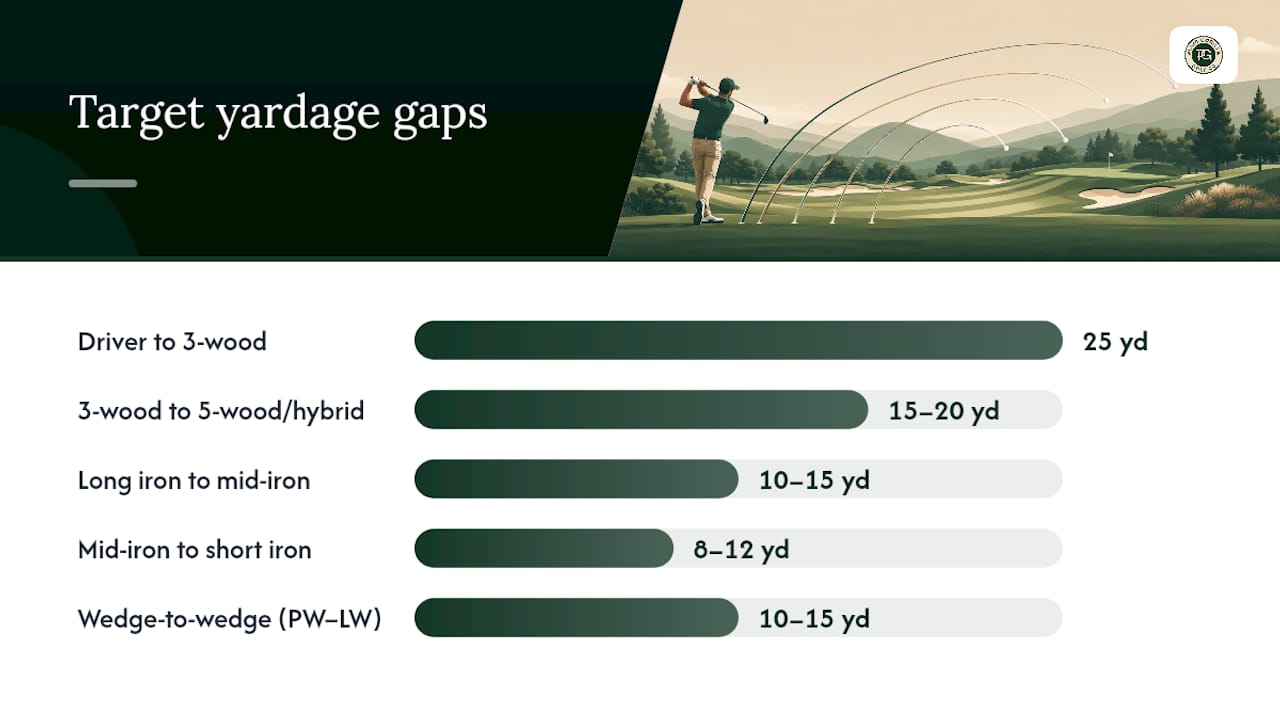
Wedge gaps are where most amateurs leave the most strokes. A 30-yard gap between a pitching wedge and a sand wedge means you’re guessing on a lot of approach shots. Tour players typically carry four wedges with 10–12 yard separations between each.
When gaps are off, here’s what to check:
- Long irons vs. hybrids: If your 4-iron and 5-iron carry the same distance, swap the 4-iron for a hybrid. Hybrids launch higher and are easier to hit consistently, which restores the gap naturally.
- Wedge lofts: Many off-the-shelf sets leave a 6–8 degree loft gap between the pitching wedge and sand wedge. Adding a gap wedge (50–52 degrees) fixes this cleanly.
- Shaft flex: A shaft that doesn’t match your swing speed creates inconsistent gaps across the set, not just one club. This is the most common hidden culprit.
- Lie angle: A flat lie angle on irons pushes shots right and can reduce effective carry. A fitter can check this in minutes.
Modern loft compression on irons, where manufacturers strengthen lofts to make numbers look impressive, can collapse the gap between long irons and fairway woods. Understanding how set design affects distance gaps is worth your time if you’ve noticed your 5-iron and 3-wood are closer than they should be.
If gaps are inconsistent across three or more clubs, see a professional fitter. A one-hour fitting session with a launch monitor will identify the problem faster than months of guessing on the range.
How do you measure your own carry distances accurately?
Published averages are a starting point. Your personal carry chart, built from real data, is what you actually use on the course. Golf Monthly recommends using averaged carry yardages and excluding extreme mishits, because most golfers base their club choice on their best shot, not their average. That’s a reliable way to miss greens short.
Here’s a protocol that works:
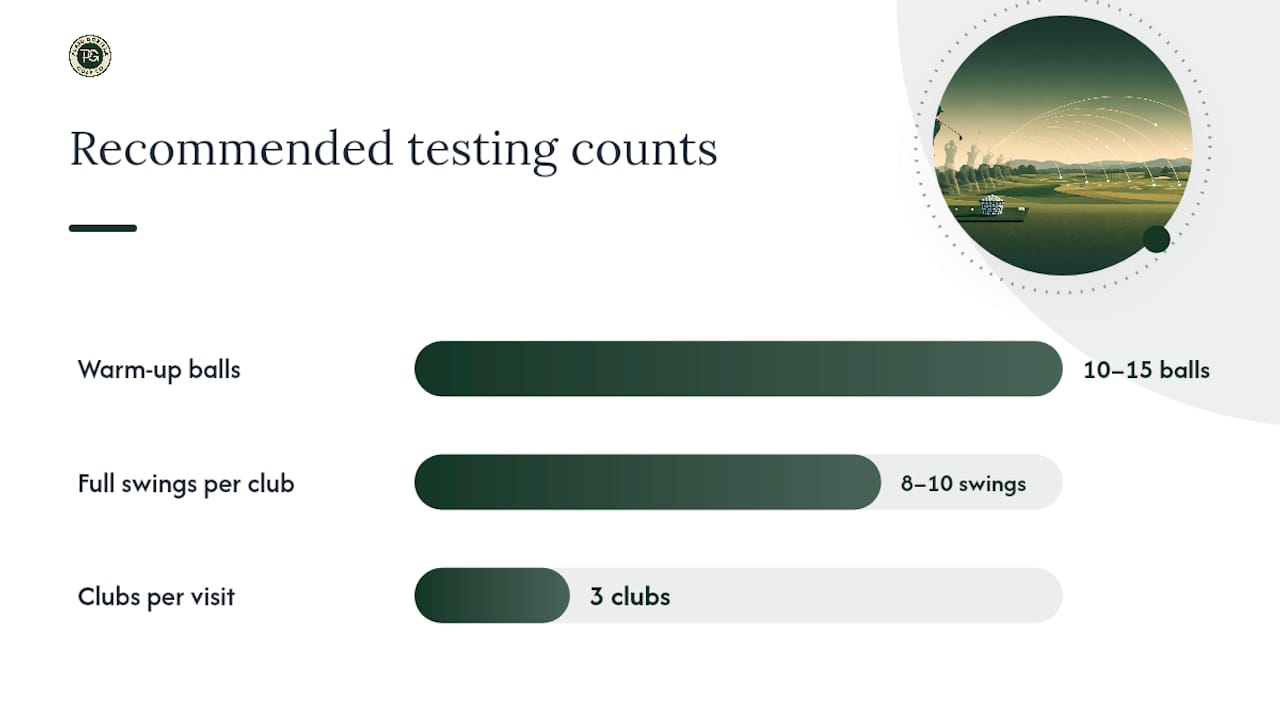
- Warm up properly. Hit 10–15 balls before you start measuring. Cold muscles produce shorter, less consistent shots that will skew your averages low.
- Use one ball model. Switching between a range ball and your course ball mid-session introduces a variable you can’t control. Range balls typically fly 5–10 yards shorter than premium balls.
- Set a consistent tee height for driver. For irons, hit off a mat or tight lie, not a fluffy range turf that inflates contact.
- Hit 8–10 full swings per club. This is enough to get a meaningful average without fatigue distorting the later shots.
- Discard obvious outliers. Remove tops, shanks, and any shot you knew was a mishit at impact. Keep the rest.
- Average the remaining shots. That number is your stock carry for that club.
- Record carry and total separately. A launch monitor gives you both. If you’re using a rangefinder and a measuring wheel on the range, mark the first bounce, not the final resting spot.
- Retest seasonally. Your distances in April after a winter off will differ from your August peak. A quick 3-club check at the start of each season keeps your chart current.
Tool options:
- TrackMan or FlightScope: The gold standard for accuracy. Available at most fitting centres and many golf academies across Canada.
- Shot Scope or Arccos: GPS shot-tracking systems that build your carry averages automatically over multiple rounds. Arccos uses sensors in your grips; Shot Scope uses a watch and tagged clubs. Both give you real on-course data, which is more relevant than range data for most players.
- Garmin Approach R10: A portable launch monitor that retails for a fraction of TrackMan’s price and delivers reliable carry, ball speed, and spin data for home or range use.
- Rangefinder and measuring wheel: Low-tech but workable on a quiet range. Mark your first bounce with a tee, pace it out, and log the number.
Launch monitors are the most accurate method for measuring carry distances, reporting carry, ball speed, launch angle, and spin rate simultaneously. A professional fitting session gives you all of this in one hour, plus a fitter’s interpretation of what the numbers mean for your set.
Pro Tip: Don’t test every club in one session. Pick three clubs per range visit, rotate through the bag over a few weeks, and your data will be more reliable than a single marathon session where fatigue sets in by the 8-iron.
How do you use carry distances to make better decisions on the course?
Numbers on a chart only help if you apply them correctly under pressure. A few simple heuristics make this easier.
Core decision rules:
- Always plan to carry the obstacle, not reach the target. If there’s water 140 yards out and the pin is 155, your job is to carry 140 plus a margin, not to hit 155. Pick the club that gives you 145–150 yards of carry comfortably.
- Favour the longer club when in doubt over hazards. A ball that flies 5 yards past a bunker is fine. One that lands in it costs you a stroke.
- Use back-of-green yardages for conservative play. When the pin is front and you’re between clubs, aim for the middle or back of the green. A two-putt bogey beats a chip from a hazard.
- Plan for your average, not your best. If your 7-iron averages 128 yards carry but you’ve hit it 145 once, use 128 for your decision.
Adjustments to make on the fly:
- Temperature: In cold conditions (below 10°C), subtract roughly 1 yard of carry per degree below your baseline testing temperature. Canadian spring and fall rounds often play 10–15 yards shorter than summer.
- Wind: A full headwind at 15 mph can reduce carry by 10–15 yards on a mid-iron. A tailwind adds roughly half that amount. Club up into the wind, club down with it.
- Uphill/downhill: Add roughly 1 yard of effective distance per foot of elevation gain, subtract for elevation loss. A green that sits 20 feet above you plays about 5–7 yards longer.
- Firm fairways: On dry, firm turf, rollout increases. This matters for layups and tee shots, less so for approaches where you’re using carry anyway.
The 70/30 rule is a useful mental model for approach shots. In practice, it means you commit to the carry first, then let the swing happen. Two examples:
- Par-3, 155 yards, pond short of the green: Carry needed is 148 yards. Your 6-iron averages 137 carry, your 5-iron averages 145. Take the 5-iron and swing with confidence. The 70% focus is clearing 148 yards.
- Par-4 layup, 210 yards to the green, bunker at 165: Carry needed past the bunker is 168 yards. Your 5-wood averages 170 carry. Lay up with the 5-wood, land past the bunker, leave a comfortable wedge in.
How do Canadian conditions affect your carry distances?
Canada’s climate creates real distance variation across the season, and ignoring it means your summer yardage chart is wrong by October. A few factors are specific enough to be worth calling out.
Seasonal and environmental factors:
- Cold air: Denser air in cold temperatures reduces carry. This is the biggest seasonal variable for Canadian golfers. A round in early May or late September can play 10–20 yards shorter than the same course in July, depending on temperature.
- Dry, firm fairways: Mid-summer on many Prairie and Ontario courses produces firm turf that adds significant rollout. Your total distance increases, but your carry stays the same. Don’t confuse the two.
- Altitude: Courses in the BC interior, Alberta foothills, or anywhere above 1,000 metres carry further due to thinner air. If you’re visiting Banff or Kelowna from a sea-level home course, expect 5–10 yards of extra carry on longer clubs.
- Indoor simulators: Simulator numbers can overstate roll and sometimes understate carry under cool outdoor conditions. Always validate a few clubs outdoors before trusting a simulator-built yardage chart for real course decisions.
Simple adjustments:
- In temperatures below 10°C, club up one full club on approach shots as a starting rule, then refine based on your own testing.
- On firm summer fairways, use carry for all approach decisions and ignore the extra rollout.
- At altitude, be conservative with your first few holes until you’ve seen how the ball is actually flying.
Dressing for the conditions also matters more than most golfers admit. Bulky layers restrict your swing and reduce carry. A layering guide for Canadian golf rounds covers how to stay warm without sacrificing swing freedom, which is directly relevant when you’re trying to hit your stock distances in April.
Pro Tip: Do a quick 3-club test at the start of each new season — driver, 7-iron, and pitching wedge. If your numbers are off from your summer chart, adjust everything proportionally rather than re-testing the whole bag.
How was this carry-distance chart compiled?
The charts in this article are benchmarks built from published aggregated datasets, not original primary research. Here’s what went into them and where the limitations sit.
Primary data sources:
- TrackMan: Industry-standard launch monitor used in professional fitting and tour settings. TrackMan’s published averages and smash-factor guidance informed the distance ranges and the skill-tier structure used here.
- Shot Scope: Large-sample GPS shot-tracking data from amateur golfers across thousands of rounds. Shot Scope data captures real on-course carry distances, not range estimates.
- Arccos: Sensor-based shot-tracking system with a substantial amateur dataset. Arccos data consistently shows that amateurs miss greens short more often than long, which reinforces the case for using carry averages rather than best-shot estimates.
- Golf Science Journal (loft study): A peer-reviewed study examining driver loft effects on launch variables and distance, used to contextualise the relationship between loft, spin, and carry.
Measurement definition used: Carry is the distance from the point of impact to the ball’s first contact with the ground. All figures in the charts above use this definition. Total distance (carry plus rollout) is not included in the chart figures.
Limitations:
- Sample populations across these datasets are mixed in terms of age, fitness, equipment, and ball model. The figures are averages of averages.
- Numbers are rounded to the nearest yard for readability. Treat them as ranges, not fixed values.
- Published averages are a directional starting point. They are not a substitute for personal testing with a launch monitor or shot-tracking system across multiple rounds.
A straight take on what these numbers actually mean
Most golfers spend too much time chasing distance and not enough time understanding it. The chart in this article will tell you roughly where you should be. What it won’t tell you is why you’re 20 yards short of it, or whether that gap is coming from swing speed, strike quality, shaft flex, or a ball that doesn’t suit your launch conditions.
The golfers who actually improve their scoring from a yardage chart are the ones who treat it as a diagnostic tool, not a report card. If your 7-iron carry is 15 yards below the mid-handicap average, that’s useful information. It points you toward a launch-monitor session, a shaft check, or a few weeks of focused ball-striking work. It doesn’t mean you need a new set of irons.
There’s also a tendency to overestimate. Shot Scope and Arccos data both show that amateurs consistently overestimate their carry distances and then wonder why they’re short of greens. The fix isn’t complicated: test honestly, average your real shots, discard the outliers, and build a chart from what you actually hit, not what you occasionally hit.
Golf on your terms starts with knowing your numbers. Not someone else’s.
Dress for the range, play with confidence

Cold-weather testing sessions and early-season range work are where your yardage chart gets built. Plaid Gorilla Golf’s Club Kit bundle pairs a premium heavyweight hoodie with a snapback, built for exactly this kind of work. Canadian-made, bold by design, and warm enough to keep your swing loose when the temperature drops. No filler, just gear that works.
SHOP THE DROP at Plaidgorillagolf
Sources
- How to calculate carry distances for better on-course decisions
- What is Smash Factor in Golf? | Trackman Explained
- The effect of static club head loft of a driver on golf ball launch variables and distance
- Average Distance for Each Golf Club: The Complete Chart by Skill Level
- 5 Ways To Find Your Real Yardages | Golf Monthly
FAQ
What should my club distances be?
Your carry distances should match your handicap tier and swing speed, not a tour player’s numbers. A mid-handicapper (10–18 HCP) typically carries a driver around 210 yards and a 7-iron around 128 yards, but personal testing with a launch monitor gives you the only figures worth trusting on the course.
How far should a male golfer hit a 7-iron?
A male golfer at a mid-amateur level (10–18 handicap) averages roughly 128 yards of carry with a 7-iron, while a scratch golfer averages closer to 155 yards. Swing speed, strike quality, and shaft flex are the biggest variables between those numbers.
What is the 70/30 rule in golf?
It keeps you committed to clearing trouble first rather than fixating on the pin.
How far does Rory McIlroy hit each club?
Rory McIlroy’s driver carry is significantly longer than average due to his elite swing speed and ball-striking quality, reflecting performance well beyond typical amateur levels.
Does cold weather really affect carry distances in Canada?
Yes, meaningfully. Cold, dense air reduces carry, and Canadian golfers playing in temperatures below 10°C can expect to lose 10–20 yards on longer clubs compared to summer conditions. Club up one full club on approach shots as a starting adjustment, then refine based on your own seasonal testing.