


Garment longevity means how long a piece of clothing keeps working and looking the way it should through actual, repeated use. Not how long it hangs in the closet. Not how long it sits in a drawer looking pristine. How long it survives real wear, real washing, and real life.
Researchers measure this three ways, and each one tells you something different:
- Years — how long you keep and use the garment (use time)
- Wears — how many times you actually put it on (use intensity)
- Washes — how many cleaning cycles it goes through before it starts breaking down
A large wardrobe study found the average garment in circulation is about 2.6 years old, which points to a total expected lifespan of roughly 5.2 years for that same piece. Industry labs back this up with hard testing: brands run garments through repeated wash cycles specifically to find the point where seams, colour, and fabric start to give out. That number, not the price tag, is the real story of a garment’s quality.
Key Takeaways
Garment longevity works as service lifespan, the real-world time a piece stays both structurally sound and socially wearable, and the smartest buying decisions weigh cost against expected wears, not years on a hanger.
| Point | Details |
|---|---|
| Service lifespan rules everything | It’s the minimum of physical durability and social acceptability, whichever runs out first ends the garment’s usefulness. |
| Track wears, not just years | A garment worn often for one year can deliver more value than one owned for five but rarely used. |
| Care habits are your biggest lever | Washing less, air drying, and repairing early extend life more than any single purchase decision. |
| Test data sets real expectations | Pilling often appears by 10 washes and denim colour loss by 20, so factor washing frequency into your buying choices. |
| Construction quality is checkable | Plaid Gorilla Golf’s reinforced hoodies and hats, like the Bogey Kit and the Pine hoodie, show what stitch density and fabric weight look like when built for real, repeated wear. |
Table of Contents
- What is the difference between physical, social, and service lifespans?
- How is garment longevity measured in years, wears, and washes?
- What factors actually determine how long clothes last?
- What are the most common ways clothes fail?
- How does the industry actually test for durability?
- What is a realistic lifespan for different types of clothing?
- How do you spot a garment built to actually last?
- When should you repair a garment instead of replacing it?
- Why garment longevity should change how you shop
- Where to read more on garment longevity research
- Building a wardrobe that’s made to last
- Sources
- FAQ
What is the difference between physical, social, and service lifespans?
Three separate clocks are running on every piece of clothing you own, and confusing them is where most “this fell apart fast” complaints actually come from.
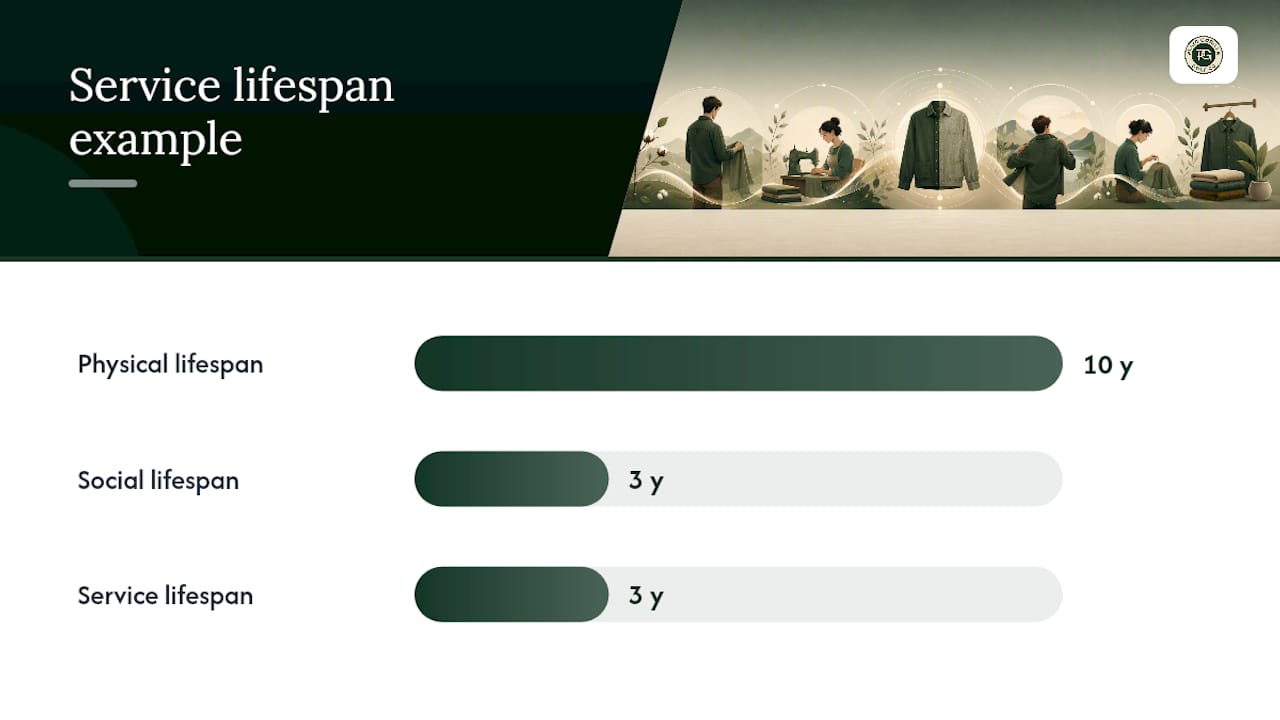
Physical lifespan is the technical one. It’s the point where the fabric, stitching, or trims fail structurally, whether that’s a blown-out seam, a hole worn through at the elbow, or fabric so thin you can see through it. This is pure materials science: fibre strength, weave density, thread quality.
Social lifespan is different. It’s the point where a garment is still perfectly intact but you (or the people around you) no longer consider it acceptable to wear. A polo can be structurally flawless and still get retired because the cut looks dated or the colour feels tired. This is style, not strength.
Service lifespan is the one that actually matters to your wallet and the planet, and it’s the minimum of the other two. A jacket with a 10-year physical lifespan but a 3-year social lifespan gives you 3 years of service. A trendy piece with a 1-year social lifespan but weak stitching that fails after 8 months gives you 8 months. Whichever clock runs out first ends the garment’s useful life.
Here’s the simple version:
- Service lifespan = whichever runs out first, physical or social
- Garments also swing between active use (worn regularly, part of the rotation) and passive use (owned but forgotten, sitting at the back of the closet)
- A study on European wardrobe habits found that between one fifth and one third of items hadn’t been worn in the past year, which means plenty of “owned” garments contribute almost nothing to actual service
That passive-use gap is exactly why “years owned” alone is a misleading number.
Pro Tip: Divide the purchase price by how many times you actually expect to wear something, not by how many years you’ll own it. A $120 hoodie worn 150 times costs 80 cents per wear. A $40 tee worn eight times before it’s binned costs $5 per wear. Cost-per-wear is the number that tells you what you actually paid for the garment you actually used, and researchers at the University of Bath argue labelling clothes this way could meaningfully shift buying habits.
How is garment longevity measured in years, wears, and washes?
Each metric answers a different question, and none of them tells the whole story alone.
Use time (years) is the easiest number to track because you can just count how long something has been in your closet. Its weakness: it says nothing about intensity. A coat can sit unworn for four winters and still technically post a four-year lifespan on paper, even though it delivered almost no real service.
Use intensity (wears) solves that problem. It counts the actual number of times a garment gets put on, which is a much better proxy for the value you extracted from it. This metric matters most for everyday rotation pieces, hoodies, tees, golf polos, where frequency of wear is the whole point.
Washing cycles do double duty. They’re a stress indicator (fabric and dye degrade with every cycle) and an environmental metric, since laundering is one of the biggest contributors to a garment’s total environmental footprint over its lifetime.
A real-world example makes the gap between these metrics obvious. Empirical tracking of everyday t-shirts found that an informal, everyday tee averaged about 4 years of ownership, 33 wears, and 18 washes, while a formal-occasion tee averaged 5 years, but only 9 wears and 6 washes. Same garment type, wildly different service profiles.
Run the cost-per-wear math on two $60 t-shirts bought at the same price:
- Tee A, kept five years, worn twice a month (roughly 24 wears/year over 5 years is generous, but say it’s worn rarely, 15 times total): $4.00 per wear
- Tee B, kept one year, worn almost daily, 200 times: $0.30 per wear
Tee B delivered thirteen times more value despite lasting a fraction as long in years. Years owned tells you almost nothing about value without wears attached to it.
What factors actually determine how long clothes last?
Research groups clothing lifespan drivers into four blocks, and knowing which one you can actually influence changes how you shop and care for what you already own.
Garment properties cover fibre content, weave or knit construction, seam quality, and trims like zippers and buttons. This is the physical foundation. A garment built from durable fibres with reinforced stress points simply survives more cycles before physical failure, full stop.
User demographics include age, income, and even nationality, since climate and cultural wear patterns vary by region. You can’t change your age or your local weather, but knowing they factor in helps you interpret why your lifespan numbers might differ from a benchmark.
Clothing practices are the behaviours: how you launder, whether you repair small issues early, how big your overall wardrobe is, and how you store items in the off-season. These are almost entirely under your control.
Patterns of use cover wear frequency and how often you launder relative to actual soiling. This block is the one you influence the most, and it’s the one that matters the most.
That last point isn’t a guess. A multiple regression analysis across a large international wardrobe survey found that all four blocks contribute significantly when measuring years of ownership, while patterns of use have the strongest influence on the number of wears, with garment-use variables producing the strongest predictive power in that model.
That distinction matters for anyone trying to actually extend a garment’s useful life:
- Fibre and construction (fixed at purchase): choose well upfront, because you can’t retrofit a weak weave
- Demographics and climate (mostly fixed): adjust your expectations rather than fight them
- Care practices (fully controllable): wash less often, repair small damage fast, store properly in the off-season
- Rotation and wear patterns (fully controllable): a bigger wardrobe with more rotation spreads wear across more items and extends each one’s service life
Separately, researchers have flagged that consumer attitude and replacement behaviour, how quickly you’re inclined to swap out a piece for something new, is itself a major determinant of actual service lifespan independent of the garment’s technical quality. In other words, a well-made garment can still get a short service life if you’re the kind of shopper who replaces things on a whim. Longevity is partly a materials question and partly a habit question.
What are the most common ways clothes fail?
Five failure modes account for most of the “this didn’t last” complaints researchers document, and each traces back to a specific, usually avoidable, cause.
Pilling shows up as those little fabric balls on sweaters and knitwear, caused by friction breaking fibres loose and tangling them at the surface. Loosely spun yarns and synthetic blends pill faster than tightly spun natural fibres.
Colour fading comes from a mix of UV exposure, harsh detergents, and high-heat washing or drying, which breaks down dye molecules over repeated cycles.
Thinning and fraying typically hit high-friction zones first: cuffs, collars, inner thighs on jeans, underarms. Repeated rubbing wears the fibres thin long before the rest of the garment shows age.
Seam failure happens when thread quality, stitch density, or seam type can’t handle the stress placed on that specific joint, especially at the crotch, underarms, or shoulder seams on fitted garments.
Holes at stress points are often the end stage of thinning: once fibres are worn thin enough, a single snag or stretch finishes the job.
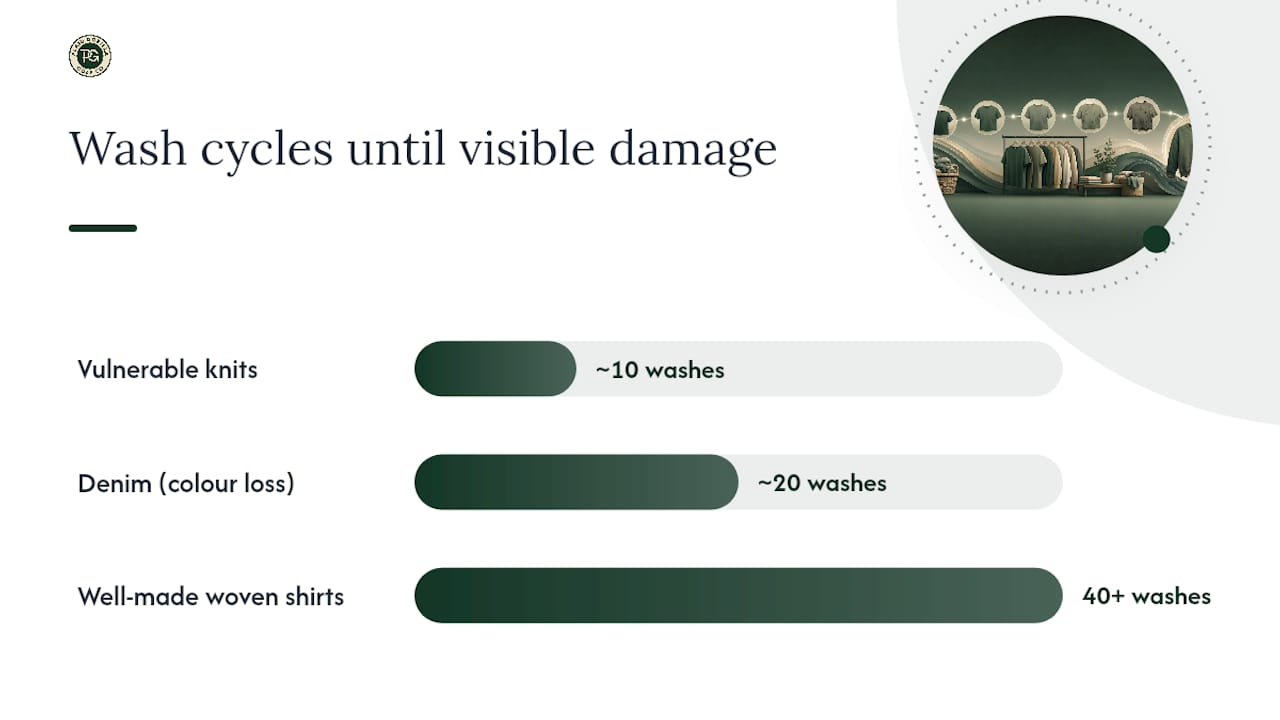
Industry testing puts real numbers on when these show up. Wash-cycle testing under the Clothing Longevity Protocol found pilling often becomes visible by roughly 10 wash cycles on vulnerable knits, while denim frequently shows noticeable colour loss by around 20 washes. Better-constructed woven shirts can withstand 40 or more washes before showing comparable deterioration.
Simple habits push those numbers out considerably:
- Wash knitwear inside out on a gentle cycle to cut pilling from friction
- Skip the high-heat dryer setting, air dry or use low heat to protect both colour and fibre integrity
- Wash denim less often (cold water, minimal cycles) to slow colour loss
- Reinforce stress-point seams with a quick tailor visit before they blow out completely
Pro Tip: Most fabric damage happens in the dryer, not the washer. Heat is the single biggest accelerant of colour fade and fibre breakdown, so if you only change one laundry habit, switch to air drying or the lowest heat setting your dryer offers.
How does the industry actually test for durability?
Brands and researchers don’t guess at durability, they test for it, and understanding the method helps you read a “durable” claim with the right amount of skepticism.
The Clothing Longevity Protocol is the closest thing the industry has to a shared testing standard. It combines a design checklist (fibre choice, seam construction, trim quality) with physical testing targets, giving manufacturers a repeatable way to benchmark a garment against known failure points before it ever ships.
Two testing methods do most of the heavy lifting. Repeated wash-cycle testing puts garments through dozens of controlled wash and dry cycles to see exactly when pilling, fading, or seam stress shows up, the same protocol that produced the 10-wash pilling and 20-wash denim fading benchmarks. Wearer trials put real garments on real people for extended stretches, often 50 to 200-plus hours of active wear, because lab washing alone can’t replicate the friction, stretch, and sweat exposure of actual daily use. Longer trials surface failure points that shorter ones miss entirely.
| Test type | What it measures | What a consumer claim typically means |
|---|---|---|
| Repeated wash-cycle test | Colour retention, pilling, shrinkage across dozens of cycles | “Holds colour after 20+ washes” suggests dye and fibre stability under real laundering |
| Wearer trial | Real-world friction, stretch, seam stress over 50–200+ hours | “Field-tested” implies the fit and seams survived actual movement, not just a lab rig |
| Tensile and seam strength test | Force required to tear fabric or pull a seam apart | “Reinforced seams” should mean measurably higher stitch density at stress points |
What is a realistic lifespan for different types of clothing?
Benchmarks vary a lot by category and by how formally or casually a piece gets worn, and reading the range correctly matters more than memorizing a single number.
Everyday knit tees land around 4 to 5 years of ownership, but wear counts diverge sharply by occasion. Informal, high-rotation tees average roughly 33 wears and 18 washes over about four years, while formal-occasion tees stretch to five years of ownership but only 9 wears and 6 washes in the same window. Denim tends to rack up high wear counts fast, with visible colour retention issues commonly emerging after 20-plus washes. Heavier pieces like coats and outerwear often get kept around five years but see far fewer wash cycles simply because they’re cleaned less often.
These ranges are wide on purpose. Climate, wardrobe size, and personal habits all push individual results up or down, which is exactly what the four-factor framework above predicts. A survey of consumer expectations by Cotton Incorporated found people report wearing clothing almost five years on average, and that same survey noted many shoppers expect cotton garments to outlast comparable man-made fibre pieces, an expectation that tracks with how natural fibres typically age.
The real use of these numbers isn’t bragging rights, it’s cost-per-wear planning. If you know a well-made hoodie realistically delivers 100-plus wears, you can compare its true cost against a cheaper alternative that might only survive 20 wears before it starts pilling or fading out.
How do you spot a garment built to actually last?
You can catch most durability red flags before you ever check out, if you know what to look for and don’t rely on the price tag to do the thinking for you.
Run through this checklist at the rack or on the product page:
- Fibre content and blends — check the tag; natural fibres and quality blends generally resist wear better than cheap synthetic-heavy fabrics
- Stitch density and seam finish — tighter, more consistent stitching at seams means more resistance before thread pulls or seams split
- Reinforcement at stress points — look for extra stitching or bar-tacking at pockets, cuffs, and underarms, the spots that fail first
- Trim quality — metal zippers and solid buttons outlast plastic hardware that cracks or jams within a season
- Colourfastness claims — a brand willing to state a wash-cycle number for colour retention has actually tested for it
- Care-label realism and repairability — a garment with accessible seams and standard trims is one a tailor can actually fix later
Plaid Gorilla Golf builds toward these exact markers. The Bogey Kit — Country Club Hat & Bogey Enthusiast Hoodie pairs premium fabric weight with reinforced construction at the stress points a hoodie actually needs it, shoulder seams, cuffs, and the front pocket. The Bogey Enthusiast Hoodie in Pine uses the same heavyweight material approach on its own, giving you a single-piece example of how fabric choice and stitch density work together to resist the pilling and seam fatigue that cheaper fleece can’t survive.
Pro Tip: Limited-edition drops affect how long you’ll want to wear something, not necessarily how long it can physically survive. Style scarcity drives social lifespan; it says nothing about fibre content or seam construction. Check the actual materials and build quality independent of how limited the run is, and check a resource like Plaid Gorilla Golf’s guide to high-performance golf fabrics if you want to understand what’s actually happening inside the fabric.
When should you repair a garment instead of replacing it?
Replace when the garment shows structural failure across multiple points, or when you’ve already repaired it more than once for the same recurring problem.
Plenty of common issues are cheap, fast fixes that meaningfully extend service life:
- Reinforcing a seam before it fully blows out (catch it early and it’s a five-minute stitch, not a full seam rebuild)
- Patching worn knees or elbows on pants and jackets
- Reattaching a loose button or replacing a broken zipper pull
- Darning small holes in knitwear before they stretch into bigger ones
Some situations call for a professional rather than a home fix. Sentimental pieces, expensive outerwear, and technical performance gear (think waterproof seams or structured tailoring) are worth a real tailor’s time, since a poor DIY repair can void the garment’s remaining service life faster than the original damage would have. For garments that are genuinely beyond repair but still structurally sound in parts, resale or upcycling into something else is a better outcome than the bin, both for your wallet and for keeping usable material in circulation longer.
The home-repair test is simple: if you can identify exactly where the damage is and it hasn’t spread, try the fix yourself first. If the fabric around the damage is also weakening, that’s your signal to see a tailor instead.
Why garment longevity should change how you shop
Understanding service lifespan changed how I think about a closet full of clothes. Most of us have pieces that technically survived for years but delivered almost no actual wear, and a handful that got worn into the ground and were worth every dollar because of it. The number that matters isn’t years owned. It’s wears delivered against what you paid.
That’s the thinking behind how Plaid Gorilla Golf approaches construction, heavier fabric, reinforced stress points, and trims that hold up, because a bold design only matters if the garment survives long enough to wear it. Quality and personality aren’t a trade-off. They’re both just part of building something meant for real, repeated use on and off the course.
Where to read more on garment longevity research
A handful of sources drive most of the data in this guide, and each is worth a direct look if you want to dig deeper into a specific angle.
- The MDPI wardrobe survey across China, Germany, Japan, the UK, and the USA is the best source for lifespan benchmarks and the four-factor regression model.
- The Clothing Longevity Protocol from WRAP is the go-to for technical testing methodology, wash-cycle targets, and wearer trial standards.
- The ScienceDirect study on use time and use intensity breaks down years versus wears versus washes with real garment-type data.
- The Cotton Incorporated durability survey offers consumer-side expectations around fibre type and perceived durability.
- The Journal of Cleaner Production study on garment failure causes is the deepest resource on why garments actually fail and how circular design can prevent it.
Building a wardrobe that’s made to last
Plaid Gorilla Golf builds every drop around the same idea this whole guide is built on: a garment only earns its price if it survives enough wears to justify it. That’s why the fabric weight, stitch density, and trim choices behind pieces like the Bogey Enthusiast Hoodie in Pine get as much attention as the pattern on the front.
If you’re tired of buying golf apparel that looks bold for one season and pills out by the next, that’s exactly the gap Plaid Gorilla Golf was built to close. Bold patterns and premium construction aren’t competing priorities here, they’re the same decision. Every limited drop is designed to hold its stitching, its colour, and its shape through the wears that actually matter, on the course and off it. Check out The Bogey Kit — Country Club Hat & Bogey Enthusiast Hoodie and see the construction details for yourself before the current drop sells out.
Sources
- What Affects Garment Lifespans? International Clothing Practices Based on a Wardrobe Survey in China, Germany, Japan, the UK, and the USA
- Unravelling the service lifespan of garments ― empirical insights on use time and use intensity
- Clothing Longevity Protocol — WRAP
- Supply Chain Insights Durability Survey 2026 — Cotton Incorporated
- Garment failure causes and solutions: Slowing the cycles for circular fashion (Journal of Cleaner Production)
FAQ
How long should a garment last?
Most everyday garments should realistically deliver 4 to 5 years of service, though the number that matters more is wears: an everyday tee might see 33 wears over roughly four years, while a similar piece worn only occasionally could take five years to hit even 10 wears.
What makes a woman look wealthy?
Fit, condition, and consistency matter more than logos, garments that hold their shape, colour, and structure over repeated wears read as higher quality than anything with visible pilling, fading, or stretched-out seams, regardless of brand.
Which brands of clothes are best for longevity?
Look for brands that publish real construction details, reinforced seams, named fibre content, and colourfastness performance, rather than vague “premium” language; Plaid Gorilla Golf builds its hoodies and hats around heavier fabric weight and reinforced stress points specifically because those choices show up directly in wash-cycle testing results.
How can you tell if a garment is high quality before buying it?
Check stitch density at the seams, feel the fabric weight, inspect trims like zippers and buttons for solid construction, and look for reinforcement at stress points like underarms and pockets, the same checklist industry wash-cycle and wearer trials are built to verify.
What’s the difference between physical lifespan and service lifespan?
Physical lifespan is when a garment technically wears out structurally; service lifespan is the shorter of that and how long you’re still willing to wear it, since a perfectly intact garment you’ve stopped wearing has effectively ended its useful life.