


Rope hats started as functional headwear for sailors and military crews in the 19th and early 20th centuries, long before golfers ever pulled one over their eyes on the back nine. The braided cord that circles the crown today is mostly decorative, a heritage detail carried forward from working caps into mid-century golf and baseball, and now into streetwear. Golf Digest has tracked its reappearance on tour, and here at Plaid Gorilla Golf, we build our own rope hats around that same history.
TL;DR:
- The decorative cord on rope hats originated from maritime, fishing, and military headwear designed for durability and visibility in harsh environments.
- Mid-century golf and baseball adopted the style for its refined look, signaling club membership and old-school formality without serving a structural purpose.
- Modern rope hats now feature various materials, shapes, and adjustable features, with the rope detail maintaining heritage appeal rather than functional purpose.
- The resurgence of rope hats is driven by nostalgia, vintage golf trends, influencer styles, and their versatility across sports, streetwear, and corporate branding.
- When choosing a rope hat, focus on fit, material, crown shape, and intended use, rather than trendy silhouettes, as the style’s heritage endures through adaptable design.
Table of Contents
- Early origins: maritime and military roots
- Adoption in sports and civilian life
- Why the rope exists: decoration, tariffs, and manufacturing history
- Design, materials, and stylistic variants
- Why rope hats are trending again
- Our take on rope hat history and design
- What most people get wrong about the rope
- Building your rope hat outfit: what to check before you buy
- Sources
- FAQ
Early origins: maritime and military roots
Long before “rope hat” meant anything to a golfer, it meant something to a sailor. Working caps built for life at sea needed a snug crown, a stiff brim to cut glare off the water, and trims that could survive salt spray without falling apart. Cord detailing was one of the few embellishments practical enough to earn a spot on functional headwear, and it stuck around for a reason beyond decoration.
- Naval and fishing crews wore caps with cord or braid trim that doubled as a visible mark of rank or unit, similar to the way piping worked on dress uniforms.
- Military surplus caps from the early 20th century carried similar cord detailing, and much of it migrated into civilian workwear after soldiers returned home.
- Early photographs and museum pieces from this period show cord trim appearing consistently on caps tied to seafaring trades, though dating any single design to an exact year is difficult given how informally these caps were produced.
The shape itself, a soft, rounded crown paired with a short, stiff brim, came from necessity. Sailors needed something that would not blow off in wind but still let them see clearly. Trade blogs covering rope hat origins point to this maritime and workwear lineage as the clearest thread connecting old seafaring caps to what we now call a rope hat.
Adoption in sports and civilian life
The rope-trimmed cap did not stay on the docks. Baseball caps borrowed elements of the silhouette by the early 1900s, and by the mid-20th century, golf had picked up the trend for its own reasons. Golf culture already leaned on structured caps and visors for sun protection, and the cord detail gave those pieces a sharper, more finished look without changing how they functioned.
- Baseball’s early adoption helped normalize cord trim as a sporty, casual detail rather than strictly a workwear signal.
- Golf’s mid-century embrace turned the rope hat into a clubhouse staple, often paired with pleated trousers and knit polos.
- Tour visibility kept the style alive for decades. Golf Digest’s coverage of vintage rope hats at the 2018 U.S. Open shows the look never fully disappeared from the pro game.
Golfers gravitated to it because the rope signalled something specific: club membership, a nod to old-school formality, and a visual break from plain ball caps. It was distinct without being loud, which fit the sport’s culture at the time.
Why the rope exists: decoration, tariffs, and manufacturing history
The honest answer is less romantic than most people expect. The rope on a rope hat is, by consensus among headwear historians and retailers, a purely ornamental detail. It does not reinforce the crown, hold sunglasses, or serve any structural purpose on a modern cap.
The visor cord functions today as a decorative heritage cue rather than a piece of structural support. It survived not because caps needed it, but because the look stuck.
One piece of manufacturing lore deserves a careful look rather than a flat dismissal: brands have, in documented cases, adjusted small apparel details to affect how a garment gets classified for tariff purposes. The Federal Register records how U.S. customs classification rules have shaped apparel design decisions in specific, documented instances, though this is a market-specific practice, not a universal origin story for every rope hat ever made. Treat the tariff explanation as one plausible factor among several, not the definitive reason cord trim exists. The sunglasses-holder theory, meanwhile, is folklore. It sounds functional, but no credible source ties it to the rope’s actual origin.
Design, materials, and stylistic variants
Not every rope hat looks or feels the same, and the differences matter once you start shopping for one. Rope material changes the visual weight of the trim, and crown shape changes how formal or relaxed the whole hat reads.
- Braided cotton cord gives a softer, more traditional look and tends to show up on retro-styled caps.
- Synthetic cord holds its shape better in humidity and rough weather, which matters if you’re wearing the hat on an actual golf course rather than just around town.
- Leatherette or faux-leather trim shows up on some modern variants for a slightly dressier finish.
- Structured crowns pair well with a stiffer rope for a cleaner silhouette, while unstructured, dad-hat style crowns tend to soften the whole look.
Modern rope hats also lean on features the originals never had: adjustable snapback or strap closures, moisture-wicking sweatbands, and lighter performance fabrics that hold up over 18 holes.
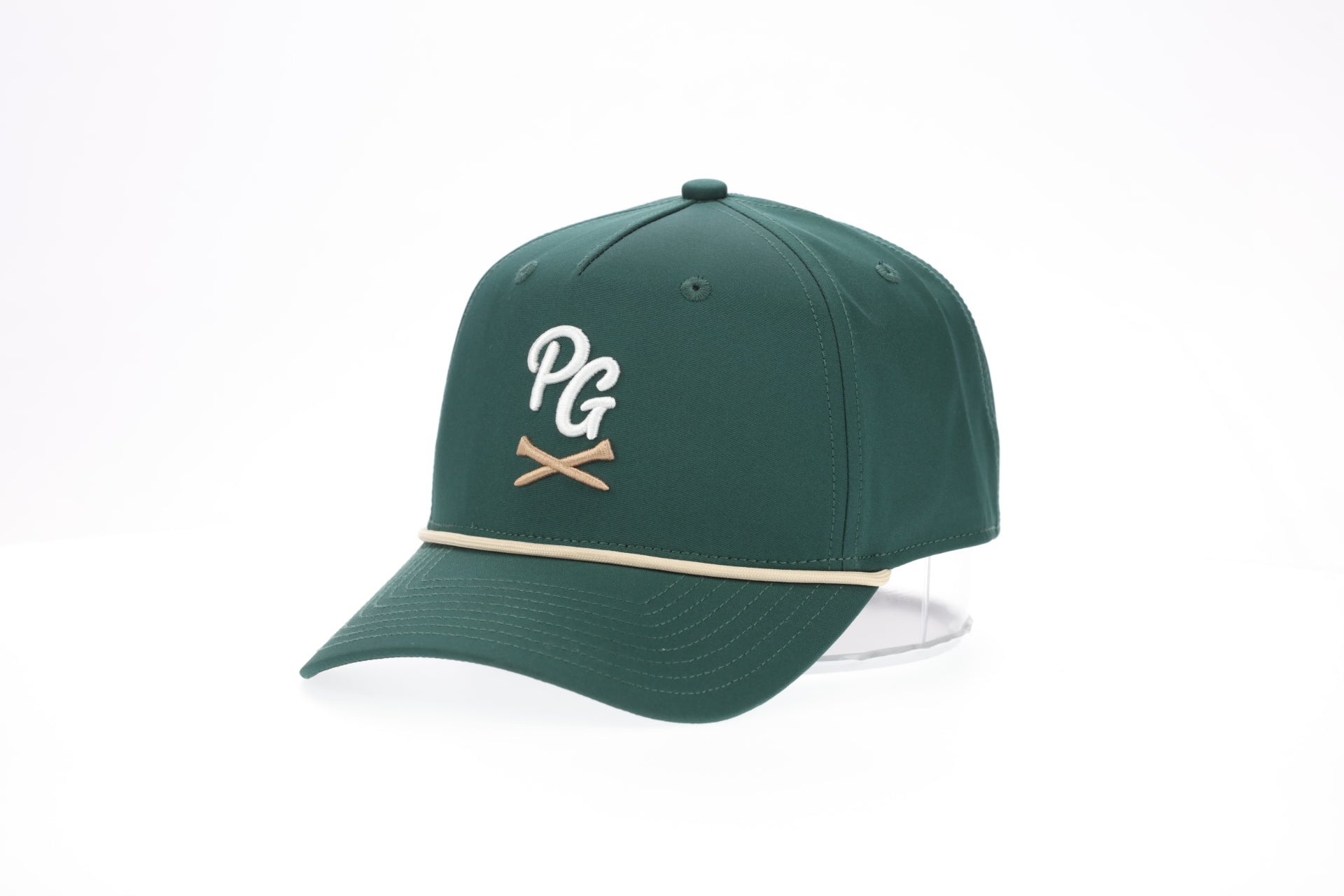
Pro Tip: Match rope colour to your outfit’s accent colour, not its base colour. A neutral hat with a bold rope trim reads intentional; matching everything head to toe reads costume-y. For outfit ideas built around this idea, our guide to styling a rope hat walks through a few formulas that work on and off the course.
Why rope hats are trending again
Nostalgia is doing a lot of the heavy lifting here, but it’s not the only force at work. Tour visibility, influencer styling, and the rise of custom merchandise have all pushed rope hats back into regular rotation.
- Retro golf styling is having a real moment, and rope hats fit that aesthetic without looking like a costume piece.
- Tour and lifestyle coverage keeps reintroducing the look to new audiences who weren’t around for its first run.
- Brands favour rope trim for merchandise because the silhouette photographs well and reads clearly even in a small social media thumbnail, a point industry commentary on rope caps has picked up on directly.
You’ll now see rope hats crossing categories freely: golf shops, streetwear drops, and corporate merch tables all carry some version of the look, which says something about how flexible the style has become.
Our take on rope hat history and design
Some apparel brands build rope hats with a maritime-to-fairway history in mind, not as a throwback gimmick but as a design choice grounded in where the detail actually came from. We treat the cord as a heritage marker worth using on purpose, not just repeating because it’s trending.
- We reference historical silhouettes and cord placement when developing new drops.
- We link related styling content, including our 2026 rope hat trend piece, so readers can see how the history connects to current product decisions.
- We treat every limited drop as an extension of that lineage, not a departure from it.
What most people get wrong about the rope
The biggest misconception about rope hat history is that people search for a hidden function that was never there. Once you accept that the rope is decorative and always has been, the more interesting question becomes why that decoration survived a century of changing fashion while dozens of other trims disappeared.
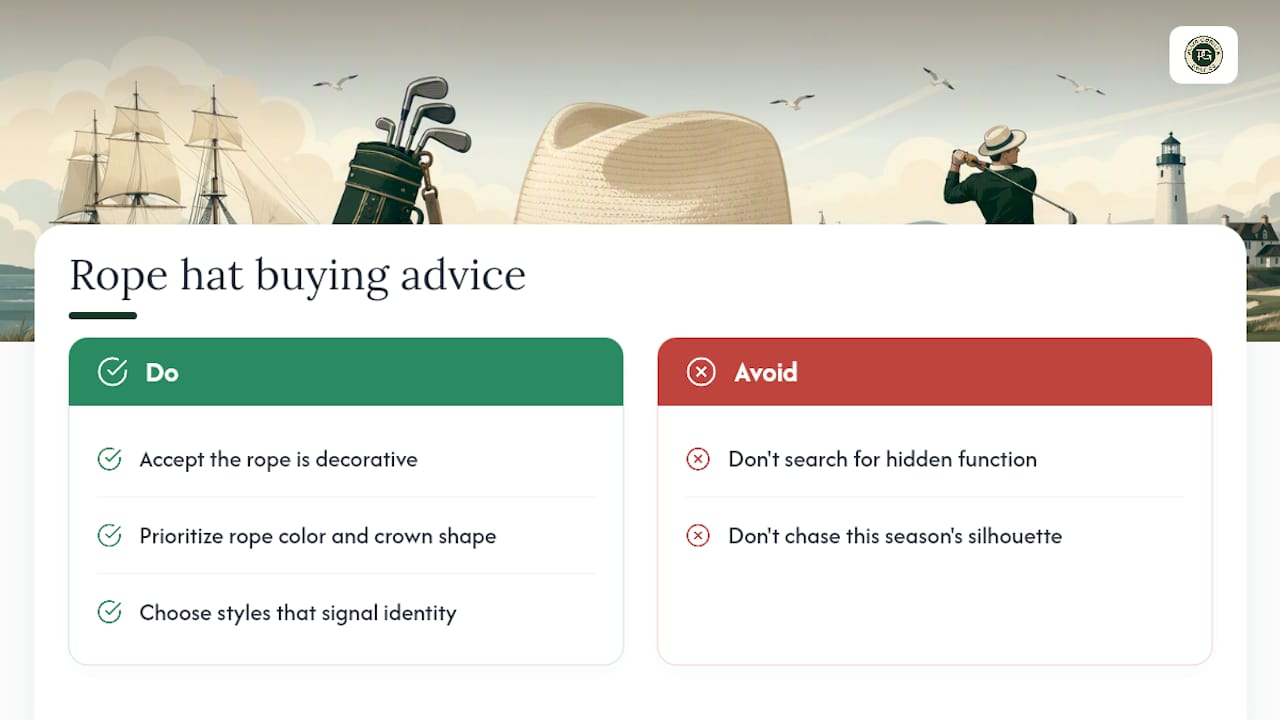
The answer, based on the evidence, comes down to visibility and identity. A rope hat photographs distinctly, reads as intentional from a distance, and signals a specific kind of confidence that plain caps don’t. That’s not a small thing in a sport that has spent decades debating how much personality players are allowed to show.
If you’re buying one, prioritize how the rope color and crown shape work with your existing wardrobe over chasing whatever silhouette is trending this season. History shows the look outlasts trends precisely because it adapts to different styles rather than locking into one.
— Mike
Building your rope hat outfit: what to check before you buy
Before you buy, run through five things: fit, rope material, crown shape, adjustability, and whether you’re wearing it for golf or everyday use. A structured crown with synthetic cord tends to hold up better on the course, while a softer cotton-braided rope suits a more relaxed, off-course look.
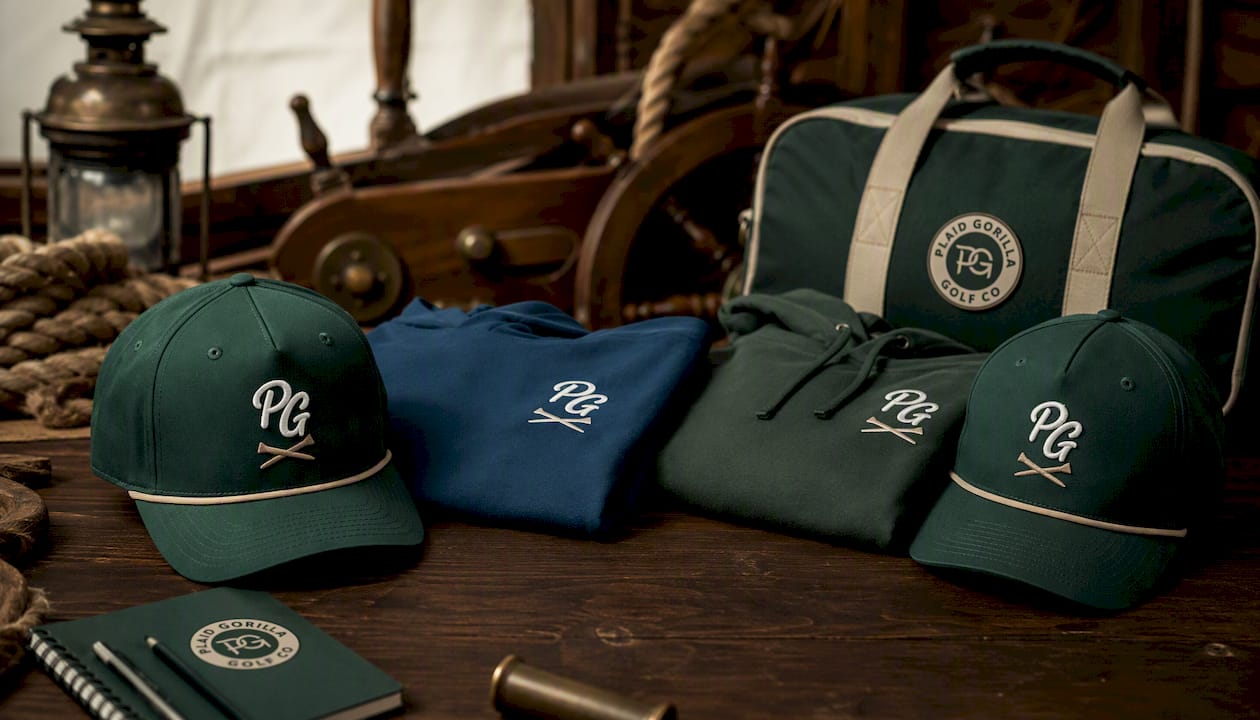
Some rope hats are designed to work both ways, without forcing you to choose between performance and personality on the fairway. The Champagne Tees Rope Hat – Ponderosa Pine leans into classic rope-hat proportions with a bold pattern underneath, ideal if you want the heritage silhouette without a plain crown. If you’re outfitting a full look, The Ponderosa Pine Set pairs that same hat with a matching hoodie, and The Course Kit bundles a rope hat with a premium hoodie for a ready-made outfit rather than piecing one together yourself. For readers who want to browse more options first, our full golf hats collection and golf hoodies line are both worth a look before you commit to a set.
Sources
- Govinfo
- Fashion statements from the 2018 U.S. Open: Vintage rope hats — Golf Digest
- What Is a Rope Hat? Meaning, Purpose, Styles & Custom Guide — Foremost Hat
FAQ
Why are rope hats popular now?
Retro golf styling has come back into fashion, and rope hats fit that look without feeling like a costume. Tour appearances, documented by Golf Digest at the 2018 U.S. Open, along with brand customization in streetwear and corporate merch, have kept the style visible across several markets.
What is the rope on a rope hat for?
The rope, sometimes called a visor cord, is decorative rather than functional on modern caps. It does not reinforce the crown or hold anything in place; it survives purely as a heritage styling detail.
What is the oldest hat in the world?
Rope hats specifically trace back to 19th and early 20th century maritime and military caps, not to any single ancient design. Headwear generally predates recorded history by thousands of years, but the rope-trimmed style is a much more recent, workwear-driven development.
What is the main difference between a rope hat and a trucker hat?
A rope hat is defined by its cord trim along the seam where the crown meets the brim, a detail borrowed from seafaring and military caps. A trucker hat is defined by its mesh back panel and foam front, a structure built for airflow rather than decoration, and the two styles can overlap when a cap features both elements.