


Do three focused, measurable blocks per week — putting, short game, and one impact/full-swing session — and you will build real, transferable skills without a simulator or a range membership. Start right now: spend five minutes on a putting gate drill (two tees two club-heads apart, three feet from a cup or target), five minutes hitting a wedge off a mat with painter’s tape on the face, and five minutes swinging a mid-iron at half-speed with a towel tucked under your lead arm. That is your first session. PracticeCaddie’s practice planning guidance and PGA professional instruction both confirm that short, structured blocks with a measurable goal beat long, unfocused range sessions every time.
Table of Contents
- What does effective golf at home practice actually look like?
- Short-game and wedge drills for your backyard, driveway, or garage
- Full-swing practice in tight spaces: nets, safe balls, and impact drills
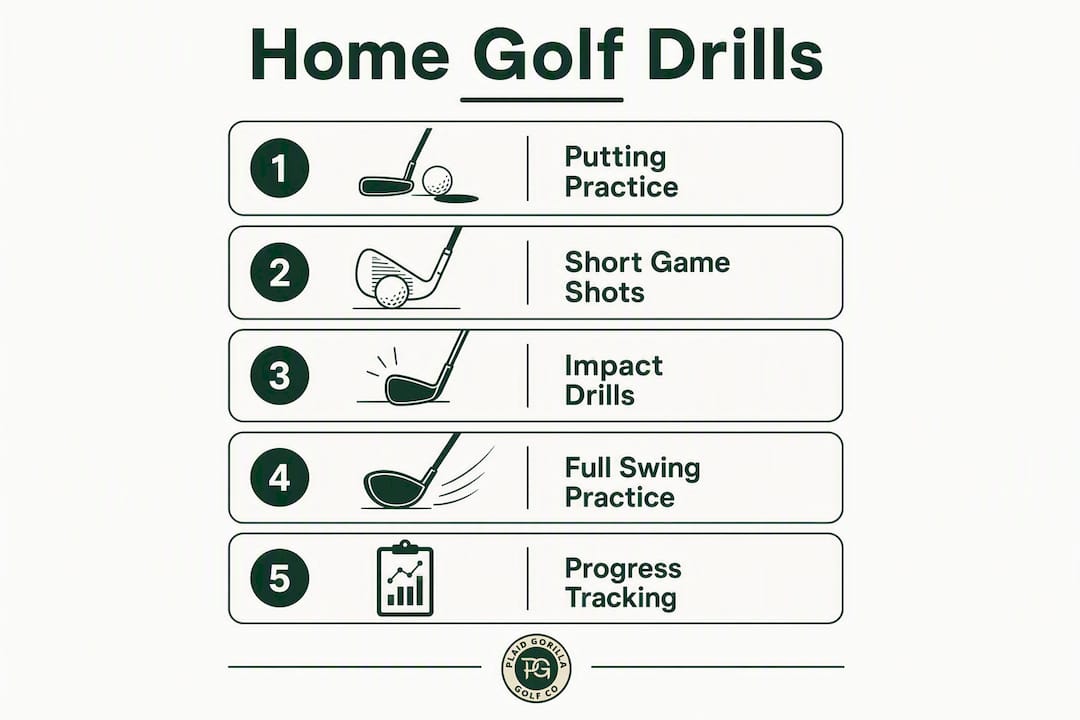
- Six ready-to-run home drills with goals and common errors
- What to buy for home golf practice in Canada: a space-first checklist
- How to structure your home sessions and track real improvement
- Safety, neighbour etiquette, and Canadian seasonal tips
- What the pros and practice research actually say
- Warm-up exercises and physical conditioning for home golf practice
- Mental game and visualisation techniques for better practice
- Key takeaways
- Why home practice matters more than most golfers think
- Gear up for your home practice sessions with Plaidgorillagolf
- Useful sources for deeper study
- FAQ
What does effective golf at home practice actually look like?
The most transferable putting work you can do at home is start-line control and speed control, not chasing green speed. Your carpet or a quality putting mat will never perfectly replicate a stimped green, and that is fine. What transfers are the stroke pattern, the face angle at impact, and your ability to roll the ball on your intended line.
Four putting drills worth your time
- Gate drill: Place two tees just wider than your putter head, roughly three feet from a target. Roll ten balls through the gate. Success criterion: 8 of 10 through the gate without tee contact. Miss two in a row? Restart the count.
- Towel drill: Lay a folded towel across the mat about 18 inches past the ball. Stroke putts that stop on or just past the towel. This trains deceleration awareness and a smooth, accelerating stroke.
- Clock drill: Set six balls in a circle around a cup or target at three feet. Putt all six without missing. Once you hole all six, move to four feet and repeat. Indoor-friendly drills like this train repeatable motion rather than relying on ball flight, which is exactly why they translate to the course.
- 20-in-a-row finisher: From two feet, make 20 consecutive putts. If you miss, restart at zero. This creates pressure and mimics the mental load of a short par putt.
| Practice distance | What it trains |
|---|---|
| 2–3 ft | Stroke repeatability and face control |
| 4–6 ft | Start-line consistency and gate accuracy |
| 8–15 ft | Pace control and speed judgement |
| 15+ ft | Lag putting and distance management |
Pro Tip: Keep your eyes over the ball and your lower body still. If your hips shift during the stroke, place a club across your thighs as a feedback rod — any movement and you will feel it immediately.
One practical note on surfaces: a quality putting mat with a consistent nap rolls truer than most household carpets. Carpet fibres vary in direction and speed, which can train a compensating stroke. If you are using carpet, roll balls in one consistent direction and treat it as a tempo drill rather than a precision start-line drill.
Short-game and wedge drills for your backyard, driveway, or garage
Wedges and chips account for a disproportionate share of your scorecard. Distance control, a consistent landing zone, and a reliable low-point matter far more for scoring than an extra 10 yards off the tee. These drills work in a backyard, a driveway with a net, or a garage with foam balls.
Step-by-step drills
- Pause chipping: Take your normal chip setup, swing back to hip height, then pause for one full second before swinging through. The pause eliminates the instinct to flip the wrists and forces a proper downward strike. Do 20 reps, aiming at a hula hoop or a towel laid on the ground as a landing zone. Success criterion: 6 of 10 land inside the target zone.
- Landing-zone ladder: Place three targets at five, ten, and fifteen yards (use towels, cones, or chalk marks). Hit five chips to each target in sequence, then reverse the order. The goal is to land within one yard of each target. This trains distance feel, not just direction.
- Bump-and-run progression: Start with a 9-iron bump-and-run to a close target, then work through 8-iron, 7-iron, and 6-iron, keeping the same swing length and letting the club do the work. This builds an intuitive feel for how loft changes trajectory without changing effort.
For beginners, PGA professionals recommend starting with a sand or gap wedge to learn downward strike. Shorter clubs naturally encourage the clubhead to reach the ground through impact, preventing the common mistake of trying to scoop or lift the ball.
Indoor versus outdoor safety: Use foam balls or limited-flight practice balls indoors. A foam ball off a mat into a net or a padded wall is safe and gives real strike feedback. Outdoors, check your flight path for fences, windows, and neighbouring property lines before hitting any real ball. A pop-up chipping net costs under $40 CAD and solves most backyard safety concerns immediately.
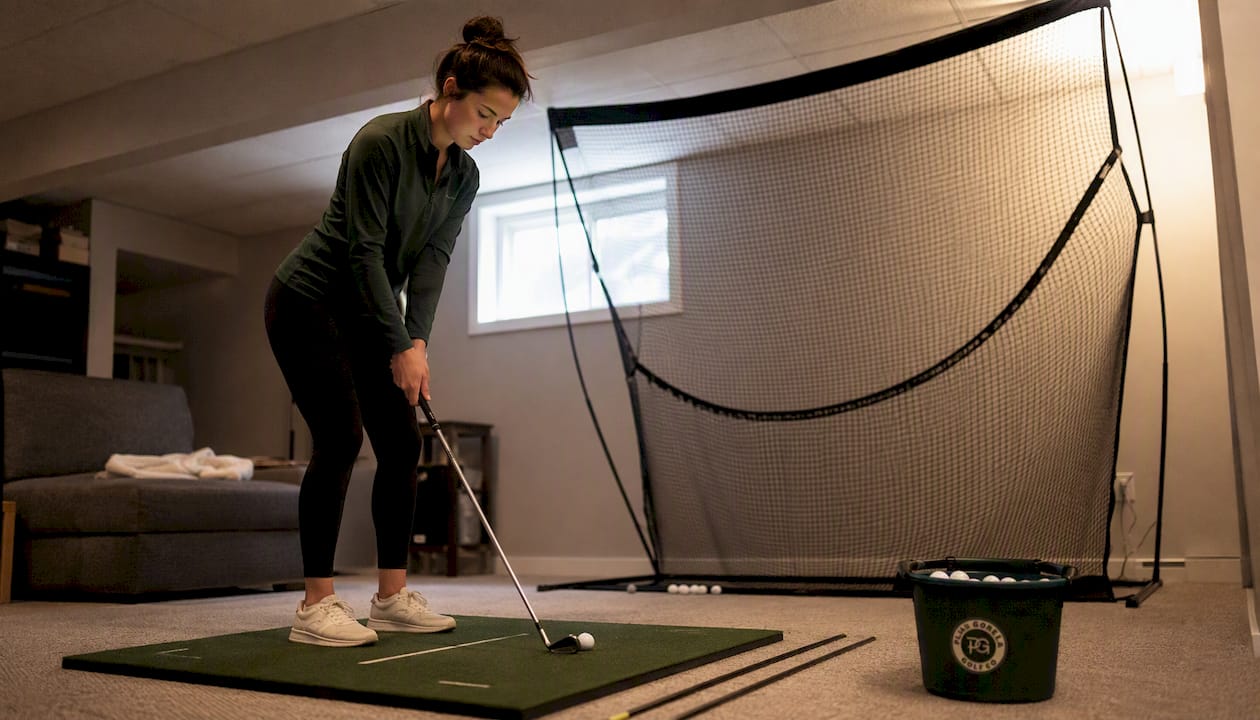
Common mistakes to watch: flipping the wrists through impact (fix with the pause drill), standing too close to the ball (check your posture at address), and swinging too hard at short targets (use a shorter backswing, not more speed).
Full-swing practice in tight spaces: nets, safe balls, and impact drills
You can train impact, tempo, and launch feel in a garage or backyard using a net, foam balls, and simple feedback tools. Ball flight distance is optional. What you actually need from a full-swing session at home is strike quality, low-point control, and tempo consistency.
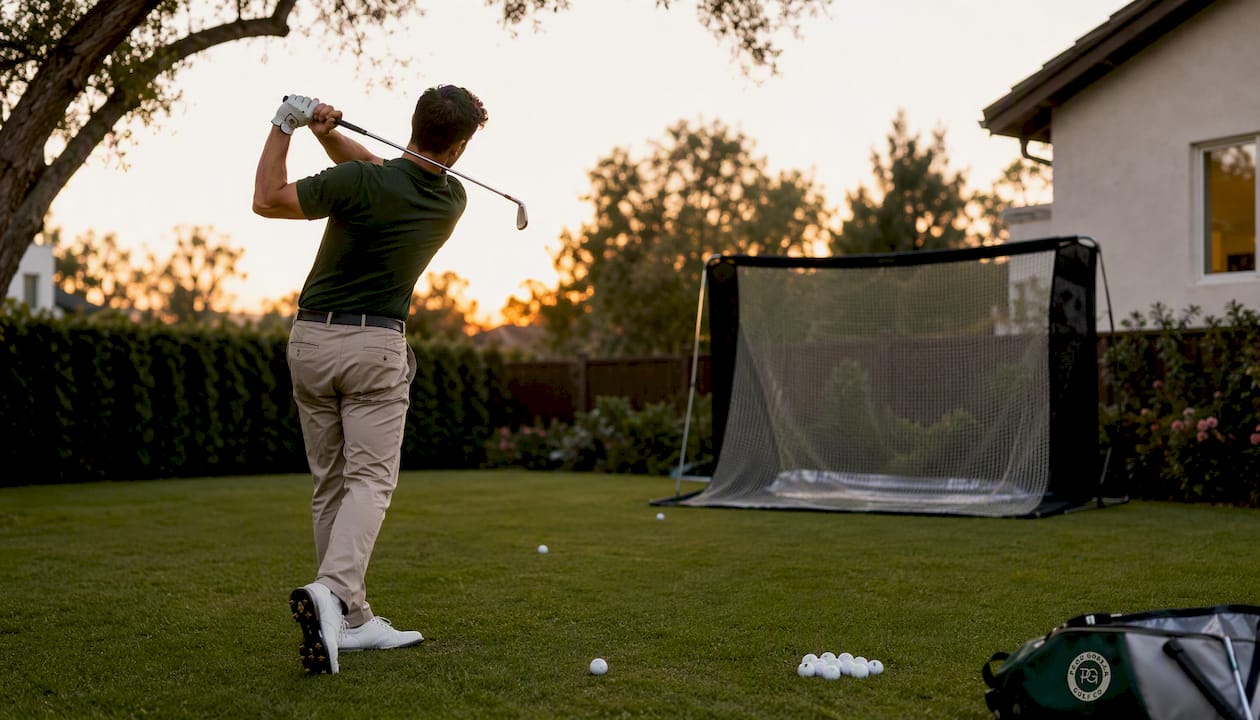
Space-clearance guidelines
Before you swing anything indoors, measure these:
- Ceiling height: You need a minimum of 8.5 feet for a standard iron swing. Driver requires 9.5 feet or more.
- Depth: At least 10 feet from the mat to the net for safe ball capture.
- Width: 6 feet of clear lateral space on each side of your stance.
- Follow-through clearance: Check for shelving, light fixtures, and overhead pipes.
Budget versus value: what you actually get
| Setup tier | Approximate cost (CAD) | What it trains | Space required |
|---|---|---|---|
| Entry-level mat + pop-up net | $80–$200 | Impact, tempo, basic strike feedback | Garage or backyard |
| Mid-range mat + framed net + alignment aids | $250–$600 | Strike quality, swing plane, tempo, low-point | Dedicated garage bay |
| Full simulator (projector + software + mat) | $2,000–$10,000+ | Full-swing data, shot shape, course play | Dedicated room or large garage |
A concise home practice kit of mat, net, and simple feedback tools covers most training needs. A launch monitor is useful but not required to make real progress.
Low-room impact drills
- Tape strike: Apply a strip of painter’s tape across the face of a mid-iron. Hit 20 foam balls into a net. The tape shows exactly where contact is made — heel, toe, or centre. No launch monitor needed.
- Half-swing tempo ladder: Swing to hip height on the backswing, hip height on the follow-through. Focus on a smooth transition and a centred strike. Do 15 reps, then extend to three-quarter swings. This builds tempo without requiring full ceiling clearance.
- Impact-only reps: Set up to a foam ball on a mat and make impact-only swings, stopping the club at the ball rather than following through. This isolates the strike position and low-point without needing net depth.
Neighbour and noise note: Metal-faced clubs hitting real balls into a net produce significant noise. In attached garages or townhouses, use foam balls and a thick mat to reduce impact sound. Check your municipality’s noise bylaws before setting up a permanent outdoor hitting station. Most Canadian municipalities restrict loud activity before 8 AM and after 9 PM on weekdays.
Six ready-to-run home drills with goals and common errors
These drills cover putting, short game, and limited-space full-swing. Each runs in 5–15 minutes and slots into a compact session.
-
Gate start-line drill (putting) Purpose: Train face angle and start-line control. How to: Place two tees just wider than your putter head, three feet from a target. Stroke 10 balls through the gate. Success criterion: 8 of 10 through the gate without touching a tee. Common mistake: Peeking at the target mid-stroke. Fix: keep your eyes on the back of the ball until you hear or feel contact.
-
Towel putting drill Purpose: Build a smooth, accelerating stroke. How to: Lay a folded towel 18 inches past the ball. Stroke putts that stop on the towel. Success criterion: 7 of 10 stop on or within six inches past the towel. Common mistake: Decelerating into the ball. Fix: feel like the putter is chasing the towel, not stopping at the ball.
-
Pause chipping drill Purpose: Eliminate wrist flip and train downward strike. How to: Chip to a landing zone, pausing one second at the top of the backswing before swinging through. Success criterion: 6 of 10 land inside a towel-sized target zone. Common mistake: Rushing through the pause. Fix: count “one” out loud before swinging.
-
Chair drill (full-swing tempo) Purpose: Train weight transfer and prevent swaying. How to: Place a chair to your trail side. Make backswing turns without letting your hip touch the chair. Do 20 slow-motion reps. Success criterion: 15 of 20 reps with no chair contact. Common mistake: Swaying instead of rotating. Fix: feel your trail knee stay flexed and your hip turn, not slide.
-
Tape strike drill (full-swing impact) Purpose: Identify and correct strike location without a launch monitor. How to: Apply painter’s tape across the clubface. Hit 15 foam balls into a net. Read the tape after each swing. Success criterion: 10 of 15 strikes within the centre third of the face. Common mistake: Gripping too tight, which promotes heel strikes. Fix: loosen grip pressure to a 5 out of 10.
-
Alignment-stick swing-plane drill Purpose: Train on-plane backswing and downswing. How to: Stick an alignment rod in the ground at a 45-degree angle behind the ball, pointing along your target line. Make slow backswings, keeping the club shaft parallel to the rod at hip height. Success criterion: 12 of 15 reps with the shaft matching the rod angle. Common mistake: Taking the club too far inside on the takeaway. Fix: feel the butt of the club point at your belt buckle at hip height.
What to buy for home golf practice in Canada: a space-first checklist
The first question is not “what is the best mat?” It is “how much space do you have?” Your space profile determines everything else.
Three space profiles
Closet or compact (under 6 ft × 6 ft): Putting mat, two tees, a putter, and a wedge. That is a complete setup. You can run gate drills, towel drills, and clock drills with simple equipment.
Garage or backyard (10 ft × 15 ft or more): Add a hitting mat, a pop-up or framed net, and foam balls. This profile supports chipping, wedge work, and limited full-swing practice.
Dedicated room or large garage (15 ft × 20 ft or more): A full setup with a quality mat, framed net, alignment aids, and optionally a basic launch monitor. This is where you can run a complete practice session covering all three skill areas.
Buying checklist by profile
Compact setup (must-have):
- Putting mat (6–10 ft, consistent nap): $40–$120 CAD
- Two tees and a target cup or disc: under $5 CAD
- Foam practice balls (pack of 12): $15–$25 CAD
Garage or backyard (must-have):
- Hitting mat (16" × 24" minimum): $60–$150 CAD
- Pop-up chipping net or framed net: $40–$180 CAD
- Foam or limited-flight practice balls: $15–$40 CAD
- Alignment sticks (pack of 2): $15–$25 CAD
Nice-to-have for any profile:
- Painter’s tape (strike feedback): $5 CAD
- Foot spray or impact tape: $10–$20 CAD
- Basic launch monitor (optional): $200–$600 CAD
What to avoid: Cheap foam mats that compress after a few sessions give inconsistent lie feedback and can promote poor strike habits. Nets without a rigid frame collapse under repeated impact and fail to capture balls safely. Spend a little more on a mat with a firm base and a net with a steel or fibreglass frame.
Comfortable layering matters more than most golfers expect. Longer practice sessions in a cool garage or backyard require clothing that moves with you without restricting your swing. A well-chosen layering system for long rounds applies directly to home practice sessions too. Plaidgorillagolf’s hoodies are built for exactly this kind of movement-first comfort.
Measure before you buy:
- Ceiling height (minimum 8.5 ft for irons)
- Room depth (minimum 10 ft from mat to net)
- Lateral clearance (6 ft each side)
- Neighbour sightlines for outdoor setups
How to structure your home sessions and track real improvement
The single best structural move is to use focused skill blocks with a measurable success criterion and a short finisher each session. PracticeCaddie recommends a warm-up, one or two skill blocks, and a finisher that creates pressure and mimics on-course demands.
Sample 4-week plan
Week 1 (all levels): Build the habit
- Session A (20 min): Gate drill × 10, towel drill × 10, 20-in-a-row finisher
- Session B (20 min): Pause chipping × 20, landing-zone ladder × 15
- Session C (20 min): Tape strike × 15, half-swing tempo ladder × 15
Week 2 (beginner focus): Repeat and raise the bar
- Repeat Week 1 sessions. Raise success criteria by one rep (e.g., gate drill: 9 of 10 instead of 8 of 10).
Week 2 (intermediate/advanced): Add complexity
- Add the chair drill and alignment-stick plane drill to Session C. Introduce the clock drill at four feet.
Week 3 (all levels): Combine skills
- Build a 30-minute session that runs gate drill → pause chipping → tape strike → 20-in-a-row finisher. Log results after each block.
Week 4 (all levels): Pressure test
- Run each drill as a “match”: if you miss the success criterion, you owe yourself a penalty round (restart the drill). Track how often you hit the criterion on the first attempt.
Progress tracking template
| Date | Drill | Reps | Made/Missed | Note |
|---|---|---|---|---|
| — | Gate drill | 10 | 8/10 | Missed two on left edge |
| — | Pause chipping | 20 | 10/15 | Rushing the pause |
| — | Tape strike | 15 | 12/15 | Heel contact on first 4 |
Log one sentence per drill. Over four weeks, patterns emerge: if you consistently miss the gate on the left edge, your face is open at impact. If tape shows heel contact, your swing path is likely too far out-to-in.
Two shorter focused sessions per week produce better rep quality than one long unfocused one. Attention and rep quality fall off after sustained practice without a break, which is why a home setup that supports 15–30 minute sessions compounds into real improvement faster than marathon range days.
To raise a success criterion, add one rep to the target (e.g., 8 of 10 becomes 9 of 10). If you fail to hit the criterion in two consecutive sessions, drop back one rep and rebuild. Video your swing from face-on and down-the-line once per week using your phone. Foot spray on the mat or painter’s tape on the face gives instant feedback without any technology.
Safety, neighbour etiquette, and Canadian seasonal tips
Safety checklist
- Clear all flight paths before every session: check for people, pets, and property.
- Use protective netting behind and beside the hitting zone for any outdoor setup.
- Shield windows with plywood or foam panels if hitting near glass.
- Wear hearing protection if using metal-faced clubs in an enclosed garage.
- Never hit real balls indoors without a rated impact net.
Neighbour and municipal etiquette
Keep practice sessions between 8 AM and 8 PM. Introduce yourself to neighbours before building a permanent outdoor setup. Check your municipality’s zoning bylaws and, if you live in a strata or condo, your strata rules before installing any permanent structure. Most Canadian municipalities treat a backyard net as a temporary structure, but permanent frames may require a permit.
Reduce noise by using foam balls indoors, placing a thick rubber mat under your hitting mat, and choosing a framed net with a padded backstop rather than a bare metal frame.
Canadian seasonal tips
Canadian winters make outdoor practice impractical for four to six months in most provinces. A garage setup with a heater, a hitting mat, and a net keeps your swing sharp through February and March. An indoor putting station on carpet or a mat requires no heat and runs year-round. If garage space is limited in winter, focus entirely on putting and short-game drills indoors, then return to full-swing work in April when the garage warms up.
For outdoor spring and fall sessions, layering for cold-weather conditions keeps your muscles warm and your swing unrestricted. A stiff, cold body produces poor reps regardless of how good the drill is.
What the pros and practice research actually say
The most useful coaching insight for home practice is this: before you design a drill, decide whether your on-course problem is a skill problem or a decision problem. MyGolfSpy’s practice research makes this distinction clearly. If you are missing greens because you choose the wrong club or aim at a tucked pin, more swing reps will not fix it. The fix is strategy, not mechanics. Design drills for skill problems; design course-management routines for decision problems.
PGA professional instruction consistently reinforces that beginners benefit most from starting with a sand or gap wedge. The shorter shaft and higher loft teach downward strike naturally, and that foundation transfers to every other club in the bag.
Pro Tip: Apply painter’s tape across the face of your mid-iron before any impact session. After each swing, read the tape. Heel contact means your path is too far out-to-in or you are standing too close. Toe contact means you are reaching or your path is too far in-to-out. This single hack replaces a $400 impact tape system.
When you modify the tape-strike drill to focus on low-point specifically, move the ball back one ball-width in your stance and focus on striking the tape’s lower half. This trains a steeper angle of attack and a lower, more consistent contact point, which is the foundation of solid iron play.
Warm-up exercises and physical conditioning for home golf practice
A five-minute warm-up before any practice session improves rep quality and reduces injury risk. Cold muscles produce inconsistent swings, and inconsistent swings produce misleading feedback from your drills.
Rotation warm-up: Hold a club across your shoulders and make 20 slow trunk rotations, feeling your hips and thoracic spine move together. This primes the rotational pattern your swing depends on.
Hip hinge drill: Stand with your back against a wall, feet 12 inches out. Hinge forward from the hips until your glutes touch the wall. Hold for two seconds, return to standing. Ten reps. This reinforces the athletic posture your swing needs at address.
Wrist and forearm mobility: Make 10 slow clockwise and 10 counterclockwise wrist circles with each hand. Follow with 10 forearm pronation/supination reps. Tight forearms are a common cause of grip tension, which kills feel in the short game.
Lateral band walks: If you have a resistance band, place it around your ankles and take 15 lateral steps in each direction. Glute activation stabilises your lower body through the swing and prevents the lateral sway the chair drill is designed to correct.
Physical conditioning for golf at home does not require a gym. Bodyweight squats, single-leg balance holds (30 seconds each side), and plank variations build the core stability and lower-body strength that support a repeatable swing. Three sets of each, twice per week, is enough to notice a difference in your balance and rotation within four weeks.
Mental game and visualisation techniques for better practice
The mental side of home practice is where most golfers leave improvement on the table. Hitting balls without a pre-shot routine or a specific target trains you to be a range golfer, not a course golfer.
Pre-shot routine for every rep: Before each drill rep, pick a specific target, take one practice swing with intention, then step in and execute. This takes 15 extra seconds per rep and trains the mental process you will use on the course. Skipping it trains you to swing without thinking, which is exactly what you do not want under pressure.
Visualisation before impact: Before each putting or chipping rep, close your eyes for three seconds and see the ball rolling along your intended line to the target. Open your eyes and execute. This technique, used by PGA Tour players and coaches, builds the connection between mental picture and physical execution.
Pressure practice: The 20-in-a-row putting finisher and the “match” format in Week 4 of the practice plan both create pressure intentionally. Pressure during practice is what makes skills transfer to the course. Without it, you are practising comfort, not performance.
Tracking mental patterns: Add one column to your progress log: “focus level (1–5).” Over four weeks, you will likely find a direct correlation between focus level and made/missed ratio. That data tells you more about your mental game than any swing tip.
One overlooked mental habit: celebrate small wins during practice. When you hit the gate drill success criterion for the first time, acknowledge it. Positive reinforcement during practice builds confidence that carries to the first tee.
Key takeaways
Consistent, measurable home practice in short focused blocks produces more transferable skill than infrequent, unfocused range sessions.
| Point | Details |
|---|---|
| Start today | Run a five-minute gate drill, five-minute tape strike, and five-minute tempo sequence right now. |
| Weekly structure | Three focused blocks per week (putting, short game, full-swing) beats one long session. |
| Measure every drill | Assign a success criterion to each drill (e.g., 8 of 10 through the gate) and log results. |
| Gear priority | A putting mat, hitting mat, pop-up net, and painter’s tape cover most training needs under $200 CAD. |
| Plaidgorillagolf apparel | The Bogey Enthusiast Hoodie is built for the kind of movement-first comfort that keeps garage and backyard sessions going longer. |
Why home practice matters more than most golfers think
Home practice is where real improvement actually happens for most Canadian golfers. The course is where you perform; home is where you build the skill. The gap between those two things is wider than most people admit.
What I find most underrated about practising at home is the feedback density. At a driving range, you hit a ball, watch it fly, and move on. At home with painter’s tape on your face and a gate drill in front of you, every single rep tells you something specific. That specificity is what compounds into lower scores.
Plaidgorillagolf was built for golfers who take the game seriously without taking themselves too seriously. Comfortable, well-made apparel is not a luxury for home practice sessions. It is what keeps you in the garage for 30 minutes instead of 10.
Gear up for your home practice sessions with Plaidgorillagolf
The difference between a 10-minute session and a 30-minute session often comes down to how comfortable you are. Cold, restricted, or uncomfortable clothing cuts practice short. Plaidgorillagolf’s limited-edition hoodies are built for exactly this: premium fleece, full range of motion, and bold Canadian style that works on the course and in the garage.

The Bogey Kit pairs the Country Club Hat with the Bogey Enthusiast Hoodie in one drop, giving you the full practice-ready look at a bundle price. If you want the hoodie on its own, the Bogey Enthusiast Hoodie in Pine is the go-to for cold-weather garage sessions. Limited drops, no filler. Browse the full Plaidgorillagolf kit and grab yours before the drop closes.
Useful sources for deeper study
- PracticeCaddie: Golf Practice Plan (2026) — the most detailed structured practice planning guide available; best for building session templates and success criteria.
- GolfLaunchLab: Golf Practice Routine 2026 — covers minimal home setups and how short sessions compound into real improvement.
- MyGolfSpy: 5 Golf Drills You Can Do at Home — step-by-step drill instructions for no-simulator home practice; strong on feedback-based drills.
- MyGolfSpy: Stop Practising the Wrong Things — explains how to separate decision problems from skill problems before designing your drill plan.
- PGA.org — the authoritative source for PGA professional instruction standards and coaching methodology.
- Golf.com (PGA professional instruction) — practical instructional guidance from PGA professionals, including beginner club selection and strike fundamentals.
- Plaidgorillagolf: Golf Accessories Guide — covers accessories and small tools useful for building an effective home practice setup.
FAQ
What is the best way to practise golf at home?
Run three short, focused blocks per week: putting, short game, and one impact or full-swing session. Assign a measurable success criterion to every drill and log your results so each session builds on the last.
What is the 70/30 rule in golf?
The 70/30 rule refers to spending most practice time on the short game (putting, chipping, wedges) and the rest on full-swing work, reflecting where most shots and scoring opportunities actually occur during a round.
What is the 80/20 rule in golf?
The 80/20 principle applied to golf suggests that most of your score improvement comes from a small portion of your practice. For most golfers, that portion is putting and wedge play close to the green, which is why home practice focused on those skills produces the fastest scoring gains.
How can I practise golf in my backyard?
A pop-up chipping net, a hitting mat, and foam or limited-flight practice balls are all you need. Run landing-zone ladder drills and pause chipping reps, check your flight path for neighbours and property lines, and use foam balls to keep noise low and the setup safe.