


An albatross is a score of three under par on a single hole. Known as a “double eagle” in the United States, it most commonly occurs with a 2 on a par-5, but can also happen by holing out on a par-4 (ace); both cases are confirmed by The Double Eagle Club. The Double Eagle Club confirms both terms are used interchangeably, and the PGA treats it as one of the rarest feats in the sport.
Key takeaways
An albatross is three under par on a single hole, making it one of the rarest feats in golf — rarer than a hole-in-one for most players.
| Point | Details |
|---|---|
| Core definition | An albatross equals three under par, achieved by scoring 2 on a par-5 or holing out on a par-4 (ace). |
| Rarity in numbers | Odds estimates range from 1-in-1,000,000 (Knuth) to 1-in-6,000,000 for amateur golfers. |
| Skill over luck | Two consecutive elite shots are required; fewer than 10% of amateurs ever reach a par-5 in two. |
| Famous benchmark | Gene Sarazen’s 1935 Masters double eagle remains the most celebrated example in tournament history. |
| Plaid Gorilla Golf | Bold, limited-edition Canadian golf apparel built for players who take the game seriously. |
Table of Contents
- What is the golf albatross definition compared to other bird scores?
- How does an albatross actually happen on the course?
- How rare is an albatross? Odds and context
- Famous albatrosses that changed tournaments
- What course conditions and strategies increase your chances?
- Where did the name “albatross” come from?
- Is an albatross skill or luck?
- An honest take on what the albatross really means
- Gear that fits the way you play
- Sources
- FAQ
What is the golf albatross definition compared to other bird scores?
Golf’s scoring ladder runs on a bird theme, and the albatross sits near the top of it. Here’s where each term lands:
- Birdie: one under par (−1) on any hole
- Eagle: two under par (−2), typically a 3 on a par-5 or a 2 on a par-4
- Albatross / Double eagle: three under par (−3)
- Condor: four under par (−4), documented only a handful of times in recorded history
| Score | Strokes under par | Hole types where it’s possible |
|---|---|---|
| Birdie | −1 | Any hole |
| Eagle | −2 | Par-4, par-5 |
| Albatross | −3 | Par-5 (score of 2), par-4 (ace) |
| Condor | −4 | Par-5 (ace), par-6 |
“Double eagle” is the dominant term in North America. Outside the U.S. and Canada, “albatross” is the standard. Both describe the same score. For a broader look at golf scoring terms, the full vocabulary goes deeper than most players realise.
How does an albatross actually happen on the course?
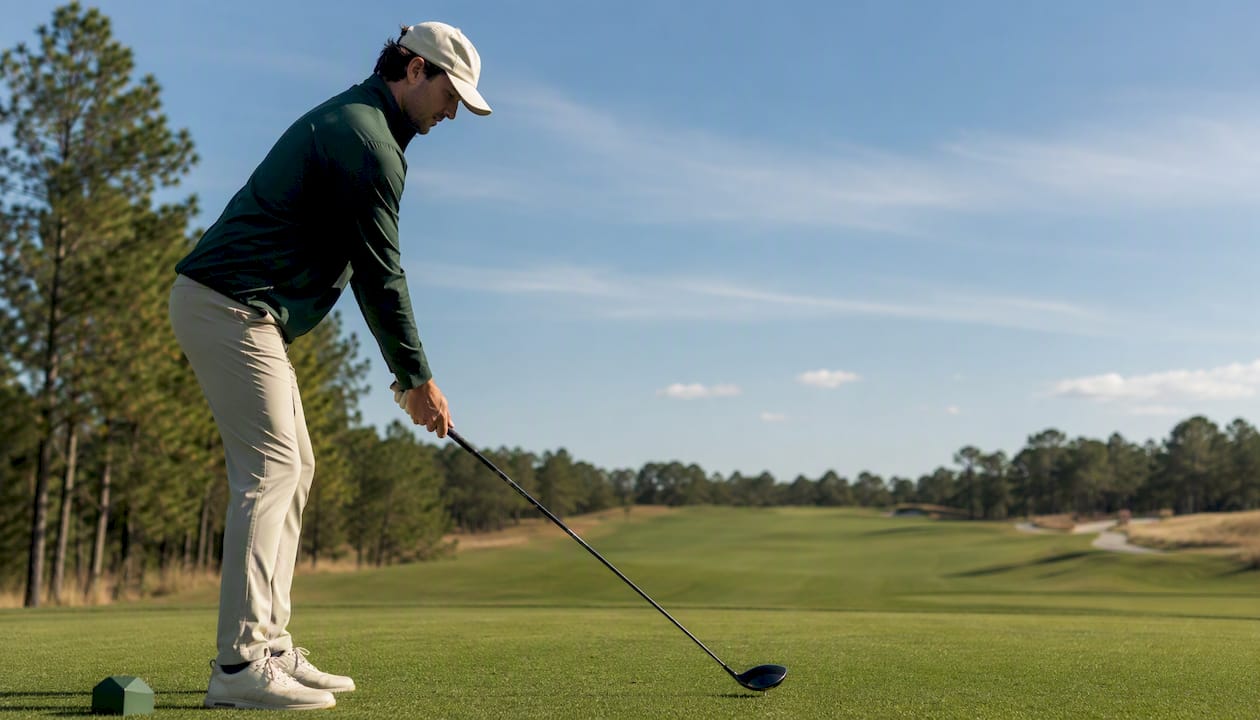
Two shot sequences produce an albatross. The most common route is scoring a 2 on a par-5: a long drive followed by a second shot that finds the hole from well over 150 yards. Rarer, but still valid, is holing out on a par-4 with a single tee shot (an ace); both routes are recognised as an albatross.
For the par-5 route, the sequence looks like this:
- Drive the ball long and straight, leaving a realistic line to the green in two.
- Select a fairway wood or long iron capable of carrying the remaining distance.
- Execute a precise approach that lands on the green with enough pace to roll toward the pin, or enough spin to stop close.
- The ball finds the hole on that second shot.
Several course features make a par-5 reachable in two: a short overall yardage (under 500 yards), a downhill layout, firm fairways that add roll, and a generous run-up to the green. Pin position matters too. A front-left flag on a wide green gives a long approach a much larger target than a tucked back-right position.
Pro Tip: Firm fairways can add 20–40 yards of roll to a well-struck fairway wood, which can improve scoring opportunities. If you’re playing a short par-5 downwind on a dry course, know your carry distance cold before you pull the trigger on that second shot.*
How rare is an albatross? Odds and context
Rare doesn’t begin to cover it. The PGA commonly cites odds of roughly 6 million-to-1 for an amateur golfer scoring an albatross. Some experts suggest the true frequency of scoring an albatross may be closer to 1 million-to-1 when accounting for course conditions and player ability. Either figure dwarfs the odds of a hole-in-one.
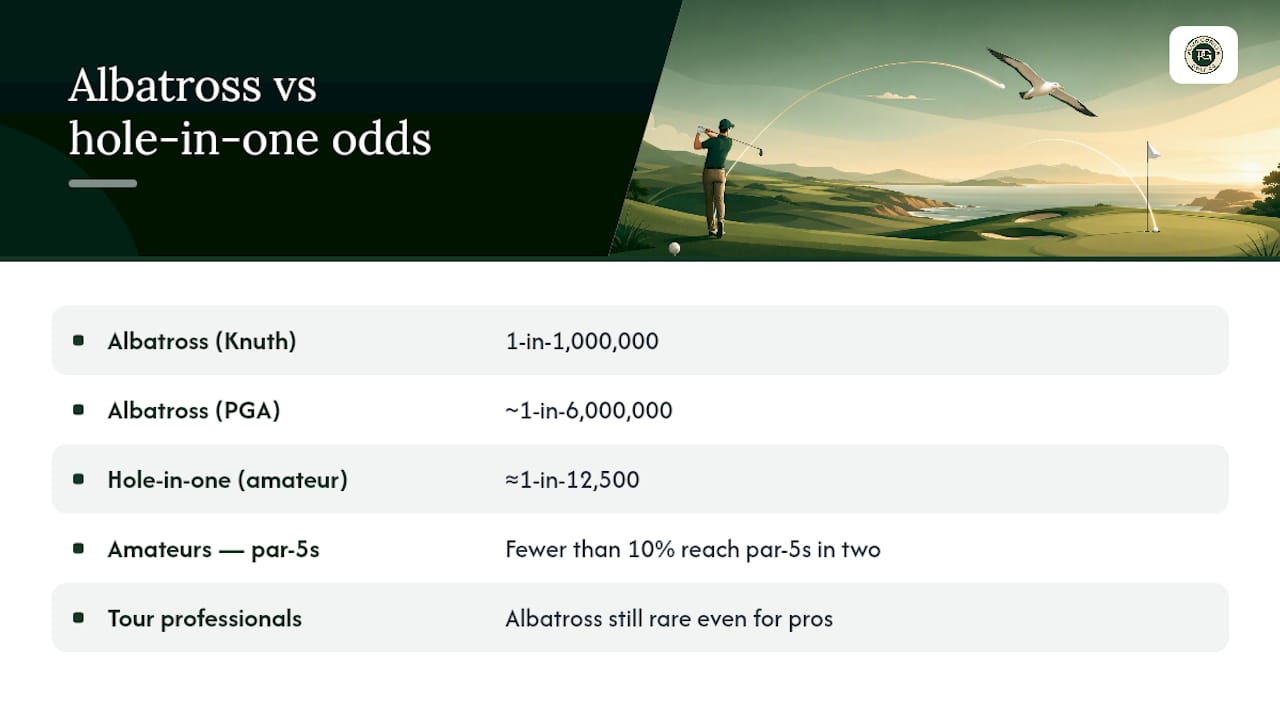
Odds callout: Estimates range from 1-in-1,000,000 (Knuth) to 1-in-6,000,000 for amateur golfers, per National Club Golfer. A hole-in-one, by comparison, runs roughly 1-in-12,500 for an average amateur.
The gap between pros and amateurs is stark. Fewer than 10% of amateur golfers reach par-5 greens in two, which means most players never even create the opportunity. Tour professionals reach par-5s in two far more often, yet double eagles remain genuinely rare even at that level.
Famous albatrosses that changed tournaments
The most celebrated double eagle in history belongs to Gene Sarazen. At the 1935 Masters, Sarazen holed a 4-wood from 235 yards on the 15th hole for a 2 on the par-5, erasing a three-shot deficit in a single swing. Golf Digest calls it “the shot heard 'round the world” and documents several other notable tour double eagles alongside it.
A few other well-documented examples:
- Bruce Devlin at the 1967 Houston Champions International, one of the earliest televised double eagles in PGA Tour history
- Jeff Maggert at the 1994 Masters, holing a 3-wood on the 13th hole
- Louis Oosthuizen at the 2012 Masters, also on the 13th, producing one of the most-watched albatrosses of the modern era
For a full list of recorded PGA Tour double eagles, the PGA Tour’s official stats archive is the most reliable reference.
What course conditions and strategies increase your chances?
No strategy guarantees an albatross, but certain factors shift the odds meaningfully. Good course management starts with knowing which par-5s on your regular course are genuinely reachable in two for your swing speed.
Player-side factors that matter:
- Carry distance with a fairway wood or long iron of 220+ yards
- Accuracy off the tee to leave a clean line to the green
- Knowing exact carry numbers for each long club, not estimates
- Targeting pins that offer a larger landing zone on the approach
Course-side factors that help:
- Par-5s under 500 yards with minimal forced carries
- Downhill or downwind holes that add effective distance
- Firm, fast fairways that extend roll after landing
- Wide greens with front-accessible pin positions
Pro Tip: Before a round, walk the par-5s and note the green’s slope from front to back. A ball that lands short and runs up a gentle slope toward a front pin is far more likely to find the hole than one that has to stop on a flat surface from 200 yards.
Tracking your real carry distances with a tool like Bag Truth removes the guesswork from club selection on those critical second shots.
Where did the name “albatross” come from?
Golf’s bird-themed scoring vocabulary traces back to 19th-century American slang where “bird” meant something excellent. A score better than par was a “bird of a shot,” which shortened to “birdie.” Eagle followed as a bigger, more impressive bird for a better score. Albatross extended the metaphor further, naming the great seabird for a feat even rarer than an eagle.
The progression looks like this:
- Birdie (−1): coined in the U.S., late 1800s
- Eagle (−2): natural extension of the bird theme, early 1900s
- Albatross (−3): British and international usage, documented around the 1920s–1930s
- Condor (−4): modern extension, treated as a curiosity
The USGA’s history pages confirm the bird-theme developed organically as the game formalised, with each new term layering onto the one before it.
Is an albatross skill or luck?
Skill, mostly. Dean Knuth frames it plainly: an albatross demands two consecutive elite shots, not a single fortunate bounce. A hole-in-one on a par-3 carries a meaningful luck component because even a mis-hit can roll in. An albatross on a par-5 requires a drive long and accurate enough to set up a second shot, then a second shot precise enough to find a 4.25-inch hole from well over 150 yards.
What separates players who have a realistic shot at one:
- Consistent driving distance above 280 yards
- Reliable fairway wood accuracy from 200+ yards
- Course knowledge and smart data analysis to identify reachable holes
The single most practical thing you can do: measure and practise your long approach distances until they’re repeatable. That’s the only part of the equation you control.
An honest take on what the albatross really means
Most golf content treats the albatross as a trivia answer. It’s not. It’s a useful lens for understanding what separates elite ball-striking from everything else. The reason albatrosses happen at Augusta National more than anywhere else isn’t magic — it’s that Augusta’s par-5s are designed to reward aggressive, precise play, and the world’s best players show up every April. The shot is rare because the combination of distance, accuracy, and nerve required is genuinely uncommon, not because the golf gods are stingy. If you’re serious about your game, the albatross is worth studying as a benchmark, not just a story.
Gear that fits the way you play
Chasing rare shots takes focus. The last thing on your mind should be what you’re wearing. Plaid Gorilla Golf builds limited-edition apparel for golfers who want to look sharp without overthinking it. The Bogey Kit — Country Club Hat & Bogey Enthusiast Hoodie pairs a bold snapback with a premium hoodie built for the course and everywhere after. Prefer a single piece? The Bogey Enthusiast Hoodie – Pine is a clean, heavyweight drop in a deep forest green that works on the range or off it. Canadian-owned, limited runs, no filler. Browse the full drop at Plaid Gorilla Golf.
Sources
- Odds of a Hole-in One, Albatross, Condor and Golf’s Other Unlikely Shots | PGA
- USGA — History FAQ: golf history questions
- Masters 2018: The (double) eagle has landed | Golf Digest
- Albatross in golf: probability | National Club Golfer
- Frequently Asked Questions | The Double Eagle Club
- Flight of the condor | Scottish Golf History
- Collins Dictionary — albatross
Consult PGA Tour official stats and Golf Canada records for tournament-specific albatross lists.
FAQ
What is the rarest feat in golf?
A condor (four under par) is technically rarer than an albatross, documented only a handful of times in recorded history. Among regularly tracked feats, an albatross—achieved by scoring 2 on a par-5 or holing out on a par-4—is considered the rarest score most governing bodies formally recognise.
What is the difference between an eagle, birdie, and bogey?
A birdie is one under par, an eagle is two under par, and a bogey is one over par on any hole. An albatross sits at three under par, making it rarer than all three.
Has Tiger Woods ever scored an albatross?
Tiger Woods has not recorded a confirmed albatross in PGA Tour competition. Double eagles remain extremely rare even at tour level, with only a small number documented across major championships.
What is an ostrich in golf?
An ostrich would represent five under par on a single hole, which is theoretically possible only on a par-6. No verified ostrich has been officially recorded; it exists as a hypothetical extension of the bird-theme scoring ladder.